Tempura: How Portugal's Gift Became Japan's Art of Frying
How Portuguese missionaries brought deep-frying techniques to Japan in the 16th century and how Japan transformed a Lenten practice into one of the world's most refined culinary arts.
La rédaction Kotoba
Studio éditorial
A sharp crack, golden batter shattering under the chopstick, a piece of pink shrimp appearing beneath its gossamer shell. Steam rises from the hinoki cypress counter as the tempura master lowers a shiso leaf into the shimmering oil with the precision of a calligrapher laying down a stroke. You are sitting at a in Ginza, watching a gesture that has been repeated millions of times over four centuries, a gesture that carries one of the most fascinating stories in culinary history: the tale of a Portuguese technique reborn as a Japanese art form.
Tempura is a living paradox. It is profoundly Japanese in its philosophy, its rigor, its aesthetics, and yet its name, its foundational technique, and its history are inseparable from Portugal, its navigators, its Jesuit missionaries, and their dietary customs. This is the story of a borrowed technique transformed into a masterpiece, of a Lenten dish elevated to haute cuisine.
The Portuguese in Japan: The Nanban Trade#
In 1543, a Portuguese ship ran aground on the island of Tanegashima (種子島), south of Kyushu. It was the first direct contact between Europe and Japan. The Portuguese brought firearms, Christianity, tobacco, and their culinary habits. For nearly a century, the trade known as would transform Japanese culture in profound ways.
Portuguese merchants established themselves in Nagasaki, which became the primary port of trade with the West. Alongside them came Jesuit missionaries, the most famous being Francis Xavier, who arrived in 1549. These clergy and traders did not merely sell and preach: they ate. And what they ate, the Japanese observed with intense curiosity.
literally means "southern barbarians." This term, borrowed from classical Chinese, originally referred to the peoples of Southeast Asia before being applied to Europeans who arrived via southern maritime routes. It did not necessarily carry the pejorative connotation one might expect: Nanban art (南蛮美術) refers to a flourishing 16th-century Japanese artistic movement fascinated by European exoticism.
Among the culinary techniques the Portuguese practiced daily, one attracted particular attention: deep-frying in oil. The Portuguese prepared fritters of vegetables and fish, coated in a batter of flour and water, then fried in hot oil. This method of cooking was virtually unknown in Japan at the time, where food was grilled, boiled, steamed, or eaten raw, but rarely fried.
Quatuor Anni Tempora: The Etymology of a Name#
The origin of the word "tempura" remains debated among linguists and historians, but the most widely accepted hypothesis links it to the ecclesiastical Latin phrase Quatuor Anni Tempora, the Ember Days of the Catholic liturgical calendar.
: the word likely derives from the Latin tempora, from the phrase Quatuor Anni Tempora, referring to the four fasting periods of the Catholic calendar during which meat was forbidden. Portuguese missionaries and merchants consumed fried fish and vegetables during these times. The kanji 天 (ten, "heaven") alludes to the divine lightness of the dish, while 麩 (fu, "gluten") and 羅 (ra, "gauze/veil") evoke the fineness of the coating.
During the Ember Days, Catholics practiced abstinence from meat. The Portuguese and Spanish present in Japan turned to fish and vegetables, which they fried in batter. The Japanese, observing these foreigners eating fried foods during the tempora, would have associated the word with the technique itself.
Other hypotheses exist: the Portuguese word tempero (seasoning), the verb temperar (to season, to blend), or even tempera (the painting technique, by analogy with the coating). Whatever the exact etymology, the connection to Portugal is indisputable.
Japan borrowed many words from Portuguese during the Nanban period: , , , , . Tempura belongs to this wave of culinary and linguistic borrowings that permanently marked Japanese culture.
The Japanese Transformation: From Edo Street Food to Culinary Art#
When the Tokugawa shogunate closed Japan to foreigners in , the Portuguese were expelled. But their culinary legacy remained. The frying technique, now mastered by Japanese cooks, would undergo a radical transformation over the course of the Edo period (1603-1868).
Initially, tempura was street food, popular and filling. In 18th-century Edo (the old name for Tokyo), mobile stalls called sold skewers of fried fish and vegetables along the canals and main roads. The dish was cheap, nourishing, and quick to prepare. It belonged to the common people, the craftsmen, the merchants of Nihonbashi.
But gradually, tempura was refined. Japanese cooks introduced three major innovations that would permanently distinguish tempura from ordinary European frying:
The light batter (koromo). Where the Portuguese used a thick, well-mixed batter, the Japanese developed a minimal coating, barely stirred, deliberately lumpy. The batter, made of flour, ice-cold water, and sometimes egg, must remain imperfect: the lumps create surface irregularities that become crispy during frying, while the thinness of the coating lets the ingredient show through.
means "garment" or "robe." It is the technical term for the tempura coating. Like a kimono that envelops the body without constraining it, the koromo must dress the ingredient with lightness, shielding it from the direct heat of the oil while letting it breathe. A good koromo is nearly translucent, crackling under the tooth but never heavy.
Respect for the ingredient. Where Western frying aims to transform the food, Japanese tempura seeks to elevate it. The cooking time is brief, the coating thin: the heart of the shrimp must remain pearlescent, the inside of the eggplant melting, the fragrance of the shiso intact. Tempura is a jewel case, not a mask.
Seasonality. Master tempura chefs follow the seasonal calendar with the same rigor as kaiseki chefs. In spring, bamboo shoots and taranome (aralia buds); in summer, ayu (sweetfish) and squash blossoms; in autumn, matsutake mushrooms and lotus root; in winter, sweet potato and shirako (cod milt).
The Art of Tempura Today#
In a high-end tempura restaurant, the hinoki cypress counter faces a single person: the tempura master. He works in front of you, above a vat of oil held at a precise temperature, armed with long metal chopsticks. Each piece is fried individually, served immediately on absorbent paper or directly onto your plate. The meal lasts an hour, sometimes more, each bite arriving at the exact moment it reaches perfection.
Oil Temperature#
Temperature control is the tempura master's obsession. The oil must be maintained between 170 and 180 degrees Celsius (338-356F), depending on the ingredient. Too cool, and the batter absorbs oil, becoming heavy. Too hot, and the exterior burns before the interior cooks. Masters judge temperature by sight (the way the oil shimmers), by sound (the crackling when a drop of batter hits the surface), and by feel (the radiant heat above the vat).
The oil itself is a crucial choice. Tokyo tempura traditionally uses , pure or blended with cottonseed or rapeseed oil. Sesame oil produces a more golden tempura with a more pronounced flavor. In Kyoto and Osaka, lighter vegetable oils are preferred, letting the ingredient's taste dominate.
The Batter: Mastered Imperfection#
The koromo recipe is deceptively simple: wheat flour, ice-cold water, sometimes an egg yolk. But everything depends on the preparation. The water must be ice-cold (some add ice cubes) to prevent gluten from developing. The flour is barely mixed, with just a few strokes of the chopsticks: lumps must remain. The exact opposite of a smooth French crepe batter. This imperfect, almost careless-looking batter is in fact the product of precise expertise.
The most demanding tempura masters prepare their batter in tiny quantities, just before each course, sometimes even for each individual piece. The batter must never rest: the gluten would develop, making it elastic and heavy. Some restaurants even cool their mixing bowl in an ice bath throughout the entire service.
Accompaniments#
Tempura is eaten with minimal seasoning. Two main options present themselves: , a light broth of dashi, mirin, and soy sauce, into which pieces are dipped along with grated daikon radish and fresh ginger; or simply salt, often flavored (matcha salt, yuzu salt, fleur de sel). Purists alternate between the two depending on the ingredient, reserving salt for delicate fish and tentsuyu for vegetables.
Types of Tempura#
Ebi Tempura: The Queen Prawn#
The is tempura's emblem. Kuruma prawns (車海老) are the most prized for their firm, sweet flesh. Before frying, the chef makes light incisions on the prawn's belly to prevent it from curling during cooking, a technique called . The perfect prawn tempura is straight, its golden tail extending beyond the batter like a fan.
Kakiage: The Vegetable Lace#
is a disc of finely cut vegetables and/or seafood, bound by a minimum of batter and fried together. The result resembles a crispy lacework, a tangle of carrots, onions, shrimp, and mitsuba (Japanese parsley). Kakiage is often placed atop a bowl of rice (kakiage-don) or noodles.
Tendon: The People's Bowl#
The is a bowl of rice topped with tempura drizzled in a thick sweet-savory sauce called . The quintessential popular dish, it transforms refined counter tempura into a quick, comforting lunch. Chains like have democratized the tendon, making it accessible for a few hundred yen.
Tempura Soba and Udon#
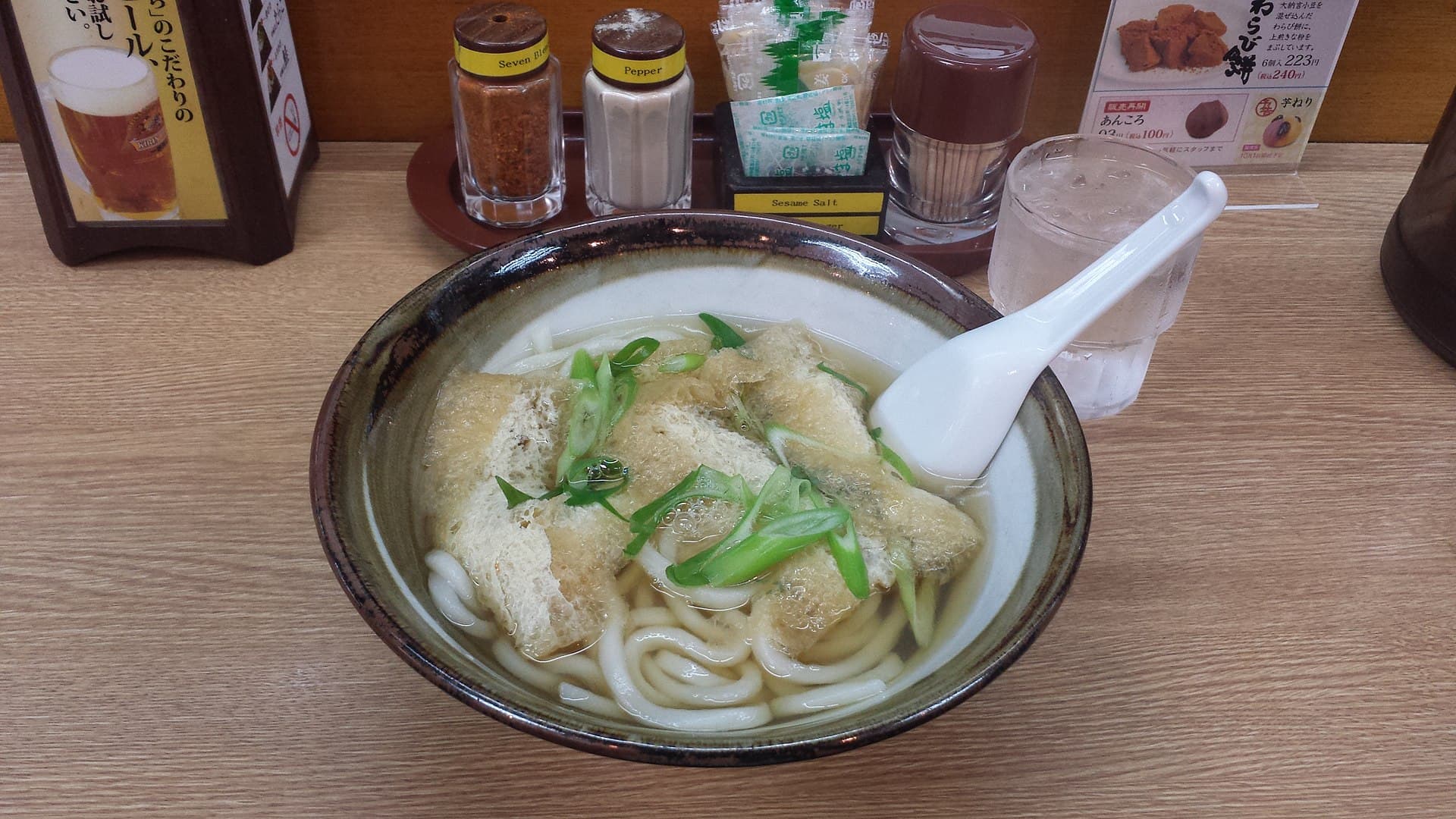
Tempura naturally accompanies Japanese noodles. and are everyday dining classics: a bowl of noodles in hot broth, topped with a piece of tempura (often a prawn or kakiage) whose batter slowly dissolves into the liquid, thickening the broth and adding a melting texture.
Regional Variations#
Like every major Japanese dish, tempura comes in as many variations as there are regions.
Tokyo (Edo-mae tempura). The Edo style favors sesame oil, fish and seafood from Tokyo Bay, and longer frying that produces a well-golden tempura. This is the style of the grand counters of Ginza and Nihonbashi, the style of tempura masters whose craft has been handed down through multiple generations.
Kyoto-Osaka (Kamigata tempura). The Kansai style uses neutral vegetable oils, an even thinner batter, and shorter cooking, producing a nearly white tempura of extreme lightness. Vegetables feature more prominently than fish, in keeping with Kyoto's Buddhist vegetarian tradition.
Nagasaki. The historic port of Nanban trade, Nagasaki preserves a tempura tradition closer to the Portuguese original: the batter is slightly thicker, sometimes seasoned, and pieces are sometimes eaten cold as snacks. , the banquet cuisine born from Nagasaki's Sino-Dutch-Portuguese fusion, always includes tempura.
Okinawa. The Ryukyu archipelago developed its own version, including hirayachi and fritters of local vegetables (goya, bitter melon; beni-imo, purple sweet potato), heirs to a frying tradition that predates Portuguese contact, influenced instead by China.
The word , referring to fried fish cakes typical of Kagoshima (the former Satsuma domain), testifies to the spread of frying techniques from southern Japan, the entry point of the Portuguese. The term reveals a geography: deep-frying arrived from the south and traveled northward up the archipelago.
Tempura and Seasons: An Edible Calendar#
The tempura master thinks in seasons. His menu changes monthly, sometimes weekly, according to what arrives and what has reached peak ripeness. A typical calendar:
- Spring: fuki-no-to (butterbur buds), taranome (aralia shoots), nanohana (rapeseed flowers), sakura-ebi (pink shrimp from Suruga Bay), shirasu (whitebait)
- Summer: ayu (sweetfish), anago (conger eel), myoga (Japanese ginger), kabocha (pumpkin), okra
- Autumn: matsutake (mushroom), renkon (lotus root), satsumaimo (sweet potato), maitake (hen-of-the-woods), ginnan (ginkgo nut)
- Winter: shirako (cod milt), uni (sea urchin), gobo (burdock root), kabu (turnip), fugu (pufferfish)
This seasonal rotation is not aesthetic whimsy: it guarantees that each ingredient is fried at the moment its flavor and texture are optimal, and inscribes the meal within the natural cycle that Japanese cuisine reveres under the name .
Frequently Asked Questions#
Is tempura really of Portuguese origin? The deep-frying technique was introduced to Japan by the Portuguese in the 16th century, a documented historical fact. However, tempura as it exists today is an entirely Japanese creation: the light batter, the philosophy of elevating the ingredient, the seasonality, and the counter service have nothing Portuguese about them. Japan borrowed a technique and made it into an art.
Why must tempura batter remain lumpy? The lumps prevent gluten development (which would make the batter elastic and heavy) and create surface irregularities that become crispy during frying. The ice-cold water also slows gluten formation. It is the deliberate imperfection that creates the perfection of the result.
What is the difference between tempura and Western fritters? Tempura uses a much thinner and less worked batter than Western fritter batter. The cooking time is shorter, the coating nearly translucent. The goal is not to hide the ingredient under a thick crust, but to protect it just enough so it steams in its own moisture, inside its thin golden shell.
Is tempura healthy? Paradoxically, good tempura absorbs very little oil. The high cooking temperature and the thinness of the batter mean the food is seared instantly, the water it contains turning to steam that pushes the oil away. Properly prepared tempura is not greasy to the touch. That said, it remains a fried food and should be enjoyed in moderation.
Where can you eat the best tempura in Tokyo? Leading names include in Ginza, famous for its vegetable tempura and monumental sweet potato; in Monzen-Nakacho, a family institution for three generations; and , a high-end chain founded in 1930. For excellent accessible tendon, in Nihonbashi offers generous bowls at popular prices.
Read alsoRamen: How a Chinese Import Became Japan's Soul Food
Like tempura, ramen is a dish of foreign origin that Japan transformed into a national icon, illustrating the country's unique ability to absorb outside influences and elevate them into something entirely new.
Article written for Kotoba Interactive. Sources: Ishige Naomichi, "The History and Culture of Japanese Food" (2001); Rath, Eric C., "Food and Fantasy in Early Modern Japan" (2010); Cwiertka, Katarzyna J., "Modern Japanese Cuisine" (2006); archives of the Nanban Trade Museum, Kobe.
Okonomiyaki: Japan's Savory Pancake and the Osaka-Hiroshima Rivalry
Everything about okonomiyaki, the Japanese savory pancake cooked on a teppan griddle. History, Osaka vs Hiroshima styles, recipe, sauces, and regional variations.
Cover image: Wikimedia Commons contributor · Wikimedia Commons · CC BY-SA 4.0