Okonomiyaki: Japan's Savory Pancake and the Osaka-Hiroshima Rivalry
Everything about okonomiyaki, the Japanese savory pancake cooked on a teppan griddle. History, Osaka vs Hiroshima styles, recipe, sauces, and regional variations.
La rédaction Kotoba
Studio éditorial
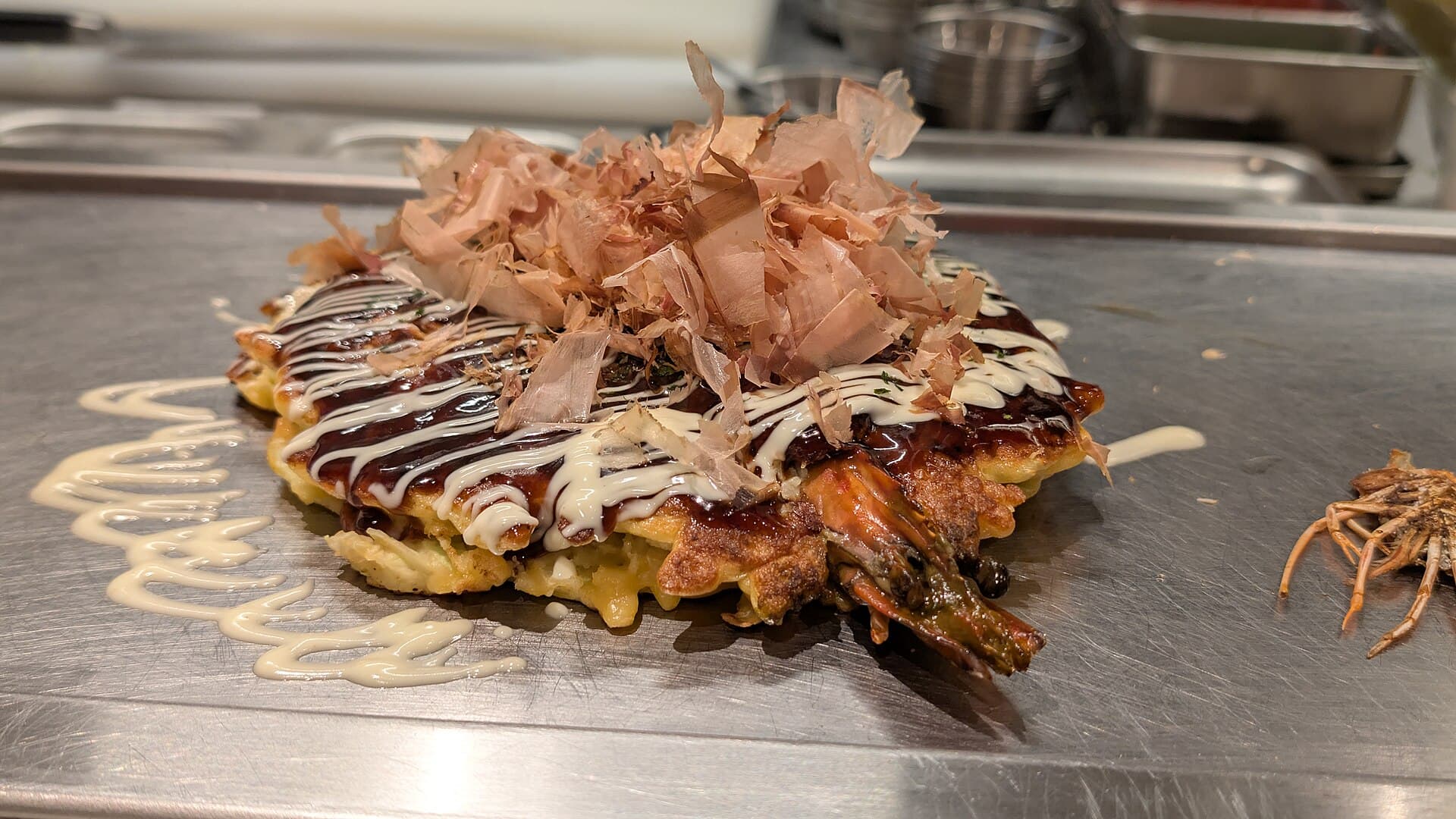
The smell reaches you first. A blend of caramelized sauce, grilled cabbage, and bonito flakes undulating in the rising heat. Before you, a searing steel plate, a , on which a thick batter is slowly cooking, crackling and browning. The cook flips the pancake with a practiced flick of the wrist, drizzles it with dark sauce, scatters a rain of green aonori and a snow of katsuobushi that dances in the hot air. You are in a restaurant in Osaka or Hiroshima, and what you are about to eat is one of Japan's most popular, most democratic, and most fiercely debated dishes: .
The word okonomiyaki breaks into two parts: , meaning "as you like it" or "to your taste," and , meaning "grilled" or "cooked." Literally: "grilled as you like it." The name is a manifesto: each person builds their pancake according to their preferences, with whatever ingredients they choose.
Sometimes called "Japanese pizza" by foreign visitors (a comparison purists find reductive), okonomiyaki is actually a thick savory pancake made from flour batter and cabbage, enriched with an endless variety of fillings and cooked on a flat griddle. It is street food turned institution, a symbol of popular culture in Osaka and Hiroshima, and the battleground of a culinary rivalry that has lasted more than seventy years.
Origins in Scarcity: A History of War and Resourcefulness#
The history of okonomiyaki is inseparable from that of twentieth-century Japan, its deprivations, and its popular ingenuity.
Ancestors from Edo and Meiji#
The roots of okonomiyaki reach back to , a thin wheat-flour crepe prepared during the Edo period (1603-1868), which the tea master is said to have served as a confection during tea ceremonies. In the Meiji era (1868-1912), was already delighting Tokyo's working-class neighborhoods: a semi-liquid batter cooked on a flat plate, topped with scraps. Later, during the Taisho era (1912-1926), appeared in the streets of Kyoto and Osaka: a thin, cheap crepe with scallions and Worcestershire sauce, sold to children and laborers for the trivial sum of one sen.
World War II and the Postwar Years#
It was during and after World War II that okonomiyaki took its modern form. Bombing had destroyed agricultural infrastructure, and rice was desperately scarce. The Americans, as with ramen, supplied wheat in abundance. Flour became the survival ingredient of a starving nation.
In Osaka and Hiroshima, two cities devastated by the war (Hiroshima by the atomic bomb on August 6, 1945), residents invented flour pancakes to which they added whatever they could find: cabbage (abundant and cheap), leftover vegetables, sometimes a bit of meat or seafood. The principle of "as you like it" was born from necessity: you cooked with what you had.
Hiroshima was nearly completely leveled on August 6, 1945. In the years that followed, okonomiyaki stalls were among the first businesses to reappear in the ruins. The pancake was not merely food: it was an act of reconstruction, a sign that life was resuming. Today, Hiroshima residents consider their okonomiyaki an emotional heritage as much as a culinary one.
In the 1950s, the first specialized restaurants opened. In Osaka, the "mixed" style became standardized; in Hiroshima, the "layered" style took shape. The two cities developed their traditions in parallel, and the rivalry began.
The Osaka Style: The Mixed Pancake of Kansai#
The Osaka style, also called , is the most internationally recognized and the one most tourists encounter first.
The Principle#
All ingredients are mixed together in a large bowl before being poured onto the teppan. The flour batter, finely shredded cabbage, eggs, dashi, and chosen fillings (pork, shrimp, squid, cheese, mochi, etc.) form a homogeneous mass that is cooked into a thick disc. The result is a pancake that is fluffy inside, slightly crispy outside, roughly three to four centimeters thick.
The Basic Recipe#
The batter consists of wheat flour, water or dashi, eggs, , and a mountain of shredded cabbage. The cabbage-to-batter ratio is critical: a good Osaka okonomiyaki contains far more cabbage than batter. Fillings are chosen by the customer: , , , , , , or the ultimate combination that brings meat and seafood together.
The Do-It-Yourself Culture#
In many Osaka restaurants, it is the customer who cooks their own okonomiyaki. Each table has a built-in teppan, and the server brings a bowl with the ingredients already mixed. It is up to the diner to pour, spread, flip (the most nerve-wracking moment for a beginner), and garnish. This participatory dimension is an integral part of the experience: okonomiyaki is a social dish, prepared and shared among friends while drinking beer and chatting.
The district in Osaka is the temple of okonomiyaki, with legendary establishments like , open since 1945, where the queue can exceed one hour.
The Hiroshima Style: Architecture in Layers#
The Hiroshima style, called or simply by outsiders (a term Hiroshima locals despise: for them, it is simply "okonomiyaki"), is fundamentally different in its construction.
The Principle#
Instead of mixing everything, the cook stacks ingredients in successive layers on the teppan, like a savory mille-feuille. Each component is cooked separately, then assembled. The result is an impressive edifice six to eight centimeters tall, with multiple textures.
The Layers, Bottom to Top#
- The batter crepe: paper-thin, serving as the base and binder
- The cabbage: a mountain of shredded cabbage, raw at first, which will wilt and reduce during cooking
- : for crunch
- The pork: thin slices of pork belly laid on top
- The noodles: or sometimes , cooked separately on the teppan and then integrated
- The egg: cracked directly onto the teppan, spread into a thin omelet, onto which the entire construction is flipped
The presence of noodles is the signature of the Hiroshima style. It is what fundamentally distinguishes it from the Osaka style, and what makes it a considerably more filling dish.
The Master's Gesture#
In Hiroshima, it is always the cook who prepares the okonomiyaki. The customer never touches the spatula. Watching an experienced chef is a spectacle in itself: they wield two with surgical precision, flip the pile of ingredients in a single fluid motion, press gently, adjust, and deliver a perfectly assembled construction to the customer.
The Okonomimura building (お好み村, "okonomiyaki village") in Hiroshima houses twenty-four okonomiyaki restaurants across three floors. It is the ultimate pilgrimage site for Hiroshima-style enthusiasts. Open since 1965, it has welcomed millions of visitors and survived several renovations without ever closing.
The Osaka-Hiroshima Rivalry: A National Debate#
Asking a Japanese person which style is the "real" okonomiyaki is like asking a Neapolitan and a New Yorker who makes the real pizza. The rivalry between Osaka and Hiroshima is real, passionate, and fundamentally good-natured (most of the time).
Osaka's arguments: the mixed style is older in its modern form, Osaka is the "kitchen of Japan" (天下の台所, tenka no daidokoro), and the interactivity of do-it-yourself cooking is the very essence of the dish.
Hiroshima's arguments: the layered style requires more technique, the distinct layers offer superior textural complexity, the noodles make it a complete meal, and an expert cook guarantees consistent quality.
In Osaka, they will tell you that okonomiyaki is a democratic art: anyone can make it. In Hiroshima, they will reply that this is precisely why you need a professional.
In truth, both styles are legitimate expressions of the same principle: a pancake of flour and cabbage, enriched with what you love, cooked on a hot plate. The debate is part of the fun.
The Teppan Experience: Cooking at Your Table#
The word combines , "iron" or "steel," and , "plate" or "board." It is the flat, thick, heated steel plate that serves as the cooking surface. In Japan, the word refers both to the equipment and to the style of cooking that uses it (teppanyaki).
The teppan is at the heart of the okonomiyaki experience. In Osaka-style restaurants, each table is fitted with a built-in griddle. Customers sit around it, order their ingredients, and cooking begins. The air fills with aromas, conversation picks up, beers circulate.
In more traditional restaurants or Hiroshima-style establishments, a large teppan faces the counter. The cook works in front of the customers, turning preparation into performance. Regulars always sit at the counter to watch the ballet of spatulas.
The teppan must be maintained at a precise temperature: too hot and the pancake burns outside while staying raw inside; not hot enough and the cabbage will not caramelize, leaving the texture limp. The best restaurants use thick steel plates that store heat uniformly.
Ingredients and Sauces: The Alchemy of Flavor#
Okonomiyaki Sauce#
The undisputed star of the seasoning is , a thick, sweet-savory brown sauce made from caramelized fruits and vegetables. The most famous brand is , based in Hiroshima since 1922, whose red-capped bottle is ubiquitous in restaurants across the country. Its flavor is a complex blend of sweetness, acidity, umami, and spices, sweeter and fruitier than the Worcestershire sauce from which it historically derives.
The Final Toppings#
After the sauce come the garnishes that define the dish's visual and gustatory identity:
- : dried bonito shavings, shaved so thin they undulate and "dance" in the rising heat. Their hypnotic movement is the most iconic image of okonomiyaki.
- : green seaweed powder with a delicate, briny fragrance.
- : red pickled ginger, adding a sharp, acidic note.
- Mayonnaise: Japanese mayonnaise (richer in egg yolk, slightly sweet) is drizzled in an artistic crosshatch pattern over the pancake. The brand is the gold standard.
Nagaimo: The Secret to Fluffiness#
The secret ingredient of a successful okonomiyaki is or , a Japanese mountain yam whose grated flesh produces a viscous mucilage. Added to the batter, it gives a lightness and fluffiness impossible to achieve otherwise. It is the difference between a restaurant-quality okonomiyaki and a failed home attempt.
Monjayaki and Other Variations: Okonomiyaki's Cousins#
Monjayaki: Tokyo's Cousin#
is the Tokyo version of the griddle pancake, older than okonomiyaki in its form. The batter is much more liquid, almost a soup, and never forms a solid pancake. You eat it directly off the plate, scraping small portions with a tiny spatula called a . The district in Tokyo is its capital, with dozens of restaurants lining "Monja Street."
Monjayaki derives its name from . During the Edo period, children would trace characters on the griddle with the liquid batter before eating it, combining writing practice and snacking. It was both a game and a treat.
Negiyaki#
, an Osaka specialty, replaces cabbage with an abundance of . Thinner and lighter than classic okonomiyaki, it is eaten with ponzu sauce rather than the traditional brown sauce.
Modanyaki#
is an Osaka-style okonomiyaki with yakisoba noodles added, borrowing from the Hiroshima style. The name comes from the English "modern," perhaps because adding noodles was considered a modern innovation, or perhaps (according to a folk etymology) from "mori dakusan" (盛りだくさん, "piled generously").
Tonpeiyaki#
is a pork-and-egg roll cooked on the teppan, simpler and quicker than okonomiyaki, often served as a side dish in izakaya.
Frequently Asked Questions#
Is okonomiyaki really a "pizza"? No. The comparison comes from its round shape and customizable nature, but the base (flour batter and cabbage vs. leavened dough and tomato), the cooking method (teppan vs. oven), and the texture (fluffy pancake vs. crispy crust) have nothing in common.
Can you make vegetarian okonomiyaki? Yes. The base of cabbage and batter is naturally vegetarian. Simply replace meat fillings with vegetables, cheese, or tofu. Be cautious, however, about dashi in the batter (often bonito-based) and the sauce (which may contain meat extracts).
Osaka or Hiroshima: which should you try first? Both. If you must choose one, the Osaka style is more accessible for a beginner (the mixing principle is intuitive), while the Hiroshima style is more spectacular (the chef's technique, the layering, the noodles).
Why do the bonito flakes move? Katsuobushi are shaved so thin that they react to the slightest heat source. The steam rising from the pancake causes them to ripple. They are not alive, despite the startling impression.
What is the best season for okonomiyaki? Any time of year, but winter cabbage (sweeter and more tender) produces the best results. Japanese people often associate okonomiyaki with cool autumn and winter evenings.
Read alsoRamen: How a Chinese Import Became Japan's Soul Food
Like ramen, okonomiyaki was born from postwar necessity and American wheat flour. Two survival foods that became national icons, two parallel stories of Japanese culinary resilience.
Sources and Credits#
- Okonomiyaki World (okonomiyakiworld.com), restaurant and recipe database
- "Japanese Soul Cooking" by Tadashi Ono and Harris Salat (Ten Speed Press, 2013)
- Otafuku Sauce Co., Ltd., historical documentation (otafuku.co.jp)
- NHK World Japan, "Trails to Oishii Tokyo: Okonomiyaki" (2021)
- Hiroshima Peace Memorial Museum, archives on postwar food reconstruction
Ramen: How a Chinese Import Became Japan's Soul Food
From Chinese broth to Tokyo counters, the full story of Japanese ramen. Origins, regional styles, Momofuku Ando and the instant noodle revolution.
Cover image: Wikimedia Commons contributor · Wikimedia Commons · CC BY-SA 4.0