Udon vs Soba: Everything You Need to Know About Japan's Two Great Noodles
Wheat flour versus buckwheat flour, hot broth versus cold dipping sauce: a deep dive into Japan's most delicious culinary rivalry. History, preparation, recipes, and vocabulary.
La rédaction Kotoba
Studio éditorial
In Japan, the question is never framed in terms of superiority. You don't ask "udon or soba?" the way you would pick a side. You ask "udon or soba?" the way you consult your mood, the season, the region you happen to be in, what your body craves at that precise moment. The two noodles have coexisted for centuries, each carrying its own history, geography, and temperament. , thick and chewy, cut from wheat flour. , thin and earthy, kneaded from buckwheat flour. Together, they map the gustatory landscape of a country where the noodle is far more than a simple starch: it is an art, a ritual, and an identity.
This rivalry has no winner. But it deserves to be understood.
Two Histories, Two Legacies#
Soba: Buckwheat From the Mountains#
The history of soba predates that of udon in their current noodle form, even though buckwheat (蕎麦, soba) has been cultivated in Japan since the Jomon period, more than five thousand years ago. For centuries, buckwheat was consumed as a porridge (sobagaki, そばがき) or as flatcakes, particularly in the mountainous regions of central Japan, notably in the province of Shinano (present-day Nagano Prefecture). Buckwheat grows quickly, withstands cold, and thrives in poor soils: it is the grain of high altitudes, harsh winters, and land that rice disdains.
The transformation into long noodles did not occur until the late sixteenth century, probably under the influence of Korean Buddhist monks who taught the Japanese to use wheat as a binding agent to hold buckwheat dough together. At the beginning of the Edo period (1603-1868), soba cut into thin strips established themselves in Edo (present-day Tokyo), where they became the city's emblematic noodle. The Edokko (江戸っ子), the children of the capital, turned them into an identity marker, eating their soba standing up, slurped down in seconds, in a gesture of popular pride.
The word combines two characters: 蕎 (kyo, the buckwheat plant) and 麦 (baku/mugi, wheat or grains in general). By extension, soba refers to the plant, the flour, and the noodles themselves. In some regions of Japan, the word soba even serves as a generic term for all noodles, including udon, which occasionally causes delicious confusion.
Udon: The People's Wheat#
The exact origin of udon is the subject of spirited debate. According to a persistent tradition, the Buddhist monk , founder of the Shingon school, reportedly brought the technique of making wheat noodles back from China during his study trip under the Tang dynasty. This legend, though unverifiable, associates udon with Kagawa Prefecture on the island of Shikoku, Kukai's birthplace and today the undisputed capital of udon in Japan.
Other theories suggest that udon derive from Chinese or from a stuffed wheat dough called . Whatever the precise origin, udon spread widely during the Muromachi period (1336-1573), helped by the expansion of wheat cultivation in western Japan. Unlike soba, associated with the east and Edo, udon took root in the west, in the Kansai region (Osaka, Kyoto) and especially in Shikoku.
The dichotomy is still very much alive today: ask a resident of Tokyo what they prefer, and they will answer soba. Ask the same question of someone from Osaka, and they will look at you with the quiet assurance of someone who knows that udon is the answer to everything.
Ingredients and Preparation: Two Philosophies of Dough#
Soba: The Art of Buckwheat#
The making of authentic soba is an exercise in precision and humility. Buckwheat flour (sobako, そば粉) is mixed with water and, in most cases, a proportion of wheat flour that serves as a binding agent. The ratio determines the quality and character of the noodles:
- : 100% buckwheat, with no wheat whatsoever. The purest, the most fragile, the kind that break if the hand trembles. Their flavor is earthy, intense, almost wild. Rare and expensive.
- : 80% buckwheat, 20% wheat. The quality standard, offering a balance between the flavor of buckwheat and the structural integrity of the noodle. The name comes from the "2-8" ratio.
The soba master, the , kneads the dough by hand, rolls it out with a wooden rolling pin into a sheet of uniform thickness, then cuts it with a heavy knife into strips of remarkable regularity. Every movement is codified. The ideal thickness hovers around 1.5 millimeters. The complete process, from mixing to cutting, takes approximately fifteen minutes in the hands of a skilled artisan.
Buckwheat is not a cereal in the botanical sense: it belongs to the Polygonaceae family, alongside rhubarb and sorrel. It is a pseudo-cereal, naturally gluten-free. The paradox: soba sold in supermarkets almost always contain wheat flour, and therefore gluten. Only juwari soba are truly gluten-free.
Udon: The Strength of Wheat#
Udon rely on just three ingredients: wheat flour (churikiko, 中力粉, medium-gluten flour), water, and salt. No binding agent, no egg, no alkaline agent. It is simplicity itself, and it is precisely this simplicity that makes mastery so demanding.
The kneading is vigorous. In traditional workshops in Kagawa, the dough is kneaded underfoot, trampled while wrapped in a cotton bag. This mechanical work develops the gluten network that gives udon their characteristic texture: an elastic resistance under the tooth, what the Japanese call , literally "the hips," a metaphor for firmness and body. An udon without koshi is a failed udon.
After kneading, the dough rests, is rolled out, then cut into thick strips of 3 to 5 millimeters, sometimes more. The noodles are then cooked in a large volume of boiling water for ten to fifteen minutes, a considerably longer time than for soba (which require only one to two minutes).
The Great Ways to Eat Them#
Soba: Hot or Cold, Always Restrained#
Soba come in two families of service:
: the cooked noodles are rinsed in ice water and served on a woven bamboo tray, the . They are dipped into a , a sauce made from , , and , enhanced with sliced scallions, freshly grated wasabi, and sometimes grated daikon. The gesture is precise: you dip only the bottom third of the noodle, never the whole thing, so as not to drown the flavor of the buckwheat.
: the noodles sit in a hot, clear broth, a light dashi seasoned with soy sauce. Toppings vary: with a fried shrimp perched atop the broth, with a raw egg whose yolk evokes the full moon, with a slice of sweetened fried tofu.
literally means "moon viewing." In the bowl, the egg yolk resting on the noodles in the clear broth recalls the full autumn moon. This poetic name illustrates the Japanese relationship with food: a dish does not merely nourish the body; it tells an image, a season, an emotion.
Udon: The Kingdom of Texture#
Udon are noodles that give themselves entirely to the broth. Their thickness absorbs flavors, and their elastic texture offers a satisfying, almost meditative chew.
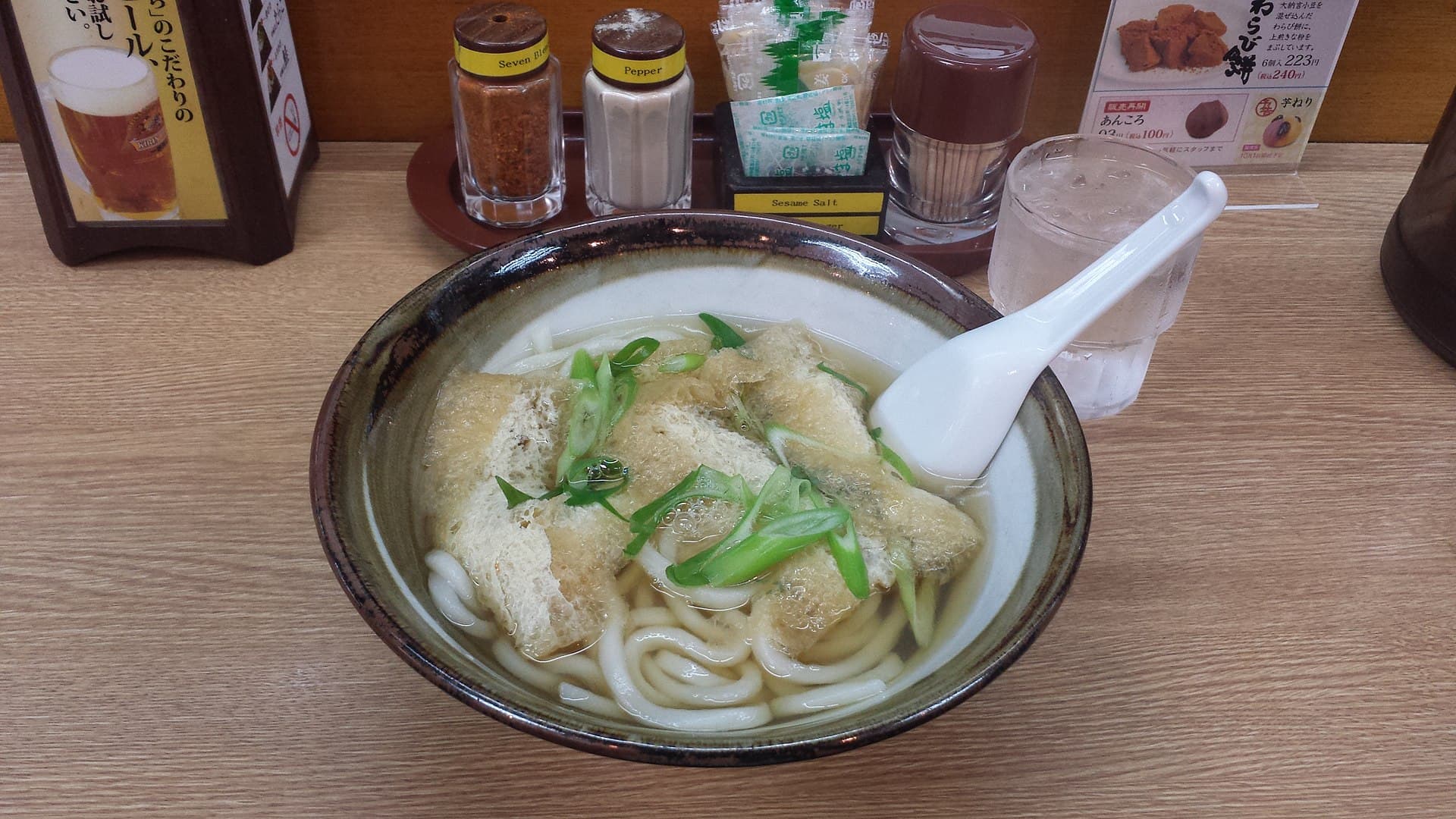
: the simplest form. A bowl of clear dashi broth, a few slices of kamaboko (fish cake), some scallions. The essential difference from soba broth lies in the seasoning: in eastern Japan, the broth is dark, rich in soy sauce; in the west, it is light, more delicate, sometimes based on kombu (昆布, kelp) and iriko (いりこ, small dried fish).
: thick udon coated in a rich, velvety curry sauce, a comforting and filling dish, particularly popular in winter.
: udon stir-fried in a wok with vegetables, meat, or seafood, seasoned with Worcestershire sauce or soy sauce. An everyday dish, lively and satisfying.
: less common than cold soba, but appreciated in summer, served the same way on a bamboo tray with tsuyu.
The Great Regional Specialties#
Japan possesses the remarkable tendency to develop dozens of regional variations of every food. Udon and soba are no exception to this rule.
Udon: A Tour of Japan in Thickness#
- , Kagawa: the king of udon. Firm noodles with a legendary koshi, served in countless ways in often tiny restaurants where you serve yourself. Kagawa Prefecture officially calls itself "the udon prefecture" (udon-ken, うどん県) and consumes more noodles per capita than any other region in Japan.
- , Akita: thin, flat udon, air-dried using an artisanal method that dates back three hundred and fifty years. Their texture is more delicate than Sanuki, almost silky.
- , Nagoya: flat, wide udon, like ribbons, served in a dark bonito broth. A dish from the culinary culture of Nagoya, a city that does nothing the way everyone else does.
- , Yamanashi: a thick miso soup containing broad, irregular udon cooked directly in the broth with pumpkin, mountain vegetables, and sometimes pork. A rustic mountain dish, nourishing and deeply comforting.
Soba: The Terroir of Buckwheat#
- , Shimane: the soba are served in three superimposed layers in stacked round bowls (warigo, 割子). The buckwheat is ground with its hull, which produces a darker, more aromatic noodle.
- , Iwate: a unique festive ritual. Small portions of soba are served in a bowl that is immediately refilled as soon as the diner empties it. The challenge is to eat as many bowls as possible. Records exceed five hundred bowls.
- , Nagano: considered among the finest in Japan, rooted in a tradition linked to mountain temples. The buckwheat cultivated at altitude, in cool air, develops a particularly refined aroma.
- Tokyo soba: the Edo tradition, where soba restaurants (sobaya, そば屋) have passed down their craft for generations. The neighborhoods of Kanda and Nihonbashi house century-old establishments where you eat standing up, quickly, in the bustle of hurried office workers.
In Tokyo, New Year's custom dictates eating on the evening of December 31st. The noodles, long and thin, symbolize longevity and perseverance. But they also break easily, representing the severing of ties with the troubles of the past year. It is considered bad luck not to finish your bowl.
The Nutritional Matchup#
Beyond flavor, the two noodles present distinct nutritional profiles.
Soba are richer in protein, fiber, and minerals (magnesium, manganese, phosphorus) thanks to buckwheat, which contains all eight essential amino acids. Their glycemic index is lower than that of udon, making them a more stable choice for sustained energy. One hundred grams of cooked soba provide approximately 99 calories, 5 grams of protein, and 0.1 grams of fat. Buckwheat also contains rutin, an antioxidant with cardiovascular properties that have been studied.
Udon, made from wheat flour, are higher in carbohydrates and provide quick energy. One hundred grams of cooked udon provide approximately 105 calories, 3 grams of protein, and very little fat. Their soft texture and digestibility make them a convalescence food in Japan: a bowl of hot udon in a light broth is often the first meal prepared for someone who is ill or a feverish child.
In summary, soba offer a slightly more interesting nutritional profile, while udon excel in comfort and digestibility. But let us be honest: nobody in Japan chooses their noodles by consulting a calorie chart. You choose them with your stomach, your eyes, and your memory.
The Broth: The Other Great Divide#
You cannot compare udon and soba without discussing the broth, because it reveals the deepest culinary fracture in Japan: the opposition between east (Kanto) and west (Kansai).
In the Kanto (Tokyo and its surrounding region), the broth is dark, nearly brown, heavily seasoned with and dried bonito. It is an assertive, direct broth that makes no apologies.
In the Kansai (Osaka, Kyoto), the broth is light, golden, relying on and kombu dashi. More subtle, lighter, it lets the ingredients speak for themselves.
The two camps have regarded each other for centuries with a reciprocal and perfectly unapologetic condescension. Someone from Osaka will find Tokyo broth too salty and too dark. A Tokyoite will judge Osaka's broth too bland and too pale. This rivalry, at once gastronomic and cultural, is one of the most enduring and most flavorful in all of Japan.
When to Choose Udon, When to Choose Soba#
There is no absolute rule, but natural inclinations that the Japanese observe without necessarily articulating them.
Choose udon when the body craves comfort: on cold days, after an exhausting day, when you seek a thick, enveloping warmth. Curry udon on a rainy day. Nabeyaki udon (鍋焼きうどん), cooked in an earthenware pot with tempura and an egg, on a winter evening. Cold, firm udon on a summer day in Kagawa, dipped in an icy sauce, when the heat kills appetite but not hunger.
Choose soba when you seek clarity, freshness, and lightness. Cold soba on their bamboo tray, the wasabi freshly grated, the tsuyu in which you barely dip. Hot soba with tempura when you want refinement within comfort. Soba when the season calls for elegance, when you want a meal that does not weigh you down, that leaves the mind clear.
And then there is context. Soba accompany transitions: you eat them for New Year's, for a move (hikkoshi soba, 引越しそば, which you offer to your new neighbors), to mark a threshold. Udon, meanwhile, accompany the everyday, the ordinary, the return to oneself.
, applied to udon, describes that elastic resistance under the tooth, that firmness which gives the noodle its personality. The word literally means "the hips," "the lower back," evoking the solidity of the human body. An udon with good koshi is one with character, one that pushes back against the jaw before yielding. It is the ultimate quality criterion, the one that every Sanuki udon enthusiast evaluates at the first touch of chopsticks.
The Art of Tasting: The Gestures That Matter#
Eating udon or soba in Japan involves a gesture that Westerners sometimes find disconcerting: , the noisy slurping of noodles. This is neither rudeness nor an accident. It is a technique. Aspirating the scalding noodles allows them to cool via the air entering the mouth simultaneously, to mix noodle and broth in ideal proportions, and to release the volatile aromas of the dashi that rise into the nasal cavity.
Soba connoisseurs add one final ritual: the . At the end of the meal, the server brings a small pitcher containing the soba cooking water, cloudy and milky, saturated with the starch and nutrients of the buckwheat. You pour it into the remaining tsuyu to obtain a sort of diluted broth that you drink like a tisane. It is at once a gesture of economy, of health, and of respect for the ingredient.
Two Noodles, One Country#
Udon and soba are not in competition. They are complementary, just as the east and west of Japan are, as winter and summer are, as the robust and the delicate are. To understand their difference is to understand something of Japan itself: a country that does not choose between refinement and rusticity, but cultivates both with the same exacting standards.
The next time you push open the door of a Japanese noodle restaurant, you will know what each choice signifies. And if the vocabulary of the Japanese table intrigues you as much as its flavors, the words of everyday Japanese cuisine, dashi, tsuyu, koshi, zaru, tsukimi, are precisely the kind of vocabulary that sticks better when you learn it in context, card by card, on JapaneseSRS.
In Japan, there is a term for people who cannot choose between udon and soba at a restaurant: they are sometimes jokingly called . The solution does exist, however: in certain establishments, you can order an , a platter that presents both noodles side by side. The Japanese compromise.
Ramen, Japan's third great noodle, has an entirely different history: born in China, adopted out of postwar hunger, then exported to the entire world in instant form. A journey worth discovering.
Photo credits: the images used in this article come from Pexels and Unsplash and are royalty-free.
Ramen: How a Chinese Import Became Japan's Soul Food
From Chinese broth to Tokyo counters, the full story of Japanese ramen. Origins, regional styles, Momofuku Ando and the instant noodle revolution.
Cover image: Wikimedia Commons