The Gaokao: the exam that decides the fate of eleven million Chinese students
Everything you need to know about the Gaokao, China's national university entrance exam. History, social pressure, intensive preparation, and impact on Chinese society.
La rédaction Kotoba
Studio éditorial
Every year, in early June, China holds its breath. Entire streets are closed to traffic. Construction sites fall silent. Car horns go quiet. Parents crowd behind school gates, faces drawn, hands clasped. Behind those gates, nearly eleven million teenagers sit down at their desks and open an exam booklet that will, in two or three days, determine the trajectory of their entire lives. This is the , the national university entrance exam, and nothing quite like it exists anywhere else in the world.
The Gaokao is not a simple test. It is a collective ritual, a national event, a stress shared by hundreds of millions of families, and the central mechanism through which Chinese society distributes the chances of upward mobility. To understand the Gaokao is to understand contemporary China: its relentless meritocracy, its faith in education, and the crushing pressure that faith places on its children.
Origins: the imperial legacy of examinations#
is short for , meaning "National Unified Examination for Admissions to General Universities and Colleges." The word combines and . Literally: the supreme exam.
China did not invent examinations, but it perfected them before anyone else. The system of , established under the Sui dynasty in 605, allowed any man, regardless of birth, to access government posts by passing a series of tests. This system functioned for 1,300 years, until its abolition in 1905. It deeply embedded in Chinese culture the idea that academic merit is the royal road to social advancement.
The modern Gaokao was born in 1952, three years after the founding of the People's Republic of China. The new government needed a centralised mechanism to select students for national universities. The exam was suspended during the Cultural Revolution (1966-1976), a decade when universities closed and education was denounced as bourgeois. Its restoration in 1977, at the initiative of , is regarded as one of the turning points of modern China: 5.7 million candidates sat the exam that year for 270,000 places, an admission rate of 4.7%.
The Gaokao is the only exam in the world where an entire country changes its behaviour for three days so as not to disturb its children.
Two days that weigh ten years#
The Gaokao takes place every year on June 7 and 8 (some provinces add a third day). All candidates across China sit the papers on the same dates, at the same times. The compulsory subjects are , , and . Depending on the province, candidates then choose between science subjects (physics, chemistry, biology) or humanities (history, geography, political science).
The maximum score is generally 750 points. The admission threshold varies by province and university. The two most prestigious universities -- and -- require scores above 680 in most provinces, a level reached by fewer than 0.1% of candidates.
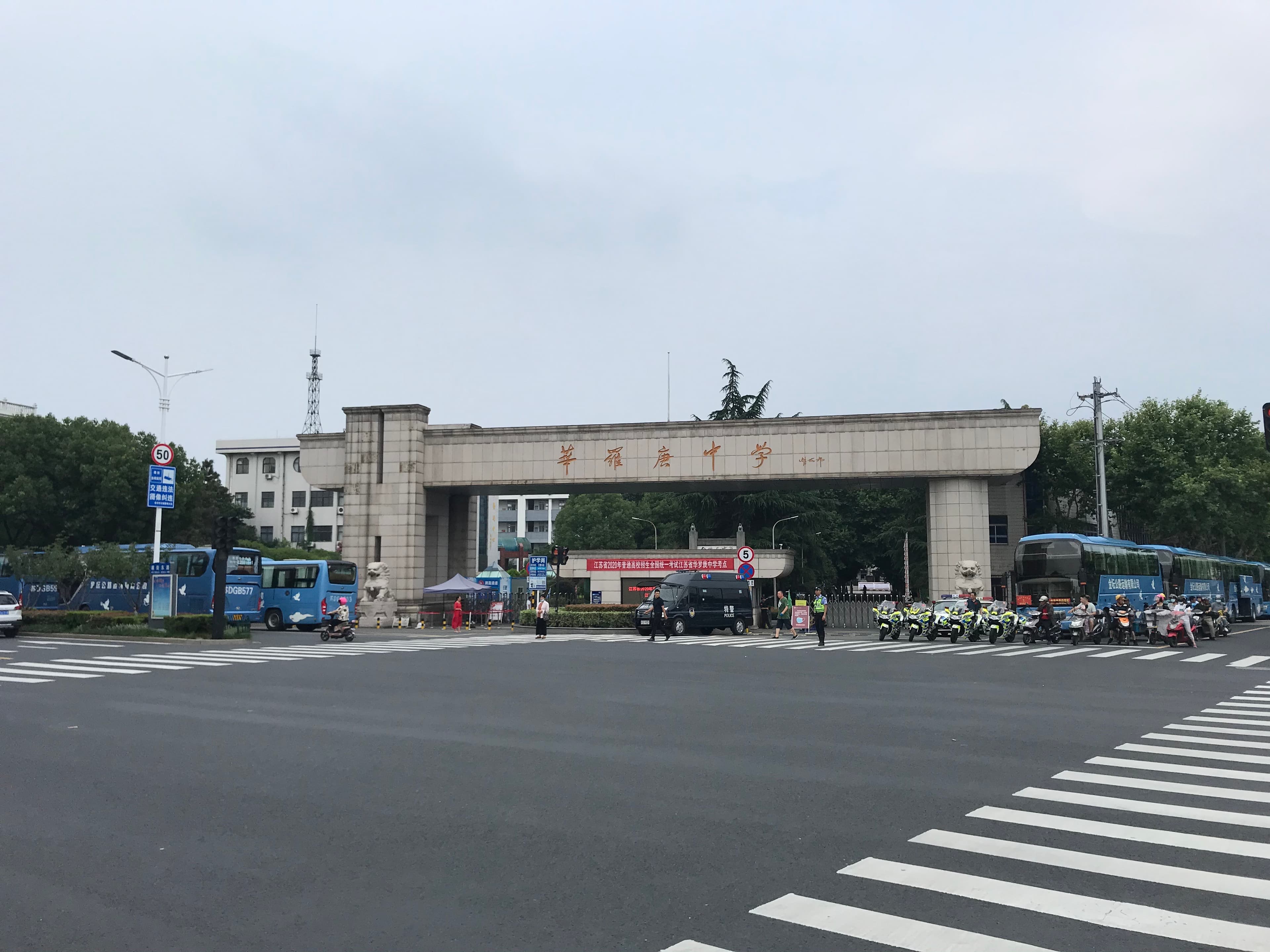
During the Gaokao, police close the streets around exam centres, construction work is suspended within a 500-metre radius, and emergency phone lines are opened for candidates running late. In 2023, a father swam across a river because the bridge was closed and his daughter had forgotten her identity card. Police then escorted him by motorbike to the exam centre.
The preparation: three years of sacrifice#
Preparation for the Gaokao begins upon entering senior high school, and for many students, well before that. The three years of high school are structured around the exam. The final year, called , is particularly intense: classes run from 7 a.m. to 10 p.m., six days a week. Students sleep in dormitories, eat in the canteen, and spend their rare free moments revising.
The involve solving thousands of practice problems. Students fill dozens of exercise books, redo previous years' papers, and train under simulated exam conditions every month. This method is criticised for being mechanical, but it remains the norm because it works: repetition builds reflexes that save the decisive minutes on exam day.
represents a colossal industry. Before the 2021 crackdown (the "double reduction" policy, 双减, shuāngjiǎn), China's after-school tutoring market was worth more than $100 billion. The government has since banned for-profit private classes in academic subjects, but the pressure system remains intact: families find other ways -- private tutors, online courses, revision camps during holidays.
The weight of the family#
The Gaokao is not the candidate's affair alone. It is a family project, sometimes spanning three generations. Parents sacrifice their savings to fund private tutoring. Grandparents move in to handle household chores and free up revision time. Some families rent an apartment near the school to spare the child long bus commutes.
The phenomenon of illustrates this devotion: mothers quit their jobs to settle near their child's school and devote themselves entirely to logistical and emotional support throughout the three years of preparation. They cook, do the laundry, monitor sleep, and become the silent guardians of a university dream that belongs as much to them as to their child.
In China, the Gaokao is not an individual exam. It is a family pact: the child studies, and the entire family reorganises itself around that effort.
The town of Maotanchang: the Gaokao factory#
No place embodies the Gaokao obsession better than , a small town in Anhui province whose high school is nicknamed the . Every year, more than 20,000 students are enrolled there, many of them -- candidates retaking the exam after a first failure.
The regime is military: wake-up at 6 a.m., classes until 10:30 p.m., lights out at 11 p.m. Mobile phones are confiscated. Outings are forbidden except on Sunday afternoons. On the day of departure for the exam centres, dozens of police-escorted buses leave the town to the applause and tears of parents lining the road. Images of this departure have gone viral on Chinese social media, a symbol of both collective determination and the unbearable pressure of the system.
The inequalities behind the meritocracy#
The Gaokao is presented as the great leveller: an anonymous exam, identical for all, where only the score counts. But this formal meritocracy masks deep inequalities.
Provincial quotas mean that the admission threshold for Peking or Tsinghua University varies according to the candidate's home province. A student from Beijing has statistically far better chances of entering an elite university than a student from Henan or Shandong, overcrowded provinces where competition is fierce. This disparity fuels deep resentment and an ongoing national debate.
The gap between cities and the countryside is just as stark. Rural high schools lack qualified teachers, teaching materials, and resources for tutoring. The children of migrant workers, whose hukou (户口, household registration) is registered in their home province, often have to return to sit the Gaokao in a province where they have never studied.
After the exam: euphoria and desolation#
Results day, usually in late June, is another moment of national tension. Scores are published online, and Chinese social media erupts with joy and heartbreak. The , the top scorers of each province, become local celebrities, interviewed on television and congratulated by officials. The term comes from the imperial system, where the zhuangyuan was the first-place laureate of the national examinations.
For those who fail or score below their hopes, the options are limited: accept a less prestigious university, try private colleges, study abroad (for those who can afford it), or become a fùdú shēng and spend another full year preparing to retake the Gaokao the following year. Roughly 15 to 20% of candidates choose this last option.
Read alsoWeChat: the super-app that does everythingWeChat is also at the heart of Chinese school life: parent chat groups, exam results, and discussions about the Gaokao all unfold there in real time.
A system in flux#
The Gaokao is the subject of ongoing reforms. Since 2014, several provinces have been experimenting with a flexible selection system where students choose three subjects out of six instead of being locked into a "science" or "humanities" track. The goal is to reduce pressure and recognise more diverse profiles.
Other reforms aim to incorporate extracurricular criteria: interviews, portfolios, personal statements. But these attempts run up against popular distrust of any system that might open the door to favouritism and corruption. The Gaokao, despite its flaws, remains perceived as the fairest mechanism available, precisely because it is brutal, anonymous, and numerical.
The debate over the Gaokao is the debate over China itself: how to reconcile meritocracy and equality? How to reward effort without crushing the young? How to modernise a system that has functioned for fourteen hundred years in various forms? Learning Chinese also means discovering these tensions, these words -- gāokǎo, fùdú, zhuàngyuán -- that tell the story of a society where education is not an abstract right but a daily, familial, visceral struggle.
FAQ#
When does the Gaokao take place? On June 7 and 8 every year (some provinces add June 9 or 10). All candidates across China sit the papers on the same dates and at the same times.
How many candidates take the Gaokao each year? Around 11 to 13 million candidates, making it the largest exam in the world. In 2024, 13.42 million students sat the exam.
What subjects are tested on the Gaokao? Three compulsory subjects (Chinese, mathematics, English) and three electives chosen from physics, chemistry, biology, history, geography, and political science, depending on the province.
Can you retake the Gaokao? Yes. Candidates who fail or wish to improve their score can become fùdú shēng (复读生) and retake the exam the following year. Around 15 to 20% of candidates are repeat takers.
Is the Gaokao the only way to enter university in China? It is the main one, but alternative pathways exist: recommended admissions for exceptional students, arts and sports entrance exams, and study-abroad programmes. These pathways remain marginal.
Photo credits: the images used in this article come from Wikimedia Commons under a CC BY-SA 4.0 licence.
996: the work system that is burning out China
Investigation into China's 996 system, where tech employees work from 9 AM to 9 PM, 6 days a week. Origins, backlash, the tang ping movement, and reforms.
Cover image: Foxy2019 · Wikimedia Commons · CC BY-SA 4.0