Guangchangwu: the Chinese grannies who make public squares dance
Discover guangchangwu, the phenomenon of collective dancing on public squares in China. Origins, controversies, social impact, and 100 million participants.
La rédaction Kotoba
Studio éditorial
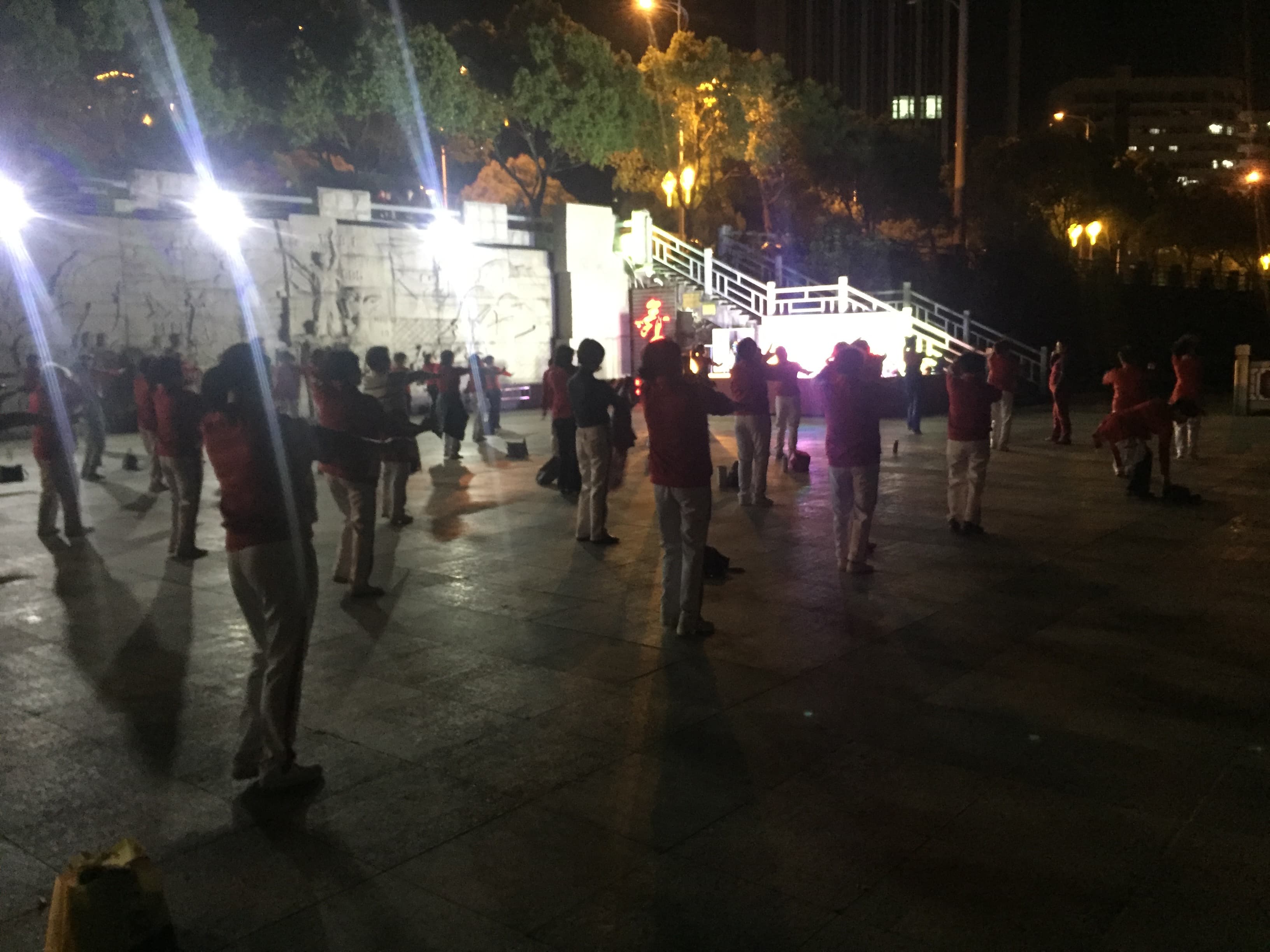
It is six in the morning in Chengdu, and the People's Park is stirring in a warm haze. Under the ginkgo trees, some twenty women in workout clothes arrange themselves in tight rows facing a Bluetooth speaker perched on a bench. The music starts -- a Chinese pop hit from the 2000s, the volume cranked to the max -- and the bodies begin to move. No instructor, no stage, no audience. Just arms rising in unison, hips swaying, knowing smiles, and a collective joy so palpable it makes you want to set down your coffee and join in. Welcome to the world of , public square dancing, the most massive and most controversial cultural phenomenon in contemporary China.
Guangchangwu involves more than 100 million regular participants -- the overwhelming majority retired women -- who, every morning and every evening, take over parks, plazas, car parks, shopping centre esplanades, and even the spaces beneath highway overpasses to dance together to amplified music. It is free, it is spontaneous, it is everywhere, and it has become one of the most recognisable symbols of Chinese urban life.
is composed of and . Literally: the dance of the square. The word guǎngchǎng refers to those vast open spaces that characterise Chinese urban design -- Tiananmen Square is the prototype -- which the dancers have reclaimed as stages for popular performance.
Origins: from Maoism to karaoke#
Guangchangwu did not appear out of nowhere. Its roots reach into two distinct traditions that intersected in 1990s China.
The first is the tradition of collective revolutionary dancing from the Maoist era. In the 1950s and 1960s, the Communist Party encouraged group physical exercises and collective dances as tools for social cohesion and public health. The , folk dances from northern China, were adapted into mass dances performed in public squares during national holidays. The habit of gathering in public spaces to move together remained embedded in Chinese culture.
The second root is the economic boom of the 1990s and 2000s. State enterprise reform pushed millions of workers into early retirement, especially women, whose legal retirement age is 50 (55 for managerial positions). These women, often still in the prime of life, found themselves with free time, a modest pension, and few accessible forms of leisure. Public squares, free and spacious, became their playground.
At first, the groups were small and discreet. Then portable speakers became cheap, choreographies spread across the internet, and the movement exploded. Within a few years, guangchangwu went from a marginal pastime to a mass phenomenon.
Guangchangwu is the quiet revenge of millions of Chinese women whom society told that retirement was the end. They turned it into a beginning.
The daily ritual#
A typical guangchangwu group operates informally. There is usually a , often the group's founder, who picks the music, learns the choreography, and stands at the front so the others can follow. There is no registration, no fee, no obligation. You show up when you can, you leave when you want.
Sessions happen twice a day: early morning (between 6 and 8 a.m.) and in the evening (between 7 and 9 p.m.). Each session lasts one to two hours. The musical repertoire ranges from Chinese pop to Tibetan and Mongolian folk music, by way of salsa, cha-cha-cha, and the occasional remixed Western hit. The choreographies are simple, repetitive, and designed to be picked up quickly: arms raised, side steps, turns, hand claps, all in rhythm.
The equipment is minimal: sports shoes, comfortable clothing, and a Bluetooth speaker loud enough to fill the square. The more organised groups have matching outfits -- often red or pink tracksuits -- and perform in local competitions or neighbourhood celebrations.
Guangchangwu has crossed China's borders. Groups of Chinese dancers have made headlines in New York (Sunset Park, Brooklyn), Paris (Place de la Republique), Sydney, and Vancouver. In Manhattan, noise complaints led to the arrest of a 60-year-old lead dancer in 2013, an incident that sparked outrage in the Chinese press and opened a debate about cultural clashes between communities.
The noise wars#
Guangchangwu is loved by those who practise it and loathed by those who hear it. The is the great social conflict tied to the phenomenon.
Guangchangwu speakers are often pushed to considerable volumes -- 80, 90, sometimes 100 decibels -- in public spaces surrounded by residential buildings. Neighbours complain they can no longer sleep, study, or watch television. Conflicts, sometimes violent ones, multiplied through the 2010s. Exasperated residents have thrown water on the dancers from their balconies. Others have purchased to blast unbearable sound back at the groups. In 2014, a man in Wuhan fired a shotgun over a group of dancers to scare them off -- he was arrested.
Local authorities have tried to regulate the phenomenon: bans after 9 p.m., volume limits, designated dance zones. In 2015, the central government stepped in: the Ministry of Culture and the General Administration of Sport published 12 official guangchangwu choreographies, an attempt at standardisation and oversight that was met with a mixture of amusement and suspicion by the dancers, who were used to their autonomy.
More than a dance: a social safety net#
To understand why guangchangwu survives every controversy, you need to understand what it represents for its practitioners. It is not simply physical exercise -- even though the health benefits are real: improved balance, stress reduction, osteoporosis prevention, maintained joint mobility.
Guangchangwu is above all a social network. In a society where retired women are often isolated -- children have left home, the husband is absent or has passed away, the neighbourhood has changed with urbanisation -- the dance group replaces the lost community. There, women find friends, confidantes, partners in crime. They celebrate birthdays, exchange neighbourhood news, and support one another through difficult times. For many women, the guangchangwu group is the most important social structure in their daily lives.
The democratic nature of guangchangwu is equally essential. You do not need to be wealthy. You do not need expensive equipment. You do not need to know how to dance -- you learn on the spot by following the others. In a country where economic inequalities are widening and free leisure spaces are shrinking, the public square remains the last egalitarian space, and the dancers defend it with a tenacity that would put many activists to shame.
Guangchangwu and a changing China#
The guangchangwu phenomenon is a mirror of contemporary China. It reveals the tensions between public and private space, between the rights of individuals and those of the collective, between a generation that knew Maoist frugality and a generation that aspires to comfort and quiet.
It also sheds light on the condition of retired women in China, a vast population (China has more than 280 million people over the age of 60) that is largely invisible in public debate. Guangchangwu gives them visibility, a voice, a presence in the city that is otherwise denied them. The mockery -- "the damas" (大妈, dàmā, "the aunties"), "the grannies who dance" -- no longer reaches them. They dance, and the city must deal with them.
The government itself has come to accept the phenomenon. In 2021, the State Council incorporated guangchangwu into its national plan for popular sport, officially recognising what everyone already knew: public square dancing is a major social fact, and it is better to guide it than to fight it.
Read alsoConfucius and Confucianism: the thought that shaped AsiaConfucianism values social harmony and respect for elders. Guangchangwu puts these principles to the test: the dancers, as elders, claim a right to public space that younger generations contest. A very Chinese generational conflict.
Dancing to exist#
Every morning, before the city wakes, and every evening, when the offices empty, the squares of China pulse to the sound of Bluetooth speakers and synchronised footsteps. The guangchangwu dancers ask for neither permission nor approval. They occupy space, they make noise, they disrupt -- and that is precisely what makes the phenomenon so fascinating. It says something profound about a society in flux: even in a country of 1.4 billion people, individuals find ways to make themselves visible.
Learning Chinese also means discovering these words -- guǎngchǎng wǔ, dàmā, lǐng wǔ -- that tell the story of a China the textbooks ignore. A China where dancing is an act of gentle resistance, where the public square is a cultural battleground, and where a hundred million retired women have decided that the best answer to invisibility is to dance.
FAQ#
How many people practise guangchangwu? Estimates range from 100 to 200 million regular participants in China, making it the most widespread collective physical activity in the country.
Who practises guangchangwu? The overwhelming majority are retired women, generally aged 50 to 75. A few men take part, but they remain a minority. The phenomenon touches every Chinese city, from megacities to small provincial towns.
Why is guangchangwu controversial? Because of the noise. The speakers used by the groups are often very powerful, and sessions take place in public spaces surrounded by housing. Conflicts between dancers and residents have sometimes turned violent.
Does guangchangwu exist outside China? Yes. Chinese diasporas have exported the practice to New York, Paris, Sydney, Vancouver, and many cities in Southeast Asia. The phenomenon provokes the same reactions there: admiration for the dancers' vitality, exasperation at the volume.
Photo credits: the images used in this article come from Wikimedia Commons under a CC BY-SA 4.0 licence.
996: the work system that is burning out China
Investigation into China's 996 system, where tech employees work from 9 AM to 9 PM, 6 days a week. Origins, backlash, the tang ping movement, and reforms.
Cover image: 彩色琪子 · Wikimedia Commons · CC BY-SA 4.0