Sakoku: How Japan Closed Itself to the World
The history of sakoku, Japan's closure under the Tokugawa. Edicts, Dejima, Christian persecution, Perry's black ships, and the nuance historians now stress.
La rédaction Kotoba
Studio éditorial
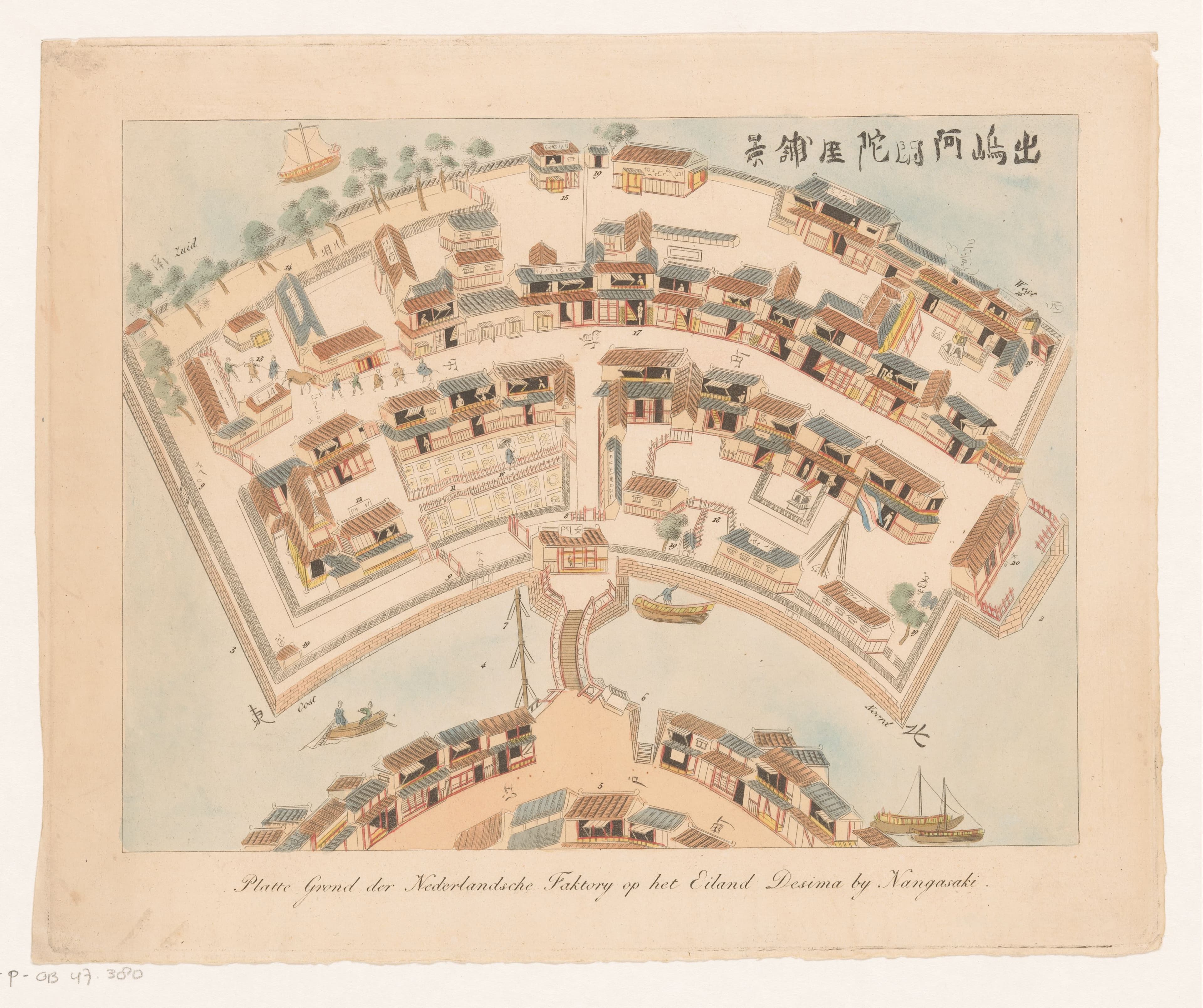
On the narrow fan-shaped tongue of land jutting into Nagasaki Bay, a Dutch merchant counts his bales of silk under the eye of a Japanese official who writes down everything. A single guarded stone bridge links the islet to the city; he will almost never cross it. All around stand palisades, watchtowers, grey water. For more than two centuries, this artificial island of a few thousand square metres, 出島 (Dejima, "the island that juts out"), was the only point through which the West could touch Japan. A keyhole for an entire archipelago.
For a long time the era was summed up in a single word: 鎖国 (sakoku), literally "chained country," "closed country." The image is striking: a Japan deliberately cut off from the world, folded in on itself for two hundred and twenty years. The reality was subtler, and historians today often prefer to speak of 海禁 (kaikin), the "maritime restrictions." Japan did not so much close as bolt its doors, keeping only four of them, each carefully controlled. This is the story of that bolt: why it was set, how it held, and who finally broke it open.
The "Christian century": when the West knocked#
It all begins in 1543, when Portuguese traders run aground on the island of Tanegashima, south of Kyūshū, and introduce the matchlock arquebus. Six years later, in 1549, the Navarrese Jesuit Francis Xavier (Francisco Xavier) lands at Kagoshima: the birth of Christianity in Japan. So opens what historiography calls the "Christian century" (1549-1650), a period of intense exchange between the archipelago and Europe.
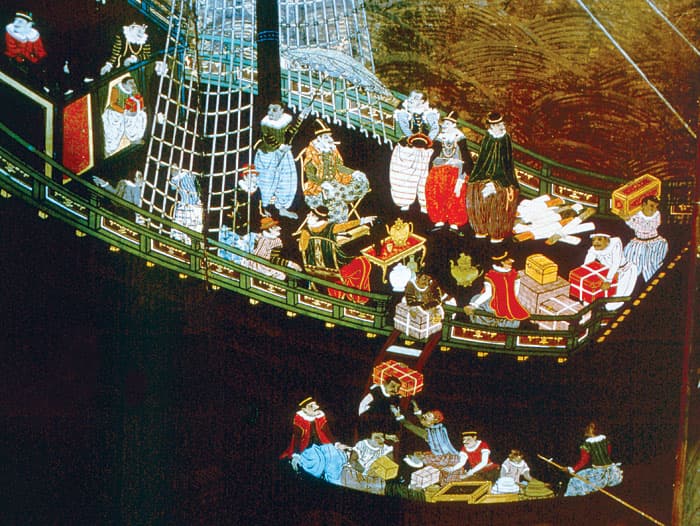
The Japanese called these newcomers the , because they arrived from the south aboard their great carracks. The poured Chinese silks, firearms, tobacco, glass, and a lasting vocabulary onto Japan: pan (from Portuguese pão, bread), tempura, kasutera (Castile sponge cake). In return flowed silver from Japanese mines, then among the most productive in the world.
Religion followed commerce. The Jesuits, then Spanish Franciscans and Dominicans after 1593, converted with spectacular success. Around 1600, the number of Japanese Christians, the , is estimated at roughly three hundred thousand, out of a population of some twenty million. Whole lords, the kirishitan daimyō, embraced the new faith. The port of Nagasaki became so Christian that it was for a time ceded to the Jesuits.
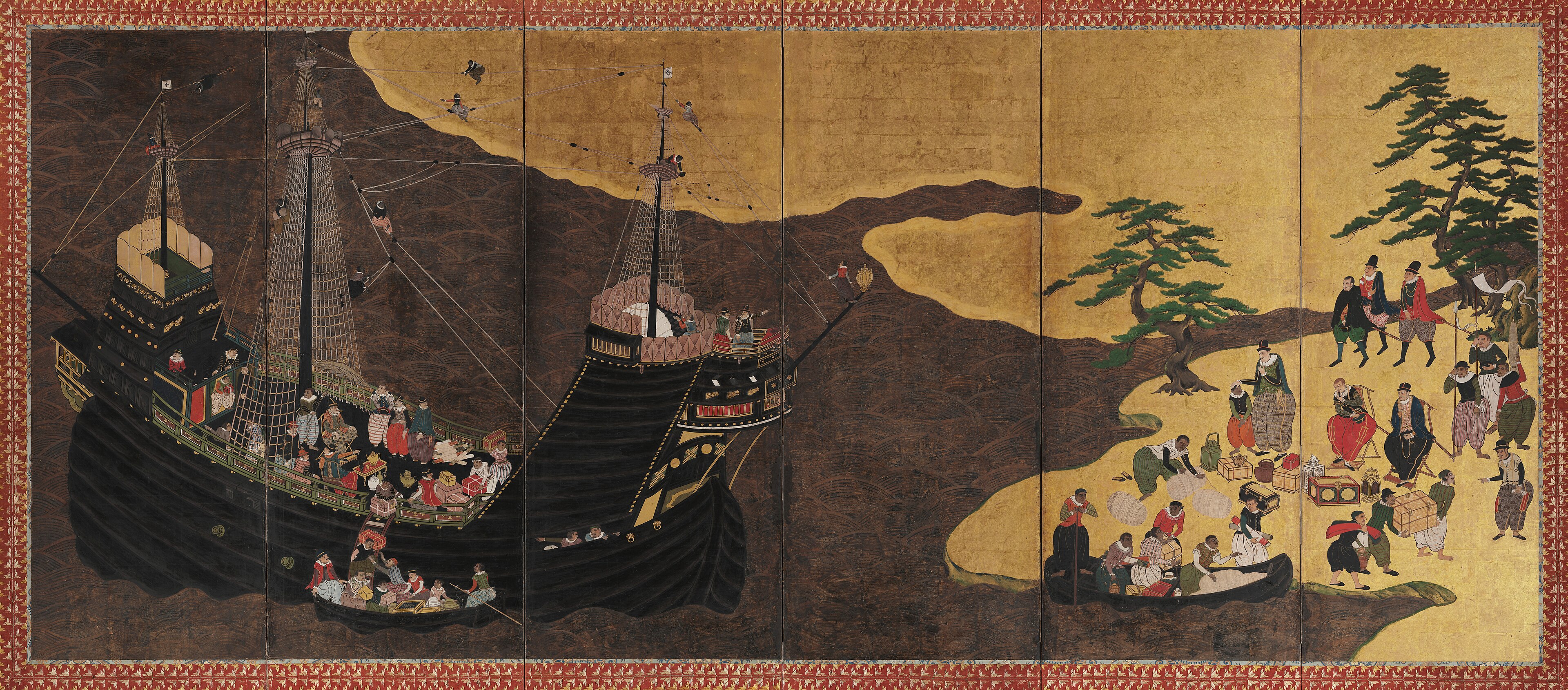
That very success would seal the fate of Japanese Christianity. To the new masters of the archipelago, the faith from the West was starting to look like a Trojan horse.
The shogun's fear: religion, loyalty, and colonisation#
Suspicion of the kirishitan was born of political calculation more than theology. Japan was barely emerging from a century of civil war, the Sengoku era (戦国, "warring states"). The unifiers, Oda Nobunaga, Toyotomi Hideyoshi, then Tokugawa Ieyasu, sought above all order and absolute allegiance. A religion that demanded a loyalty higher than that owed to one's lord, whose head resided in Rome, and whose faithful obeyed foreign priests, looked like a direct threat.
Hideyoshi fired the first warning shot in 1587 with an edict expelling the missionaries, little enforced. In 1597 he had twenty-six Christians crucified at Nagasaki, the "twenty-six martyrs of Japan," canonised in 1862. But it was under the , who seized power after the Battle of Sekigahara (1600) and established their shogunate at in 1603, that repression became systematic.
One factor weighed heavily: the rivalries that the newly arrived Protestants, the Dutch and English, deliberately stoked. Present in Japan from 1600 (the English pilot William Adams, the Miura Anjin, advised Ieyasu), these northern merchants had no interest in evangelising. They whispered an explosive idea to the shogun: the Catholic missionaries were the vanguard of conquest, exactly as in the Philippines, colonised by Spain. Fear of European colonialism joined religious fear.
Convert first, conquer next: such was the accusation the Dutch murmured at Edo. True or not, it was enough to condemn two centuries of openness.
Tokugawa Ieyasu banned Christianity throughout the country in 1614 and expelled the missionaries. Persecution intensified under his grandson, the third shogun , who ruled from 1623 and gave the lockdown its definitive form.
The closure edicts (1633-1639)#
Sakoku was not a single act but a series of decrees issued under Iemitsu between 1633 and 1639. Four successive edicts tightened the vice year by year.
The edict of 1633 forbade Japanese ships from leaving the country without official authorisation, and ordered the recall of any Japanese subject who had lived abroad for more than five years. That of 1635 went much further: it now barred any Japanese from leaving the archipelago, and any expatriate from returning, on pain of death. Foreign trade was confined to the single port of Nagasaki. That same year, the Portuguese merchants were penned onto Dejima, the artificial island built to isolate them.
Travelling overseas became a capital crime. Entire Japanese communities, like the nihonmachi (Japanese quarters) of Ayutthaya in Siam and of Manila, were abandoned to their fate, cut off from the homeland.
The decisive turn came from a revolt. In 1637-1638, in the Shimabara Peninsula and the Amakusa islands south of Kyūshū, an insurrection erupted: the . Blending peasants crushed by taxation and persecuted Christians, led by the charismatic young Amakusa Shirō, nearly thirty-seven thousand rebels barricaded themselves in Hara Castle. The shogunate mobilised over a hundred thousand men and, tellingly, asked Dutch gunners to bombard the fortress from the sea. The stronghold fell in the spring of 1638; almost all the insurgents were massacred.
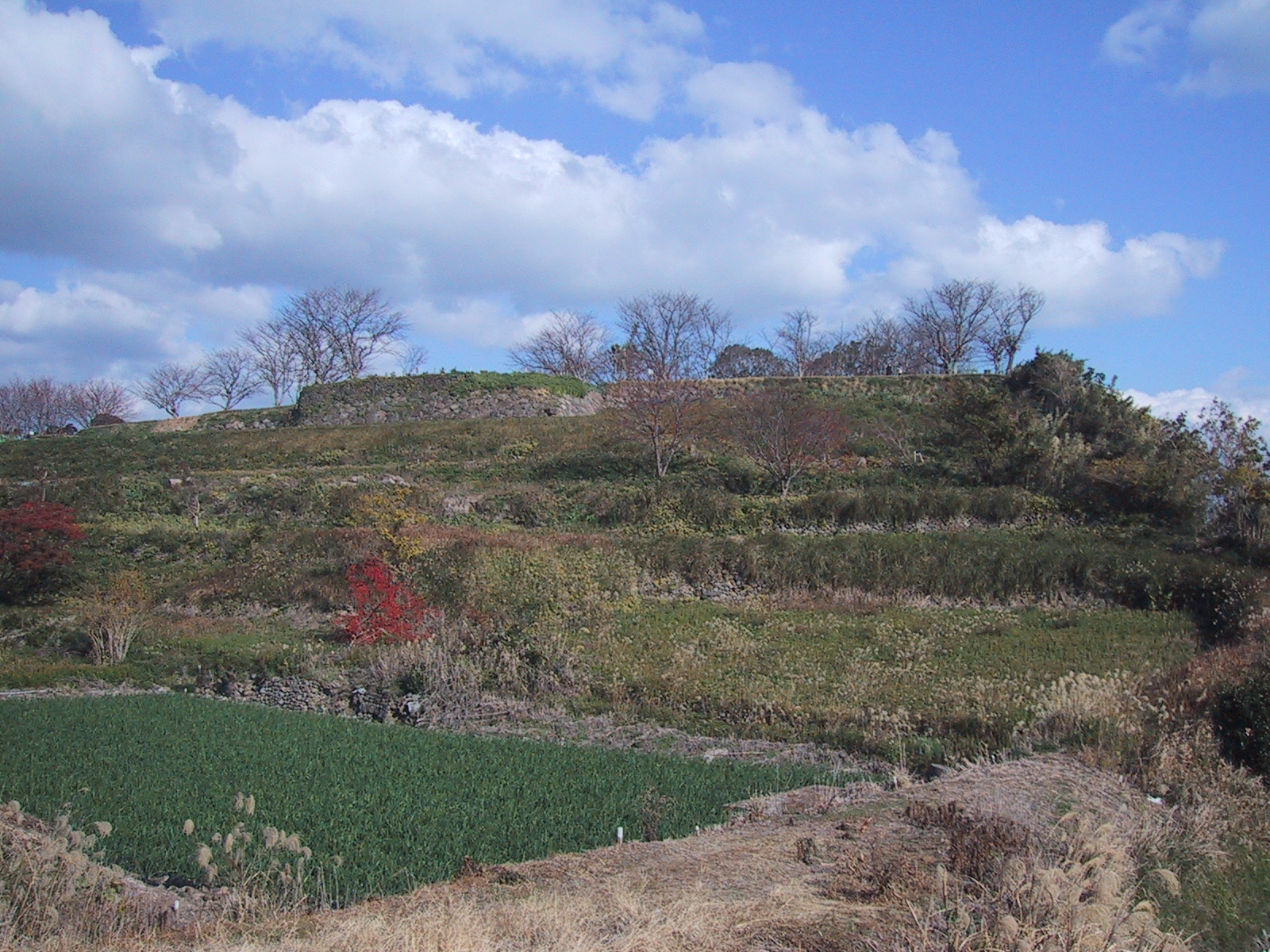
For Edo, the case was proven: Christianity fed sedition. The edict of 1639 expelled the Portuguese for good, the last link to Catholicism. When a Portuguese embassy returned from Macao in 1640 to plead its cause, sixty-one of its members were beheaded; thirteen were sent back to carry the news. The message admitted no ambiguity.
Four gates left ajar#
Tokugawa Japan was never hermetically sealed: it kept four closely watched channels of exchange, what specialists call the yottsu no kuchi, the "four mouths." It is this finding that has pushed recent scholarship, notably the work of Ronald Toby and Arano Yasunori from the 1980s onward, to prefer the term over sakoku.
Dejima: the Dutch and Chinese keyhole#
At Nagasaki, after the Portuguese left, it was the Dutch of the East India Company (VOC, Vereenigde Oostindische Compagnie) who inherited Dejima in 1641. The only Europeans tolerated, they lived in near-captivity: twenty men at most, forbidden public Christian worship, watched at all times. Each year the head of the trading post had to undertake the hofreis, the court journey to Edo, to greet the shogun and offer gifts and news of the world.
A stone's throw away, in the enclosed Tōjin yashiki quarter, Chinese merchants, far more numerous, handled the bulk of the trade. Japan imported silks, medicines, books and sugar; it exported silver, then copper and marine products.
Tsushima: the Korean gate#
The island of , midway between Kyūshū and the peninsula, managed relations with Joseon Korea (조선). The Sō clan, lord of the island, held a monopoly on trade conducted from the trading post at Busan. Above all, twelve great Korean embassies, the , travelled to Edo between 1607 and 1811, processions of several hundred people received with great ceremony: proof that real diplomacy existed under sakoku.
Satsuma and Matsumae: south and north#
In the south, the powerful Satsuma domain (薩摩) had controlled the since 1609, a formally independent state and tributary of China. Through this double allegiance, Satsuma siphoned off a share of Chinese trade while bypassing the bans. Ryūkyūan embassies also travelled to Edo.
In the north, the Matsumae clan (松前), at the tip of Hokkaidō, monopolised exchanges with the Ainu, the indigenous people of . Furs, dried fish and trained eagles passed through this northern frontier, often at the expense of an exploited Ainu people, whose revolt under Shakushain (1669) was harshly crushed.
Dejima, the keyhole of knowledge: rangaku#
Through the narrow opening of Dejima passed more than goods: an entire body of knowledge seeped in. It is called , "Dutch learning": ran is short for Oranda, Holland. While the country stayed politically closed, a curious elite drank in the West from the small spring at Nagasaki.
The breakthrough came in 1720, when the eighth shogun Tokugawa Yoshimune relaxed the ban on importing non-religious foreign books. Medicine, astronomy, cartography, botany, physics: Dutch works flowed in and found passionate translators. In 1774 appeared the , the translation by Sugita Genpaku and Maeno Ryōtaku of a Dutch anatomical manual. Struck by the accuracy of its plates when compared with a real dissection, the two scholars accomplished a painstaking labour without a dictionary. This book marks the birth of Western medicine in Japan.
Tokugawa Japan had closed its doors, not its eyes. Through the slit of Dejima came just enough light that Western knowledge never quite went out.
Figures such as the German naturalist Engelbert Kaempfer (posted at Dejima from 1690 to 1692), the Swede Carl Peter Thunberg, or later Philipp Franz von Siebold, physicians in the service of the VOC, became conduits in both directions: they documented Japan for Europe while training Japanese disciples. It was Kaempfer's posthumous work, his History of Japan, that would contain the fateful passage on Japanese isolation, and which, translated, would give birth to the very word "sakoku."
The word "sakoku" was born in 1801#
The term sakoku was not used by those who decreed the closure: it is a late invention, and this is the central argument of historians who qualify its use. No edict of the 1630s speaks of a "closed country." The Tokugawa thought in terms of order, hierarchy and the control of trade, not of national seclusion.
The word appears in 1801, from the pen of the interpreter and scholar at Nagasaki. Translating into Japanese a chapter of Kaempfer's History of Japan that defended the policy of isolation, Shizuki had to render a long Dutch phrase. He coined the neologism 鎖国 (sakoku), "closing of the country," from sa (to lock, to chain) and koku (the country). The term would only truly spread in the nineteenth century, after the forced opening, at the precise moment when Japan needed a word to name, and to mourn, its lost isolation.
This genealogy matters. To speak of "sakoku" is to project retrospectively onto two centuries a notion born at their twilight. That is why scholars like Ronald Toby insist: the system was an active and selective foreign policy, not a blind retreat.
The black ships: the end of the bolt (1853-1854)#
The closure ended abruptly on 8 July 1853, when four American warships dropped anchor in Uraga Bay, at the entrance to Edo. At their head, Commodore Matthew C. Perry. Two of them were paddle steamers belching black smoke: the Japanese named them the . Their firepower made any resistance laughable.
Perry carried a letter from President Millard Fillmore demanding the opening of Japan to trade, the resupply of American whalers, and protection for the shipwrecked. He left an ultimatum and promised to return. The shogunate, aware of the fate inflicted on neighbouring China during the Opium War (1839-1842), had little choice.
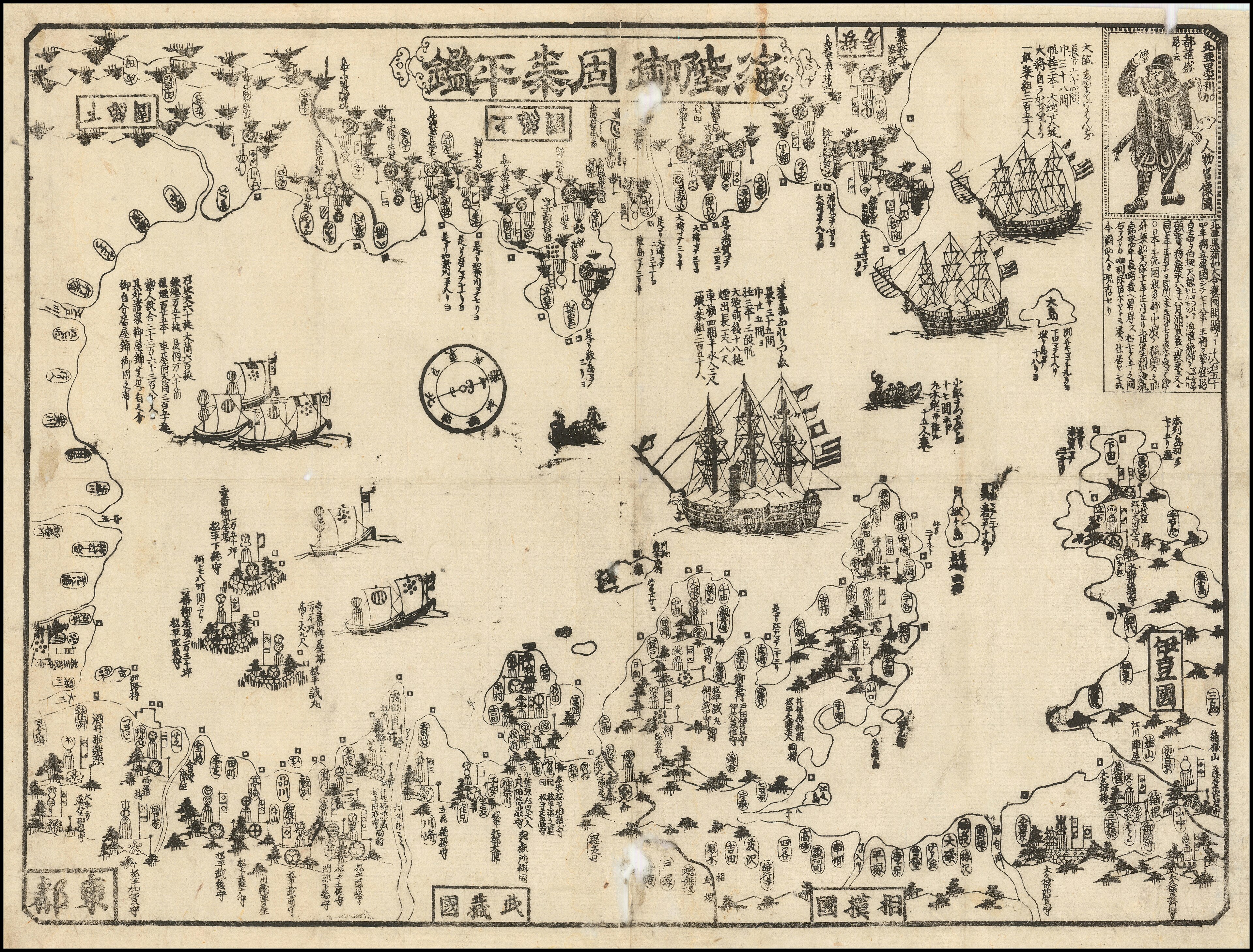
Perry returned in February 1854 with a reinforced squadron. On 31 March 1854 the was signed: the opening of the ports of Shimoda and Hakodate, protection for American sailors, the installation of a consul. Four years later, the Harris Treaty (1858) imposed free trade, additional ports, and extraterritoriality: foreign nationals escaped Japanese justice. The British, Russians, Dutch and French immediately obtained the same favours. These accords entered Japanese history as the , a humiliation whose bitterness would feed the archipelago's diplomacy well into the twentieth century.
From the opening to the Meiji Restoration#
The arrival of the black ships triggered a political crisis that swept away the regime within fifteen years. This period of collapse has a name: the . Edo's inability to repel the "barbarians" ruined its prestige and revived a vengeful slogan: , "revere the emperor, expel the barbarians."
The great south-western domains, Satsuma and Chōshū, once rivals, allied against the shogunate. After a lightning civil war, the last shogun Tokugawa Yoshinobu returned power to the court in 1867. On 3 January 1868, the placed Emperor Mutsuhito, the Meiji Emperor, back at the head of the state.
The paradox is striking: those revolutionaries who had sworn to "expel the barbarians" understood that the West could only be beaten by imitating it. Meiji Japan industrialised at a forced march, sent missions to study Europe and America (the famous Iwakura Mission of 1871-1873), and adopted railways, the telegraph, a constitution and a modern army. In a single generation, the archipelago moved from seclusion to power, to the point of defeating Russia in 1905. Rangaku, that thin trickle of knowledge that had survived at Dejima, had prepared minds for this dazzling transformation.
The hidden Christians: a faith held in the shadows#
While the country was reopening, a discovery astonished the Catholic world. Throughout sakoku, the shogunate had hunted down the kirishitan through the rite of : every suspect had to trample on a plaque engraved with Christ or the Virgin to prove their apostasy. To refuse was torture and death. Most submitted in appearance.
But part of the community went underground, transmitting the faith in secret for seven generations, without priest, without Bible, under a Buddhist guise: the , the "hidden Christians." Their Latin prayers warped into memorised formulas, their statues of Mary disguised as the goddess Kannon.
In 1865, a few months after the inauguration of Ōura church at Nagasaki, built for foreigners, a group of villagers crept up to Father Bernard Petitjean and confided that they shared his faith. The "discovery of the hidden Christians" (信徒発見) stunned Europe: a church had survived two centuries without clergy. Persecution nonetheless ceased only in 1873, when the Meiji government finally lifted the ban on Christianity under pressure from the Western powers. In 2018, UNESCO inscribed the Hidden Christian sites of the Nagasaki region on the World Heritage List.
Legacy: prison or cocoon?#
Did sakoku freeze Japan or save it? The question still divides, and the honest answer refuses sharp edges. Both theses hold a share of truth.
On the side of the prosecution, isolation deprived the archipelago of Europe's military and industrial revolutions. When Perry appeared, Japan had no ocean-going navy, no heavy industry, no comparable weapons. The technological lag was real, and the humiliation of the unequal treaties flowed directly from it. A nation that denies itself exchange for two centuries one day pays the bill.
On the side of the defence, those same two centuries were the years of the Pax Tokugawa, without major war from 1638 to 1853, an almost unique case in world history. That stability allowed the rise of Edo, which passed a million inhabitants in the eighteenth century, an explosion of literacy, the flourishing of kabuki theatre, of the ukiyo-e prints of a Hokusai or a Hiroshige, of the haiku of Bashō. Far from sterilising culture, the closure concentrated its sap. And rangaku proves that curiosity had not been extinguished.
Perhaps one must give up choosing. Tokugawa Japan was neither the blind fortress of legend nor a preserved paradise: it was a state that chose its windows onto the world, kept them narrow, and drew from them two centuries of a civilisation of rare density, before a handful of smoking ships decided, in a few weeks of the summer of 1853, that the door would stay wide open.
The language still bears the trace of that reversal: kurofune, the "black ship," still denotes in everyday Japanese any outside force that compels change. Two centuries of a bolted door, a word invented after the fact, and a nation that emerged transformed: sakoku has never stopped haunting the idea Japan holds of itself.
Frequently asked questions about sakoku#
What exactly does "sakoku" mean? The term 鎖国 (sakoku) literally means "chained" or "closed country," from sa (to lock) and koku (the country). It refers to Japan's policy of relative isolation under the Tokugawa, between 1639 and 1854. The word itself was only coined in 1801 by the scholar Shizuki Tadao.
Was Japan really completely closed? No, and this is the great nuance historians stress. The country kept four controlled channels: Dejima at Nagasaki (Dutch and Chinese), Tsushima (Korea), Satsuma (Ryūkyū) and Matsumae (Ainu). Today scholars prefer to speak of kaikin (海禁), "maritime restrictions."
Why did Japan close itself off? Out of fear of Christianity, seen as a threat to feudal loyalty, and fear of European colonialism, whose vanguard the missionaries seemed to be. The Christian Shimabara Rebellion (1637-1638) precipitated the expulsion of the Portuguese in 1639.
Who ended sakoku? The American commodore Matthew Perry, whose "black ships" entered Uraga Bay in 1853. The Convention of Kanagawa (1854) reopened Japan, triggering the fall of the shogunate and the Meiji Restoration of 1868.
What is rangaku? Rangaku (蘭学), or "Dutch learning," is the body of Western knowledge (medicine, astronomy, cartography) that entered Japan through Dejima despite the closure. The anatomy treatise Kaitai Shinsho (1774) is its symbol.
In this article
The cultural terms covered here, each with a short definition.
- Black Ships
- Western warships, led by Commodore Perry in 1853, that forced Japan to reopen.
- Commodore Perry
- U.S. Navy officer who pressured Japan into ending its seclusion in 1853-1854.
- Dejima
- Artificial island in Nagasaki, Japan's only window onto Europe during the closure.
- Edo period
- Era of peace under the Tokugawa shoguns (1603-1868), the height of samurai society.
- Kakure Kirishitan
- 'Hidden Christians' who secretly kept their faith during Japan's ban on Christianity.
- Rangaku
- 'Dutch learning': the study of Western science through Dutch books during the seclusion.
- Sakoku
- Japan's policy of national seclusion (1639-1853) that cut nearly all ties with the outside world.
- Tokugawa
- Shogun dynasty that ruled Japan from 1603 to 1868 and enforced the country's closure.
The 47 Rōnin: history and legend of a revenge
The true story of the 47 rōnin and its legend, the Chūshingura. From the 1701 Akō incident to the seppuku at Sengaku-ji: facts, dates and the myth of samurai Japan.
Cover image: Rijksmuseum · Rijksmuseum · CC0