The 47 Rōnin: history and legend of a revenge
The true story of the 47 rōnin and its legend, the Chūshingura. From the 1701 Akō incident to the seppuku at Sengaku-ji: facts, dates and the myth of samurai Japan.
La rédaction Kotoba
Studio éditorial
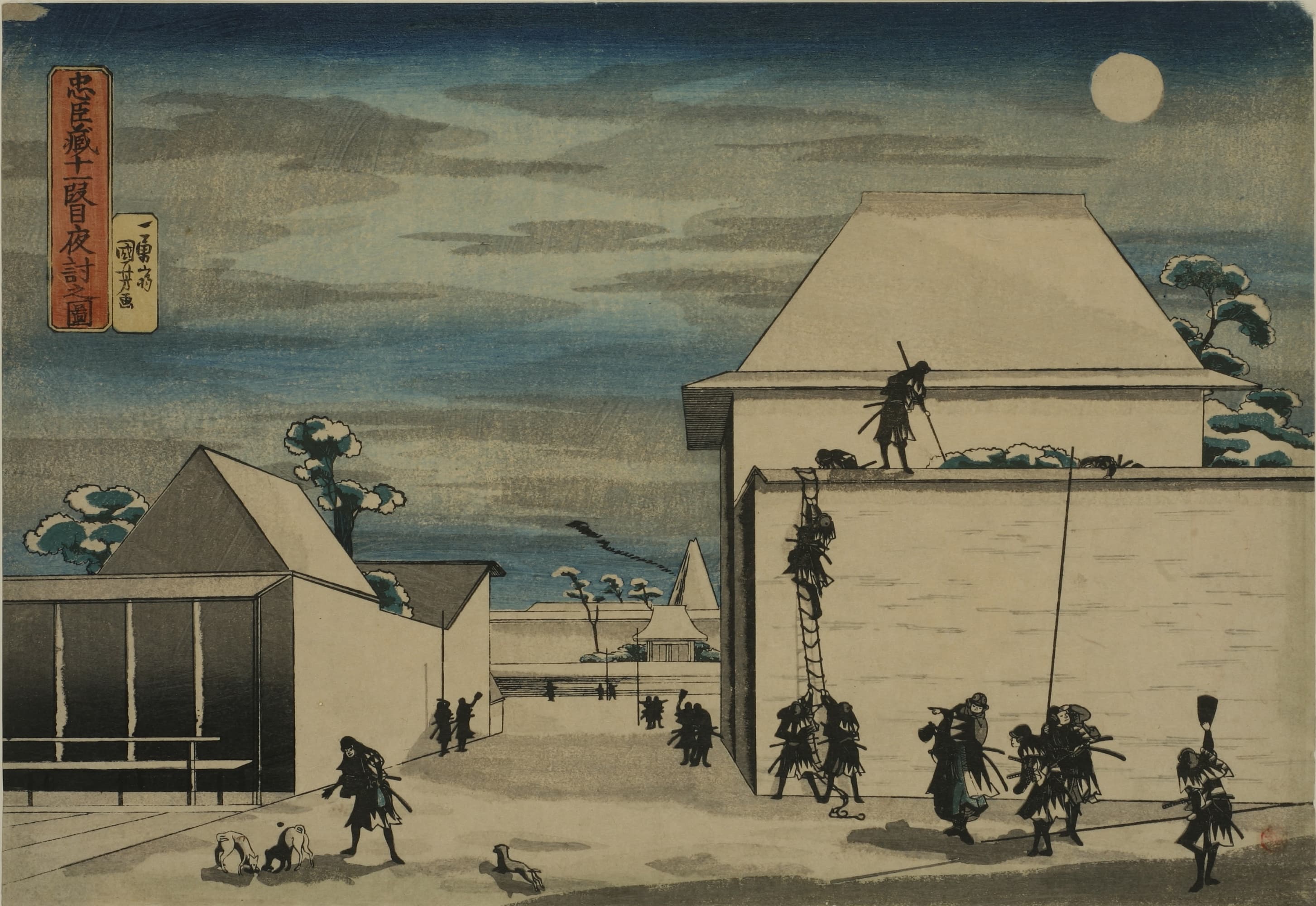
Snow falls over Edo on the night of the 14th day of the 12th month. It is nearly four in the morning, the Honjo district sleeps beneath a white blanket, and forty-seven men in makeshift armor fan out in silence around a sprawling mansion. A drumbeat, an agreed signal, and the gates give way. For two hours, in the freezing corridors and the snow-covered garden, sword and spear ring out. At dawn, the attackers finally find the man they have hunted for almost two years, cowering in a charcoal shed. They offer him the dagger to die as a samurai; he trembles too violently to take it. So they cut off his head, and carry it, still steaming, to lay upon the grave of a dead lord.
This scene, told and re-enacted thousands of times since 1703, lies at the heart of Japan's most famous tale: that of the 四十七士 (shijūshichishi, the forty-seven samurai), better known in the West as the forty-seven . But between the documented facts of the and the national myth that became the 忠臣蔵 (Chūshingura), the gap is vast. To untangle one from the other is to understand how Japan told itself its own idea of loyalty.
The affront that started it all: Edo, March 14, 1701#
It all begins with a sword stroke inside the shōgun's castle. On the 14th day of the 3rd month of the 14th year of the Genroku era, March 14, 1701 in the Gregorian calendar, , the young daimyō of the Akō domain (in present-day Hyōgo prefecture), drew his short sword in a corridor of Edo Castle and wounded a senior protocol official, , better known by his title , on the brow and shoulder.
Asano, thirty-four years old, had been charged with receiving the imperial envoys from Kyōto, a prestigious mission governed by an etiquette of formidable precision. Kira, a seasoned master of ceremonies, was supposed to instruct him. What really happened between the two men? Contemporary sources are silent on the motive. Tradition holds that Asano, as he struck, shouted a line that has become famous:
"Do you remember my grudge of these recent days?"
But this motive (that Kira had humiliated Asano, or demanded bribes Asano refused) already belongs to legend. No document of the period confirms it. What is certain, by contrast, is the punishment.
Drawing a blade within the precincts of the shōgun's castle was a capital crime, regardless of any provocation. The fifth shōgun, , known for his severity, ordered Asano to take his own life by that very day. Asano carried out the sentence in the garden of an Edo residence on the afternoon of March 14. Kira, for his part, was not troubled in the slightest. The Akō domain was confiscated, the castle returned to the government, and the roughly three hundred samurai in Asano's service found themselves overnight without a lord, without land, and without income: they had become rōnin.
Two years of patience: the strategy of Ōishi Kuranosuke#
The leader of the rōnin waited almost two years before striking, and it was this patience that made the legend. At Akō, the domain steward, , whose real name was , took command of the bewildered retainers. A senior administrator in his forties, he first had to manage the surrender of the castle and the dispersal of the men. Many, driven by necessity, sought new employment or another trade.
One question divided the loyal: should they hand over the castle by force, in a collective suicide of protest, or submit? Ōishi chose submission, the better to prepare his revenge. The warriors' code tolerated, even valued, , but the situation was a trap: to avenge Asano was to defy the decision of the shōgun himself.
Ōishi formed a secret pact with a core of determined samurai. To lull Kira's suspicions, for Kira, knowing the resentment of the Akō men, had reinforced his guard and planted spies, the leader ostentatiously gave himself over to dissolution. Tradition reports that he frequented the pleasure houses of Kyōto, in the Gion district, drank in public, neglected his appearance, and let himself be called a coward. One anecdote, almost certainly apocryphal, tells of a Satsuma samurai who, finding him drunk in the gutter, trampled him in contempt. Ōishi even repudiated his wife and children to protect them from what was to come.
To avenge a dead man, one must first know how to die to one's own reputation. For two years, the most faithful of retainers played the part of the dishonored drunkard.
Meanwhile, the network organized itself. Conspirators settled in Edo, some disguised as merchants or craftsmen, to watch over Kira's residence and chart its layout. One of them, it is said, married the daughter of a contractor who had worked on the mansion in order to obtain its plans. When everything was ready, at the end of 1702, the conspirators, forty-seven in all, including Ōishi's own son, , barely fifteen or sixteen years old, gathered in the capital.
The night of the raid: January 30-31, 1703#
The attack took place on the night of the 14th day of the 12th month of Genroku 15, that is, the night of January 30 to 31, 1703 in the Gregorian calendar. This discrepancy of dates, the year 1702 in the Japanese lunar calendar corresponding to January 1703 in ours, explains why sources waver between the two years. In Japan, the commemoration is held on December 14, true to the original calendar.
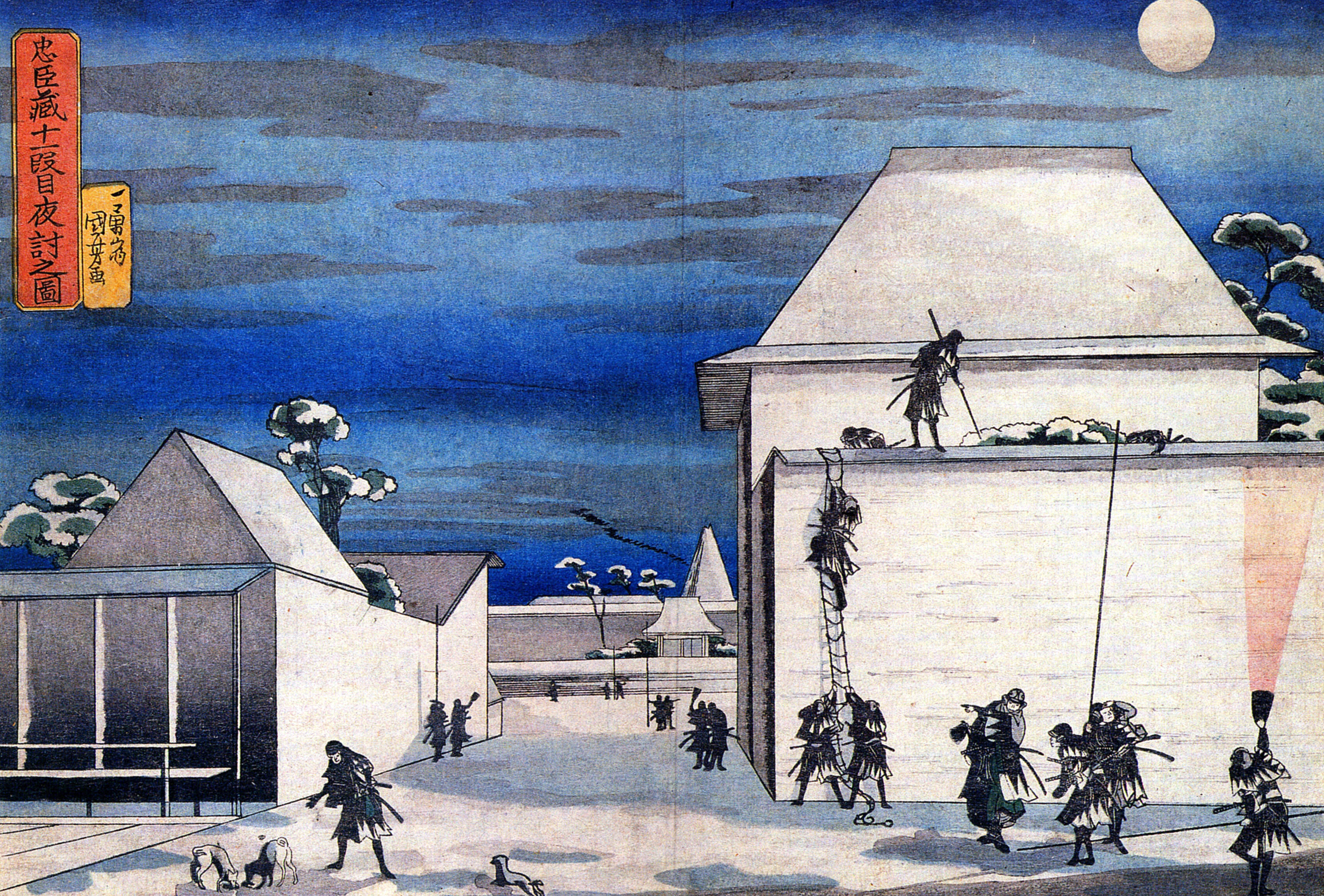
That night, snow blanketed Edo. The forty-seven gathered, donned coordinated equipment (an outfit often described as inspired by the firefighters' uniforms of the time, so they could recognize one another in the dark) and marched on Kira's residence in the Honjo district, near the Sumida River. Ōishi divided his force into two groups: one would attack through the main gate, the other from the rear. Men were posted on the rooftops with bows to prevent anyone from raising the alarm at the neighboring houses.
The fighting lasted about two hours. Kira's guards, taken by surprise, resisted; the attackers killed some fifteen of them and wounded more, without losing a single one of their own. But the master of the house remained nowhere to be found. They searched the building, felt the beds still warm, then Ōishi discovered a man hidden in a charcoal or fuel shed. By a scar on his brow, the mark left by Asano's blow nearly two years earlier, they recognized Kira Yoshinaka.
According to the account passed down, Ōishi knelt, respectfully stated the reason for their coming, and offered Kira an honorable death by seppuku, holding out the very dagger that had served Asano. The old man, Kira was by then over sixty, remained prostrate, unable to answer. The rōnin beheaded him. They put out the hearth fires to prevent a blaze, closed the mansion, and resumed their march through the city at dawn, carrying Kira's head in a pail.
The pilgrimage to Sengaku-ji and the surrender#
Their destination was their lord's grave. The forty-seven crossed Edo to Sengaku-ji temple (泉岳寺), where Asano Naganori had been buried nearly two years before. There, in the freezing morning, they washed Kira's head in a well (the "head well" still shown to visitors) and laid it as an offering before the tomb, with a farewell letter addressed to their master. The revenge, the adauchi, was accomplished.
On the way back, the city already buzzed with their exploit. Rather than flee, the rōnin gave themselves up, distributing themselves among the residences of several daimyō charged with guarding them. They had never intended to escape justice: they had avenged their lord, and now accepted the price.
They did not flee. That, perhaps, is the most radical act in the whole affair: to have killed for honor, then surrendered to the law.
This double movement, the illegality of the revenge, followed by voluntary submission to authority, placed the shogunate before a dilemma that occupied the finest minds in the country.
The verdict: justice or honor?#
The shogunate ruled in favor of an honorable death, but only after a fierce debate. The rōnin had committed a premeditated murder and violated public order; the law called for their execution as criminals. Yet popular opinion and many samurai saw in them models of , embodying the warrior ideal of .
The shōgun's councilors and the Confucian scholars clashed. The philosopher , a major intellectual figure of the age, proposed the solution that prevailed: to recognize the moral rectitude of the rōnin while sanctioning their transgression of the law. Rather than beheading them like common assassins, a shameful death, they would be allowed to take their own lives by seppuku, an end reserved for warriors and laden with honor.
On March 20, 1703 (the 4th day of the 2nd month of Genroku 16), the forty-six survivors (one of the conspirators, , having been detached from the group before or after the raid, his fate remains disputed) carried out seppuku in the residences where they were held. Young Ōishi Chikara died alongside the older men. All were then carried to Sengaku-ji and buried near their lord Asano, where they had laid the head of their enemy.
One detail underscores the ambiguity of the affair: Kira, the victim of the attack, was not honored in turn. His own house was soon stripped of its goods and its rank, the shogunate judging that he had defended himself poorly: proof that, in this story, no one emerges unscathed from the judgment of the age.
From history to myth: the birth of the Chūshingura#
In less than half a century, the Akō incident became Japan's greatest dramatic narrative. In the very weeks following the seppuku, plays drew on it. But shogunate censorship forbade staging recent political events involving real families. Authors got around the obstacle by transposing the story to an earlier era and changing the names.
The seminal work is , a bunraku puppet play written by Takeda Izumo II, Miyoshi Shōraku and Namiki Senryū, premiered in Ōsaka in 1748 and immediately adapted for kabuki. The action is shifted to the 14th century, under the Ashikaga shogunate. Asano Naganori becomes , Kira Yoshinaka becomes , and Ōishi Kuranosuke becomes . Beneath this transparent disguise, the entire audience recognized the Akō affair.
The Chūshingura was a phenomenal success and durably shaped collective memory. It was this play, not the archives, that fixed the most famous details: Kira's cruelty, the humiliations inflicted on Asano, Ōishi's feigned drunkenness, the pathos of the farewells. The play added subplots, female characters, heartrending sacrifices, dramatic elements absent from the facts. The very title, now synonymous with the whole affair, is a theatrical invention.
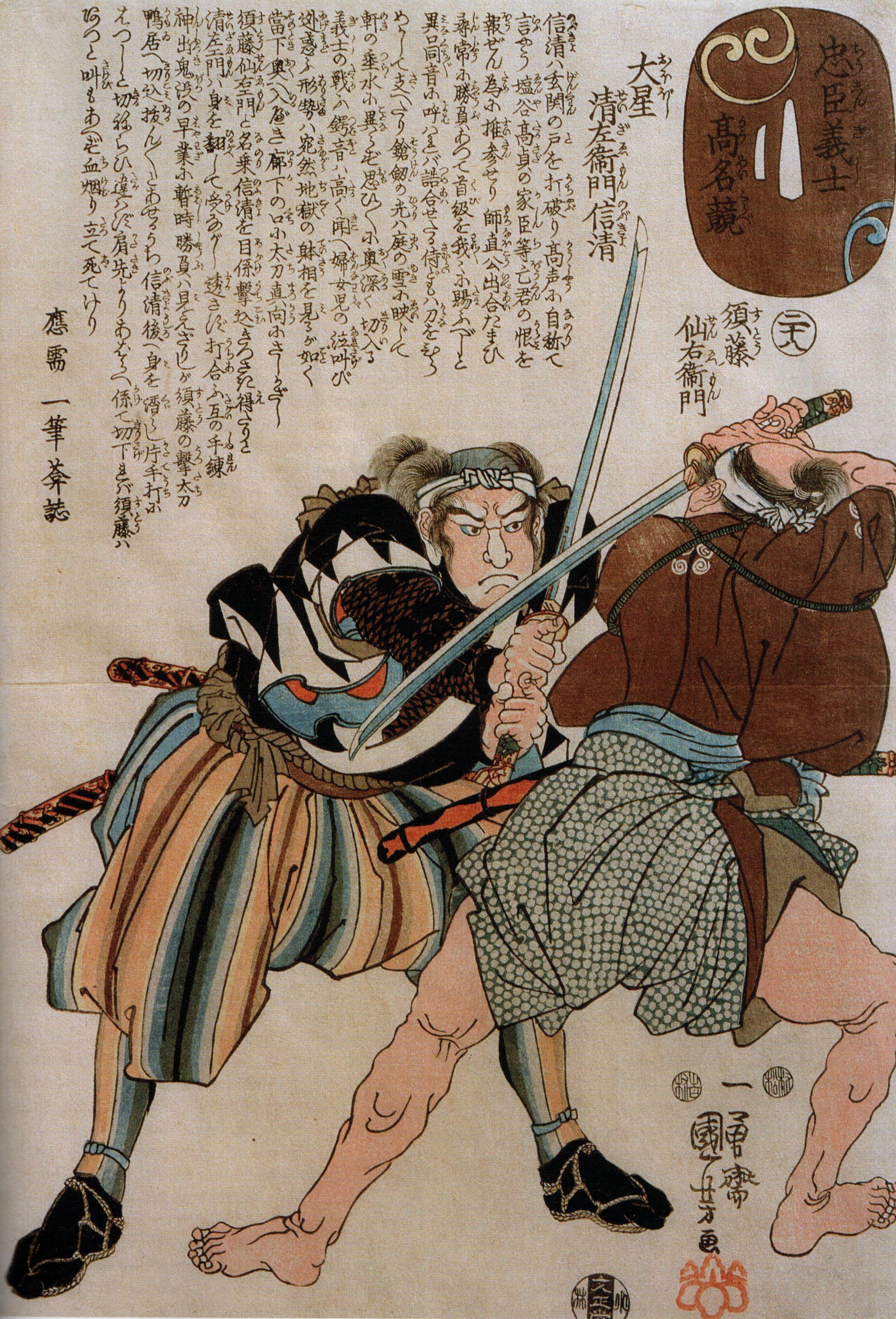
This tension between the staged 忠臣蔵 and the historical 赤穂事件 runs through everything we think we know about the forty-seven rōnin. The woodblock prints of and , in the 19th century, popularized portraits of the warriors and froze their heroic poses in the popular imagination. The story had become a heritage, reworked by every generation.
An endless afterlife: from cinema to manga#
The Chūshingura is Japan's most adapted story, and one of the most filmed in the world. Japanese cinema seized on it from its earliest days: dozens of versions exist, including the monumental two-part fresco by , Genroku Chūshingura (元禄忠臣蔵, 1941-1942), shot in the midst of war. Television made a ritual of it: for decades, Japanese channels scheduled a Chūshingura serial at year's end, and NHK's annual 大河ドラマ (taiga drama) has been devoted to it several times.
Hollywood tried its hand too, with uneven results: the film 47 Ronin (2013), starring Keanu Reeves, took such fantastical liberties (witches, demons, monsters) that it strayed almost entirely from the facts. The story has also fed countless novels, including a famous reinterpretation by Osaragi Jirō, as well as plays, prints, video games and manga.
Beyond entertainment, the story remains an object of study. Historians still debate Asano's motives, the real character of Kira (long demonized by the theater, he is today rehabilitated by some scholars and remains, in his ancestral region of Aichi, a respected lord), and how much of Ōishi's conduct was deliberate performance. The border between document and fiction stays in motion, and it is precisely this gray zone that keeps the story alive.
Giri against the law: what the legend holds in tension#
If the story of the forty-seven rōnin has fascinated for three centuries, it is because it stages an unresolvable moral conflict. On one side, giri: the vassal's absolute duty to his lord, the foundation of warrior ethics, which demanded that Asano be avenged. On the other, the law of the shogunate, which forbade private justice and defended public order. The rōnin could not honor one without violating the other, and they chose to bear both to the end.
The bushidō, that warrior ideal of which the rōnin became the supreme illustration, prized loyalty, self-sacrifice, and indifference to death. But the code, as it was later theorized, owes much to the image the Chūshingura imposed. The forty-seven did not apply an already-established bushidō: through their act and the myth it engendered, they helped to define it. This is one of the deepest paradoxes of the affair: the legend shaped the very ideal it claims to illustrate.
The shogunate itself was caught in this tension. To condemn the rōnin to an honorable death was to acknowledge the moral worth of their act while reasserting the authority of the law. Ogyū Sorai's solution, punish the crime and salute the virtue, has remained a textbook case of Confucian political philosophy, studied far beyond Japan.
Sengaku-ji today: a living place of memory#
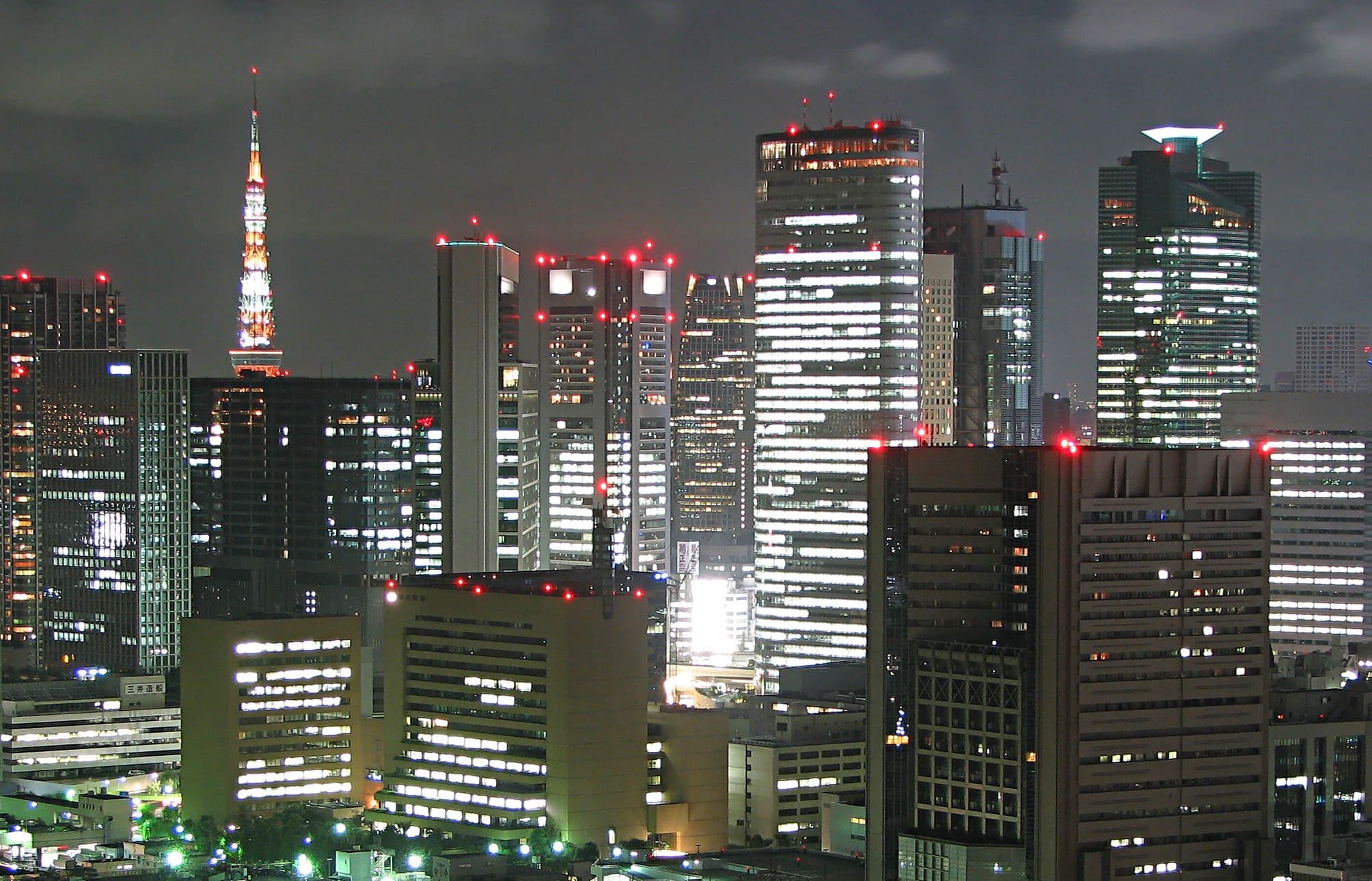
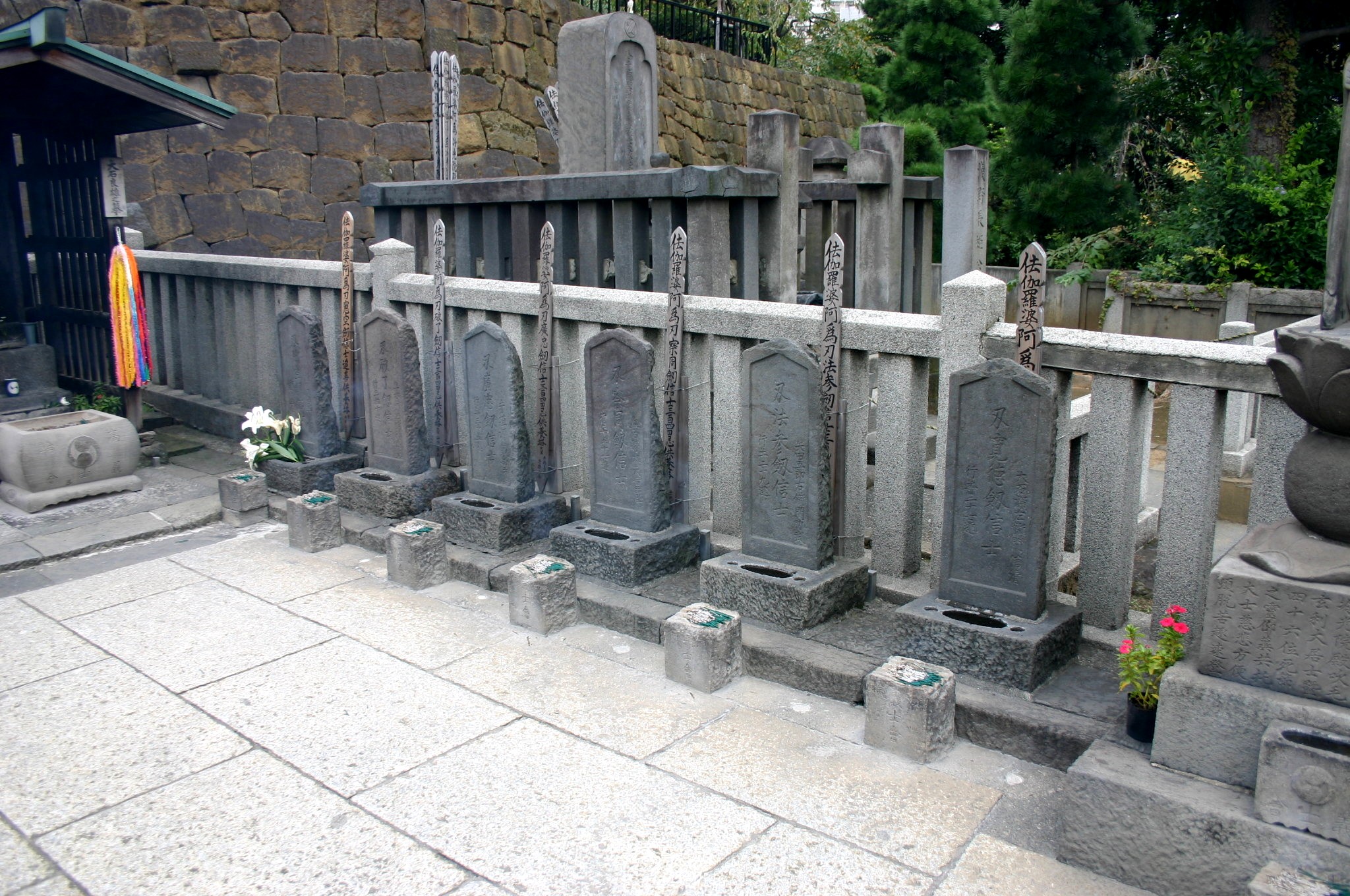
The graves of the forty-seven rōnin can still be visited at Sengaku-ji temple, in the Minato ward of Tōkyō, and remain a major pilgrimage site. The tombs, lined up in an enclosure near that of Asano Naganori, are tended and adorned with flowers. Visitors burn incense there: tradition holds that the smoke rising from them testifies to the public's unbroken devotion, more than three centuries after the events. The temple's small museum preserves objects attributed to the warriors, and the well where Kira's head was washed is still shown.
Every year, on December 14, the temple celebrates the 義士祭 (Gishi-sai, the "festival of the loyal warriors"). Worshippers and reenactors in period costume recreate the rōnin's procession through the district; incense is offered, the names of the forty-seven are read aloud, and their memory is honored in an atmosphere at once solemn and popular. The date, faithful to the original lunar calendar, perpetuates the memory of the snowy night of the raid.
What unfolded on that winter night of 1703 far exceeds a simple vendetta. The forty-seven rōnin bequeathed to Japan a question it has never ceased to ask itself: how far does loyalty go? At what price is honor paid? Three centuries later, on the cold stone of Sengaku-ji, the smoke of the incense still rises: proof that a nation still remembers, and recognizes itself, in the act of forty-seven men who agreed to die rather than betray a dead man.
Photo credits: images from Wikimedia Commons, under a free license.
In this article
The cultural terms covered here, each with a short definition.
- Akō incident
- The 1701-1703 affair in which the lord of Akō was condemned, sparking the 47 Rōnin's revenge.
- Bushidō
- Moral code of the samurai, valuing honor, loyalty, courage and self-discipline.
- Chūshingura
- Genre of plays and films retelling the legend of the 47 Rōnin.
- Edo period
- Era of peace under the Tokugawa shoguns (1603-1868), the height of samurai society.
- Samurai
- Member of Japan's warrior class, bound by the bushidō code and loyal to a lord.
- Sengaku-ji
- Tokyo temple where the 47 Rōnin and their lord are buried, a place of pilgrimage.
- Seppuku
- Ritual suicide by disembowelment, a samurai's way to restore lost honor.
- The 47 Rōnin
- Band of samurai who avenged their lord in 1703, an emblem of loyalty in Japan.
Sakoku: How Japan Closed Itself to the World
The history of sakoku, Japan's closure under the Tokugawa. Edicts, Dejima, Christian persecution, Perry's black ships, and the nuance historians now stress.
Cover image: Utagawa Kuniyoshi · Utagawa Kuniyoshi · Public domain