Ramune: the marble soda of Japan
The full history of ramune, Japan's iconic marble soda. Victorian origins, the Codd bottle, flavours, the opening ritual, and its enduring place in Japanese pop culture.
La rédaction Kotoba
Studio éditorial
The sound is unmistakable. A muffled crack, then a hiss of carbonation, then the crystalline clink of a glass marble rolling inside an impossible bottle. Around you, red paper lanterns sway in the humid July air, the smell of mingles with the scorched-sugar sweetness of a stall, and in your hand, a pale blue bottle is beading with condensation under the sweltering night. You have just opened a , and that simple gesture carries a hundred and fifty years of history, an ocean crossed, a Victorian invention forgotten by the West but preserved intact by Japan.
Ramune is more than a soft drink. It is a memory object, a seasonal marker, a tactile ritual that resists the age of disposability. Its story begins in industrial England, crosses the seas to the treaty ports of Meiji-era Japan, and ends up as one of the most enduring symbols of the Japanese summer.
is the Japanese phonetic rendering of the English word lemonade. Filtered through Japanese phonology, lemonade became remonēdo, then contracted into ramune. The word is a linguistic fossil: it preserves the trace of an era when Japan was absorbing Western vocabulary at breakneck speed.
A Victorian invention: the Codd bottle#
Hiram Codd and the carbonation problem#
To understand ramune, you first need to understand its bottle. In 1872, the British engineer Hiram Codd patented a new kind of lemonade bottle. The problem he was trying to solve had been tormenting every carbonated-drink manufacturer in Victorian England: how to keep the carbon dioxide inside the bottle without an expensive and unreliable cork stopper?
His solution was elegant. The Codd bottle contained a glass marble lodged in the neck. When the bottle was filled with carbonated lemonade and turned upside down, the pressure of the CO₂ pushed the marble against a rubber gasket in the throat, creating an airtight seal. To open it, you simply pushed the marble inward with a plunger. The marble dropped into a specially shaped chamber in the neck designed to catch it, and the drink could flow freely.
The invention was an immediate success in Victorian England. Thousands of mineral water manufacturers adopted the Codd bottle. But its reign would be short: by the 1890s, the crown cap, invented by the American William Painter in 1892, prevailed through sheer simplicity and low cost. Within a few decades, the Codd bottle vanished from Europe and America, relegated to antique collections.
Except in Japan.
The arrival in Japan#
In 1876, a Scottish pharmacist based in Kobe, Alexander Cameron Sim, began producing carbonated lemonade in Codd bottles for the foreign residents of the treaty-port concessions. The drink was an instant hit with the Japanese. In 1884, the first Japanese ramune factory opened in Osaka. Production spread rapidly across the country.
When the West abandoned the Codd bottle for the crown cap, Japan refused to follow. The marble bottle had become too deeply rooted in daily culture, too bound to a specific pleasure — the opening gesture, the clink, the playful resistance — to be replaced by a simple pry-off cap. Japan kept the Codd bottle, refined it, and made it iconic.
Hiram Codd died in 1887 without ever setting foot in Japan. He never knew that his invention, forgotten in his own country, would survive for more than a century and a half in an archipelago on the other side of the world.
The bottle: anatomy of a cult object#
The modern Codd-neck design#
The modern ramune bottle is an evolution of the original Codd bottle, adapted by Japanese glassmakers over the decades. It retains the glass-marble principle, but its shape has been refined: a narrow neck leads to a retention chamber (the kubiwa, 首輪, literally "collar") where the marble settles after opening, prevented from blocking the flow by two small indentations in the glass.
The body is slightly curved, with a marked waist between the neck and the belly. The shape is so distinctive that it is instantly recognisable even in silhouette. Traditional bottles are made of , but since the 2000s, PET (plastic) versions have appeared — cheaper to produce and unbreakable, at the cost of some of the magic.
The opening ritual#
Opening a ramune is a three-step act that is an integral part of the experience:
- Remove the plastic cap covering the mouth and retrieve the plunger stored inside it.
- Place the plunger on the marble and press firmly with the palm of your hand. The marble drops with a satisfying pop, releasing the gas in a burst of foam.
- Wait a few seconds for the foam to subside, then drink by tilting the bottle so the marble rolls into one of the two retention grooves.
This ritual, which requires a modicum of skill (children often fumble, producing geysers of lemonade), is a complete sensory experience: the feel of the plunger, the sound of the pop, the sight of the foam, the sweet-tart taste, and the clink of the marble against the glass as you drink.
Japanese children often try to extract the marble from a glass bottle after emptying it. It is nearly impossible without breaking the glass, which adds to the mystique of the object. Modern plastic bottles, however, allow you to unscrew the base to recover the marble — a concession to the universal desire to possess that little translucent sphere.
Flavours: from classic to improbable#
The original taste#
Classic ramune has a taste that is hard to pin down. It is not lemon, not lime, not orange. It is a sui generis flavour, a synthetic, tangy blend that the Japanese simply identify as "ramune flavour" (ラムネ味, ramune-aji). This flavour has become a taste category in its own right within the Japanese palate, on a par with matcha or yuzu: you can find ramune-flavoured sweets, ramune-flavoured ice cream, ramune-flavoured Kit-Kats.
The base aroma combines citrus notes (lemon and lime), a hint of vanilla, and a pronounced acidity, all in a highly carbonated, moderately sweet water. Compared to Western sodas, ramune is less sugary and more effervescent.
The flavour explosion#
Since the 1990s, ramune manufacturers have multiplied flavours with characteristically Japanese inventiveness. Today's range includes:
- Classic flavours: original, strawberry (いちご, ichigo), melon (メロン), peach (もも, momo), muscat grape (マスカット), yuzu (柚子), lychee (ライチ)
- Seasonal flavours: watermelon (すいか, suika) in summer, mandarin (みかん, mikan) in winter, cherry blossom (桜, sakura) in spring
- Eccentric flavours: curry, takoyaki (たこ焼き), wasabi, kimchi, milk (牛乳, gyūnyū), cola, champagne, and even a habanero chilli version
Brands compete for creativity, knowing that outlandish flavours generate social-media buzz and become collector's items for tourists.
The major brands#
The ramune market is dominated by a handful of historic producers:
- : founded in 1946 in Osaka, the largest ramune producer in Japan, with over 30 flavours
- : based in Shizuoka, known for experimental flavours (Mount Fuji cola, curry)
- : specialists in traditional glass bottles
Ramune and matsuri: the taste of summer#
An absolute seasonal marker#
In Japan, ramune is inseparable from summer. More specifically, it is inseparable from the matsuri, the local festivals that punctuate July and August in every neighbourhood, every town, every village. The , food and game stalls lining the grounds of temples and shrines during the festivities, invariably sell ramune from tubs of crushed ice, alongside kakigōri (かき氷, shaved ice), yakisoba (焼きそば), and takoyaki.
Ramune belongs to an essential Japanese cultural category: the , literally "poems of wind and things" — the objects, sounds, and sensations that mark a season. The clink of the marble in the bottle is a sound of summer on a par with the song of the cicadas (semi, 蝉), the chime of the , and the crackle of .
Ramune in everyday life#
Outside the matsuri, ramune can be found at , those small neighbourhood sweet shops — increasingly rare — where children buy cheap snacks after school. It appears in during the summer season, in ryokan (旅館, traditional inns) and at , where an ice-cold bottle after the bath is a ritual in itself.
Ramune is also a gift of nostalgia. Japanese adults buy it to recapture the taste of childhood summers — a phenomenon advertisers exploit with retro visuals and slogans evoking , that gentle nostalgia so central to Japanese sensibility.
Ramune in pop culture#
Anime, manga, and video games#
Ramune is omnipresent in Japanese pop culture. In anime and manga, a summer matsuri scene almost invariably features a character drinking ramune. The distinctive bottle, with its marble visible through the glass, is a visual shorthand for "summer", "festival", "carefree youth".
The anime , a romantic series set in a rural village during summer, uses the drink as a central metaphor: the marble trapped inside the bottle symbolises the characters' bottled-up feelings. In by , a scene of sharing a ramune on a Tokyo rooftop seals the bond between the two protagonists.
Ramune also appears in Japanese video games as a recovery item or consumable. In some summer-set visual novels, the sound of the marble is even woven into the sound design.
Ramune candy#
is a spin-off product that has become as famous as the drink itself. Ramune tablets — round, crumbly, tangy — are packaged in small plastic bottles mimicking the shape of the Codd bottle. produces the most iconic ones, recognisable by their sky-blue packaging.
These tablets are 90% glucose, making them a concentrated source of quick energy. They have become a popular snack among students during exam season and gamers in long sessions — a pragmatic use that coexists with their image as a childhood treat.
An object of cultural resistance#
The survival of the Codd bottle#
The fact that Japan is the last country in the world to mass-produce Codd bottles is a remarkable cultural phenomenon. The global beverage industry long ago adopted aluminium cans, PET bottles, and twist-off caps — containers that are more practical, cheaper, and easier to recycle.
The glass ramune bottle is the opposite of all that: fragile, heavy, difficult to fill (the bottling process requires specialised equipment to insert the marble and seal it), and its opening demands a learning curve. It survives because it offers something none of its substitutes can replicate: an experience.
Ramune facing modernity#
Glass ramune bottle production has been slowly declining since the 1990s. Specialised glass manufacturers are becoming scarce, production costs are rising, and mass retailers prefer PET formats. Purists consider PET ramune an oxymoron: without the weight of the glass, without the crystalline clink of the marble, without the chill that glass preserves better than plastic, the experience is diminished.
Yet ramune is not disappearing. It is reinventing itself: limited-edition flavours, collaborations with anime franchises, collector bottles, growing exports to Southeast Asia, North America, and Europe. In Japanese grocery shops in Paris, New York, and São Paulo, ramune is often the first product non-Japanese customers notice, drawn by that strange bottle with a marble inside.
Ramune around the world#
Exports#
Ramune exports have been growing steadily since the 2010s, carried by the global wave of interest in Japanese culture. It can be found in Asian grocery stores, Japanese specialty shops, and increasingly in the "world foods" aisles of Western supermarkets.
The appeal rests as much on the object as on the taste. In a world of anonymous cans and interchangeable plastic bottles, the ramune bottle is an event. Videos of people opening ramune for the first time have amassed millions of views on YouTube and TikTok, often filmed by non-Japanese discovering the mechanism.
Imitations and tributes#
Several Asian countries now produce drinks inspired by ramune, notably South Korea, Taiwan, and Thailand. These versions use the marble bottle but with local flavours. In the United States and Europe, microbreweries and artisan soda makers are experimenting with the Codd format — paying tribute to a Victorian invention that only Japan knew how to keep alive.
FAQ#
Does ramune contain alcohol? No. Classic ramune is an alcohol-free carbonated lemonade. Alcoholic versions (ramune chūhai) exist but are distinct spin-off products, sold separately in the alcohol section.
Can you swallow the marble? No. The marble is too large to pass through the neck and remains trapped in the retention chamber. It cannot be accidentally swallowed.
Does PET-bottle ramune taste the same? The liquid is identical, but many enthusiasts consider the glass bottle to deliver a superior drinking experience: glass keeps the drink colder and does not alter the flavour.
Where can I buy ramune outside Japan? In Japanese grocery stores, Asian supermarkets, and online shops specialising in Japanese products. It is increasingly available in the international-foods sections of major Western supermarket chains.
Why is ramune associated with summer? By cultural tradition. Ramune is sold primarily during matsuri (summer festivals) and is classified among the fūbutsushi (seasonal emblems). Its refreshing taste and high effervescence make it a natural summer drink.
Credits and sources#
- Codd, H. (1872). British Patent No. 3070 for the marble-sealed bottle
- Hata Kōsen — official website (hata-kosen.co.jp)
- Ashkenazi, M. & Jacob, J. (2003). The Essence of Japanese Cuisine, Curzon Press
- Cwiertka, K. (2006). Modern Japanese Cuisine: Food, Power and National Identity, Reaktion Books
- Ramune Kyōkai (ラムネ協会) — Japan Ramune Association
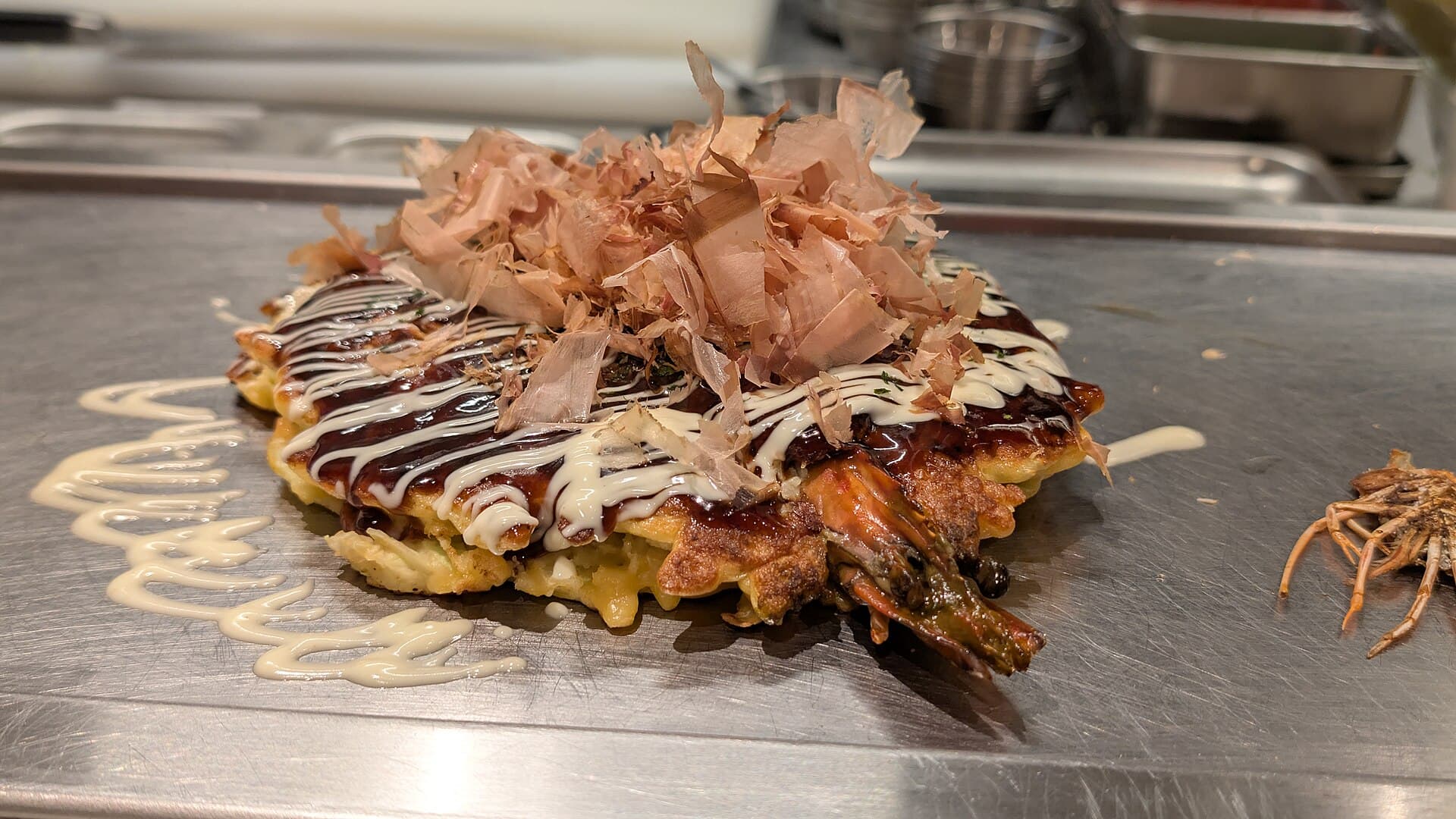
Okonomiyaki: Japan's Savory Pancake and the Osaka-Hiroshima Rivalry
Everything about okonomiyaki, the Japanese savory pancake cooked on a teppan griddle. History, Osaka vs Hiroshima styles, recipe, sauces, and regional variations.