Wushu: the Chinese martial art between combat and poetry
History of wushu and Chinese kung fu: from Shaolin to taiji quan, internal and external styles, traditional weapons and the legacy of martial arts in China.
La rédaction Kotoba
Studio éditorial
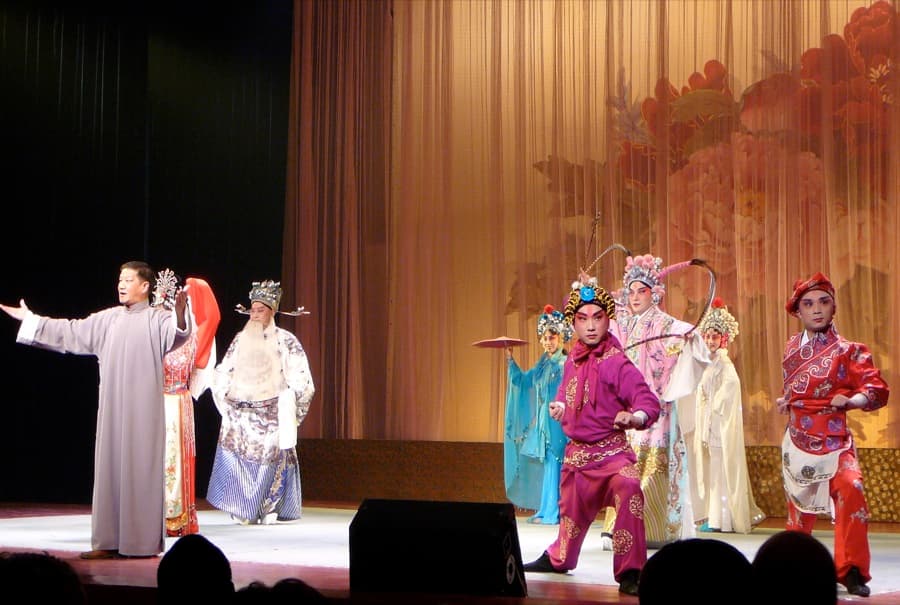
The fist rises and the whole body follows, like a sentence spoken in a single breath. The man in the red tunic chains movements so fast the eye can no longer separate the blow from the gesture: strike and dance become one. This blur between combat and choreography, between violence and grace, is the heart of wushu, the Chinese martial art that gave the world what it calls kung fu.
designates the whole of Chinese martial arts, a heritage of hundreds of styles developed over more than two millennia. In the West, the term has become synonymous, but the Chinese word actually refers to any skill honed through long practice, be it fighting, cooking or calligraphy. To understand wushu is to enter a universe where the body thinks and every gesture carries a philosophy.
Waijia and neijia: two families, two breaths#
Chinese tradition distinguishes two great families of styles. The favour muscular power, speed and explosiveness. The most famous is , born according to legend in the Buddhist monastery of Shaolin, in Henan, where monks are said to have developed martial exercises to strengthen bodies weakened by meditation. Strikes are direct, stances low and rooted, energy projected outward.
The seek instead to cultivate internal energy, the . , and are the three pillars. Here, movements are slow, fluid, circular, and power arises not from muscle but from structure and release. Taiji quan, practised every morning in Beijing's parks by millions of Chinese, has become the very image of martial serenity.
Wushu does not separate body from mind: to strike is also to think, and the slowness of taiji conceals a power that haste will never know.
Shaolin: the temple where it all begins#
No place embodies wushu better than the , founded in 495 at the foot of Mount Song, in Henan. According to tradition, the Indian monk introduced physical exercises there in the sixth century to help the monks endure long hours of seated meditation. From these exercises the first kernel of Shaolin martial arts is said to have been born.
The historical reality is more complex: combat techniques existed in China well before Bodhidharma, and Shaolin absorbed and codified practices from across the region. But the myth speaks a deep truth: Shaolin wushu is inseparable from Chan Buddhism (禅, Chinese Zen), and martial discipline there is conceived as a path of spiritual cultivation, not mere warrior training.
unites wǔ (武), "martial, warlike," and shù (术), "art, technique." The character 武 itself contains 止 (zhǐ, "to stop") and 戈 (gē, "halberd"): to stop the spear, that is, to end conflict. The Chinese martial ideal is not conquest, but peace.
The weapons: extensions of the body#
Wushu is not limited to unarmed combat. Chinese tradition developed an arsenal of that the practitioner learns to wield as extensions of the body. The four classical weapons are the , the , the and the .
Each weapon has its character: the dao is fierce and cutting, the jian elegant and precise, the gun powerful and sweeping, the qiang piercing and nimble. The jian, nicknamed "the gentleman of weapons," holds a special place in the Chinese imagination: it is the sword of scholars, Taoist immortals and wuxia heroes. Learning to handle a weapon is learning a new body language, with its own grammar and poetry.
Wing chun, zui quan and the forest of styles#
The richness of wushu lies in the profusion of its styles, estimated at several hundred. , made world-famous by Ip Man and his student Bruce Lee, relies on economy of movement and close-range combat. imitates the staggering of a drunkard to destabilise the opponent. reproduces the gestures of the hunting insect.
This diversity is no whim: each style was born from a context, a climate, a body. Northern styles, developed on the plains, favour high kicks and sweeping footwork. Southern styles, born in the tight spaces of boats and alleyways, prioritise arm work and stable stances. Wushu is a mirror of Chinese geography and history.
Read alsoConfucius and Confucianism: the thought that shaped AsiaConfucian morality, with its notions of respect, hierarchy and self-cultivation, runs deeply through the ethics of Chinese martial arts. Wude (martial virtue) is a direct echo of Confucian thought.
From wushu to cinema: legend on the big screen#
Wushu found a second life through cinema. Wuxia films (武侠, "martial heroes"), a genre born in Chinese popular literature, brought martial arts to screens worldwide. From Bruce Lee, who shattered cultural barriers in the 1970s, to Jet Li, a wushu champion turned film star, to the aerial choreographies of Ang Lee's Crouching Tiger, Hidden Dragon, wushu has become a universal visual language.
But cinema also transformed how wushu is perceived: the flying combat and supernatural powers of wuxia have distanced the martial art from its daily reality. True wushu is less spectacular and more demanding: hours of repetition, stances held until pain, the patience of a monk. Mastery comes not from talent, but from gōngfu, from effort accumulated day after day.
An art between tradition and Olympic sport#
Today, wushu lives a dual existence. On one side, traditional styles are still passed from master to disciple, in martial schools and temples, with their ancient forms and individual philosophies. On the other, competitive wushu, codified by the International Wushu Federation, has become a sport with categories for taolu (choreographed routines) and sanda (free fighting).
Wushu has knocked on the door of the Olympic Games for decades. Whatever the institutional outcome, it remains one of China's most living cultural legacies: an art where fist and brush, strength and grace, breath and silence walk together. To learn Chinese is also to grasp these words, wǔshù, gōngfu, qì, which say that in China the body is a calligrapher and combat, a poem.
FAQ#
What is the difference between wushu and kung fu? Wushu (武术) is the official Chinese term for the whole of Chinese martial arts. Kung fu (功夫, gōngfu) literally means "mastery acquired through effort" and applies to any skill, not just combat. In the West, kung fu became synonymous with wushu through the influence of cinema.
What is the Shaolin Temple? A Buddhist monastery founded in 495 in Henan, legendary birthplace of Chinese martial arts. Monks there are said to have developed physical exercises linked to meditation, giving rise to the Shaolin style, the most famous of the external styles.
Is taiji quan a martial art? Yes. Despite its apparent slowness, taiji quan (太极拳) is an internal martial art in which every slow movement corresponds to a combat application. It cultivates internal energy (qi), body structure and relaxation, rather than raw muscular force.
How many wushu styles exist? Several hundred, from the great systems like Shaolin, wing chun or taiji quan, down to local and family styles passed from generation to generation. Tradition distinguishes Northern styles (kicks, amplitude) from Southern styles (arm work, stability).
Photo credits: the images used in this article come from Pexels and Unsplash and are royalty-free.
Blue and white porcelain: China's fragile treasure
History of Chinese blue and white porcelain: Jingdezhen, cobalt, Yuan and Ming dynasties, kraak ware, export to Europe and a living legacy.