Kimchi and Kimjang: Korea's Art of Fermentation
The story of kimchi and kimjang, the great collective autumn preparation. Origins, varieties, the science of fermentation, and Korea's UNESCO heritage.
La rédaction Kotoba
Studio éditorial
In the courtyard the air smells of chili, garlic and the sea. A dozen women, pink-gloved, sit in a circle around mountains of cabbage. In their hands, each leaf receives its caress of red paste, tucked in one by one the way you tuck in a child. A grandmother peels off a dripping piece and holds it, blazing with spice, to her granddaughter's mouth. The ritual has a name, a season and now worldwide recognition: it is , the great autumn potting.
is no mere condiment. It is the identity food of Korea, present at nearly every meal, made in hundreds of varieties, and carrying a craft passed from mother to daughter for centuries. Behind its spice hides a science of fermentation and a collective memory that says a great deal about the peninsula.
Origins: preserving vegetables before winter#
Kimchi was born of necessity: surviving the Korean winter. From antiquity and the Three Kingdoms period (first century BCE to seventh century CE), the inhabitants of the peninsula salted and fermented their vegetables to keep them through the long cold months when nothing grows. The first kimchi was not red at all: it was simply brined vegetables, close to a turnip or cucumber pickle.
The ingredient that defines kimchi today, , is in fact a late arrival. Native to the Americas, it reached Korea only after contact with Portuguese and Japanese traders, most likely around the sixteenth and seventeenth centuries. Its mass adoption in Korean cooking, and therefore in kimchi, became widespread only in the eighteenth century. Before that, kimchi was white or seasoned with other spices.
The red kimchi the whole world associates with Korea is only two or three centuries old. It is an ancient dish that underwent a recent revolution: the meeting of a Korean vegetable and a chili from the other side of the world.
, now emblematic of the most common kimchi, baechu-kimchi, also took hold late, as better-suited varieties were cultivated. The history of kimchi is thus the history of a recipe in perpetual evolution, shaped by trade and agriculture.
Kimjang: a communal choreography#
Kimjang refers to the collective preparation of large quantities of kimchi as winter approaches, traditionally in late autumn, in November and early December, when temperatures cool enough to slow fermentation. It is one of the high points of the Korean domestic calendar.
The process is painstaking. You begin by splitting and salting the cabbages for several hours to soften them and draw out their water. Meanwhile you prepare the , the seasoning paste: chili powder (gochugaru, 고춧가루), garlic, ginger, scallion, slivered white radish, and above all a brine of fermented fish or shrimp, , which brings the umami depth. Every family, every region has its formula.
Then comes the most convivial stage: coating each cabbage leaf with the paste, a long task done by many hands. Kimjang gathers neighbors, sisters, mothers and daughters; they share the labor, the news, and taste together the first kimchi wrapped around a slice of boiled pork, . The pots were once buried in earthenware jars, , to hold a stable temperature all winter.
The amount produced at a family kimjang could reach one to two hundred cabbages, enough to feed a household until spring. Today the dedicated kimchi refrigerators found in most South Korean homes reproduce the temperature and humidity of the buried jars of old.
In 2013, kimjang was inscribed on UNESCO's Representative List of the Intangible Cultural Heritage of Humanity, not for the dish itself but for the social practice it embodies: an act of solidarity, transmission and sharing that strengthens community bonds.
The science of fermentation#
What turns a salted cabbage into living kimchi is lactic fermentation. The salt creates an environment in which beneficial bacteria flourish, notably the lactobacilli (especially Leuconostoc and Lactobacillus), which consume the vegetables' sugars and produce lactic acid. This acid lowers the pH, preserves the vegetables by preventing harmful microorganisms from developing, and gives kimchi its characteristic sourness.
Fermentation is a living, continuous process. A young kimchi is crisp, fresh, slightly fizzy; as it ages it grows sourer, softer, more powerful. Koreans use these stages differently: fresh kimchi as a side dish (banchan), mature kimchi in cooked dishes like the stew or the pancakes .
is the act of preparing and storing kimchi in large quantities for winter. The word covers both the preservation technique and the social ritual that accompanies it.
Nutritionally, kimchi is rich in probiotics, fiber, and vitamins A and C. Several Korean studies, relayed by the , have explored its effects on digestion and immunity. Kimchi regularly appears in international rankings of health-promoting fermented foods, alongside yogurt, sauerkraut and miso.
A family of hundreds of varieties#
To reduce kimchi to spicy cabbage alone would be a mistake. There are more than a hundred documented varieties, which differ by season, region and base vegetable.
Baechu-kimchi: the classic#
, made from napa cabbage coated in red paste, is the best known and most eaten. It is the one prepared in bulk at kimjang.
Kkakdugi: diced radish#
is made of crunchy cubes of white radish (mu, 무), seasoned with the same paste. Its firm texture and juice pair especially well with beef-bone soups.
Baek-kimchi: white kimchi#
, "white kimchi," is made without chili, in a gentle brine scented with pear, jujube and pine nuts. It is probably the closest to the historical pre-chili kimchi, and a favorite of those wary of heat.
Mul-kimchi and dongchimi: brined kimchis#
, radish kimchi in a clear brine, and the are eaten almost like refreshing cold soups whose juice you drink. Dongchimi broth even serves as a base for some summer cold noodles.
Kimchi today: between tradition and the geopolitics of taste#
Kimchi remains central to contemporary Korean eating, so much so that a South Korean is estimated to eat several kilos a year. The watchword "kimchi!" even replaces "cheese" in front of the lens, stretching the lips for photo smiles.
But the dish has also become a matter of national identity and cultural diplomacy. South Korea jealously defends the parentage of kimchi against competing industrial products, notably Chinese ones. The debate over Chinese pao cai and the naming of kimchi sparked media tensions in the early 2020s, testifying to Koreans' visceral attachment to this heritage. In 2021, Seoul even formalized a distinct Chinese transliteration, , for Korean kimchi to set it apart from pao cai.
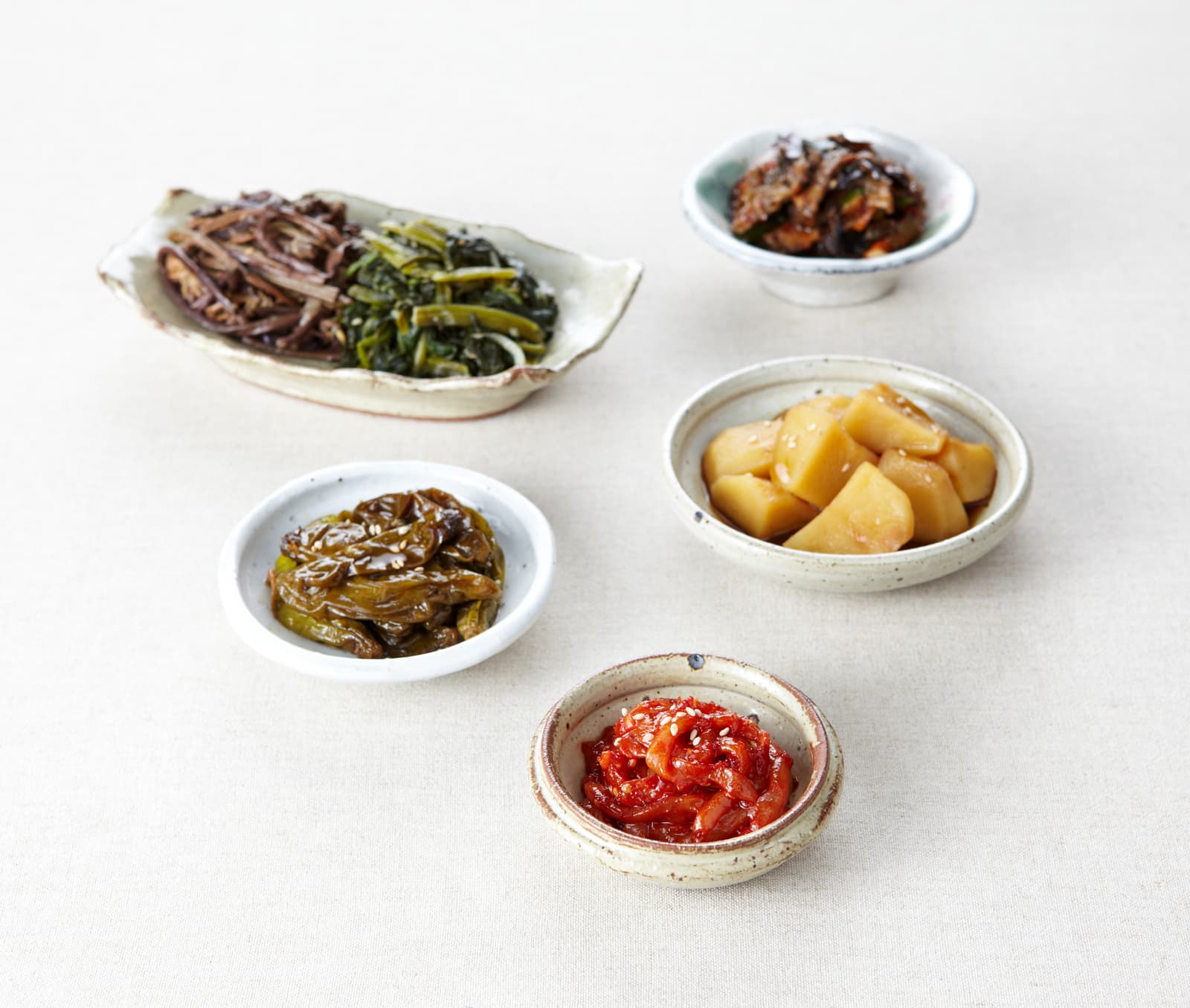
Read alsoBanchan: The Small Dishes That Define Korean DiningKimchi is the king of banchan, the small side dishes that cover the Korean table at every meal.
Internationally, carried by the Korean cultural wave, kimchi has conquered shelves the world over. It turns up in Los Angeles tacos, gourmet burgers and fusion bowls. Kimjang itself is losing ground to urban lifestyles, but municipalities and associations organize charitable collective kimjang events, where tons of kimchi are prepared and redistributed to those in need. The ancestral gesture thus survives, transformed: no longer only to preserve winter, but to connect people.
Every bite of kimchi tells this story: a vegetable brined against the cold, a chili from the Americas, women's hands gathered in a courtyard, and a whole nation recognizing itself in a red earthenware pot.
FAQ#
Has kimchi always been spicy? No. Red chili reached Korea only in the sixteenth and seventeenth centuries and became common in kimchi only in the eighteenth. Historical kimchi was white or simply brined.
What exactly is kimjang? It is the collective preparation of large quantities of kimchi in autumn to get through winter. The practice has been on UNESCO's intangible cultural heritage list since 2013.
Is kimchi good for your health? Rich in probiotics from lactic fermentation, in fiber and vitamins, it is often cited among beneficial fermented foods, provided you watch its salt content.
How many kinds of kimchi are there? More than a hundred, from cabbage baechu-kimchi to radish kkakdugi, plus white baek-kimchi and brined kimchis like dongchimi.
Photo credits: the images used in this article come from Pexels and Unsplash and are royalty-free.
In this article
The cultural terms covered here, each with a short definition.
Banchan: The Small Dishes That Define Korean Dining
Banchan, the small shared dishes at every Korean meal, carry centuries of philosophy, fermentation science and seasonal wisdom. A deep dive.