Hangeul: The Korean Alphabet Invented by King Sejong
The story of Hangeul, the Korean alphabet created in 1443 by King Sejong. Origins, how the jamo work, syllable blocks, and why it can be learned in a morning.
La rédaction Kotoba
Studio éditorial
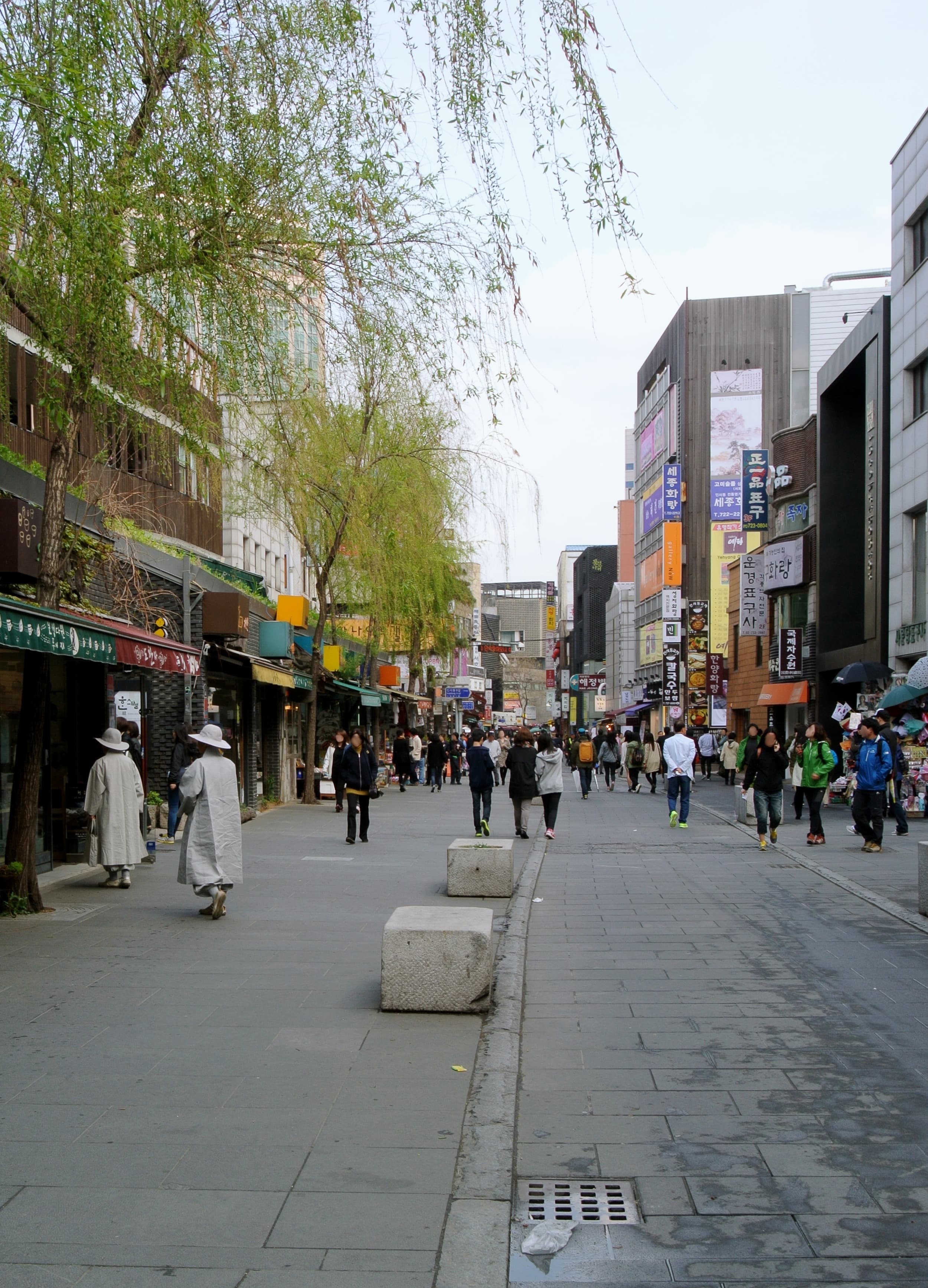
On a Seoul storefront, a word glows in rounded and squared strokes: 한국 (hanguk, "Korea"). To the untrained eye, these shapes look like ideograms, cousins of Chinese characters. It is an illusion. Behind the appearance hides one of the youngest and most rational writing systems on the planet: an alphabet of twenty-four letters, designed in a few years by a scholar-king, and readable on the very first afternoon of study.
is not the product of slow, millennia-long sedimentation like most of the world's scripts. It has a birth date, an author, and a manifesto. To understand its invention is to understand how a fifteenth-century sovereign decided, against the elite of his time, that ordinary people had the right to read and write.
Before Hangeul: writing Korean with Chinese characters#
Before 1443, Korean had no script of its own. For more than a thousand years, the literate elite of the peninsula recorded their language using , the Chinese characters borrowed from neighboring China. The problem was structural: Chinese and Korean belong to different language families. Chinese is isolating and monosyllabic; Korean is agglutinative, rich in grammatical endings that Chinese characters could transcribe only through awkward contortions.
Hybrid systems existed, such as and , which repurposed hanja to write Korean sounds. But mastering them required years of study of the Chinese classics. The result: writing remained the privilege of a thin aristocracy, the . The vast majority of Koreans, peasants, artisans, and women of every class, stayed illiterate, not for lack of intelligence but for lack of a tool.
A people who cannot write their own language is a people whose written voice has been confiscated. It is this realization, not mere technical ambition, that drives Sejong's reform.
King Sejong and the manifesto of 1443#
, fourth ruler of the dynasty, is the acknowledged inventor of Hangeul. Enthroned in 1418, this scholar-king surrounded himself with researchers in the , a royal academy devoted to learning. In that setting, completed in 1443 and promulgated in 1446, an entirely new alphabet was born.
The founding text is called the , "the correct sounds for the instruction of the people." Its preface, attributed to Sejong himself, is one of the most moving documents in the history of writing:
"The sounds of our language differ from those of China and do not match Chinese characters. So among the ignorant, many wish to express themselves but cannot. Moved by compassion, I have created twenty-eight new letters, so that everyone may learn them easily and use them conveniently in daily life."
The intent is social as much as linguistic. Sejong notes that the alphabet is so simple "a wise man masters it before the morning is over, and a fool learns it in ten days." This was no courtly hyperbole: it still holds true today.
The invention nevertheless met fierce resistance. In 1444 the scholar sent the king a now-famous protest, arguing that abandoning Chinese characters would lower Korea to the rank of "barbarians" and break with civilization. Behind the cultural argument lay a question of power: democratizing writing would strip the yangban of a monopoly.
For centuries Hangeul was scorned by the elite and nicknamed or "women's writing." Only at the end of the nineteenth century, with the rise of Korean nationalism, was it rehabilitated and named hangeul, "the great script," by the linguist Ju Sigyeong around 1912.
How Hangeul works: an engineer's logic#
Hangeul today has twenty-four basic letters, called : fourteen consonants and ten vowels. Its genius rests on two principles that twentieth-century linguists hailed as revolutionary.
Consonants that draw the mouth#
First principle: the basic consonants imitate the shape of the organs that produce them. It is an articulatory alphabet, without equal in history.
- ㄱ (g/k) shows the root of the tongue blocking the throat.
- ㄴ (n) depicts the tongue tip touching the palate.
- ㅁ (m) draws the closed mouth, a square.
- ㅅ (s) evokes the shape of a tooth.
- ㅇ (ng/silent) represents the open throat, a circle.
The other consonants are built by adding strokes to these five parent shapes, according to the intensity of the sound. Thus ㅋ (aspirated k) is a ㄱ with an added stroke, ㄷ (d/t) derives from ㄴ, and so on. The script encodes phonetics itself.
Cosmological vowels#
Second principle: the vowels rest on three primal strokes drawn from Neo-Confucian philosophy. A dot (originally round, now a stroke), ㆍ, symbolizes Heaven; a horizontal line, ㅡ, the Earth; a vertical line, ㅣ, Man standing between the two. All the vowels, ㅏ ㅓ ㅗ ㅜ ㅑ ㅕ ㅛ ㅠ, arise from combining these three elements.
literally means "the great script" or "the Korean script." The term spread in the early twentieth century; under Joseon, the alphabet bore the name of its manifesto, Hunminjeongeum.
Assembly into syllable blocks#
Here is where Hangeul disorients the Western beginner. The letters do not line up linearly as in the Latin alphabet: they assemble into square syllable blocks, read left to right and top to bottom. Each block holds at minimum an initial consonant and a vowel.
Take the word 한국 (hanguk). The first block 한 (han) combines ㅎ (h), ㅏ (a) and ㄴ (n). The second, 국 (guk), assembles ㄱ (g), ㅜ (u) and ㄱ (k). Each syllable thus forms a compact visual unit, which explains the misleading resemblance to Chinese characters: the same graphic density, the opposite principle. Hanja are memorized by the thousand; the Hangeul block is decoded by calculation.
From contempt to national emblem#
For four centuries Hangeul survived in the margins: popular novels, women's correspondence, Buddhist literature aimed at the unlettered. Official documents and high literature stayed in Classical Chinese.
The reversal came at the turn of the twentieth century, carried by nationalism in the face of foreign interference. Reformers such as theorized the alphabet as the soul of the nation and gave it its modern name. During the Japanese colonial period (1910-1945), the occupier tried to impose Japanese and suppress the teaching of Korean; defending Hangeul became an act of patriotic resistance. The was persecuted, its members imprisoned in 1942.
After Liberation, both Koreas made Hangeul their official script. The North abolished hanja outright; the South drastically cut their use, to the point that a South Korean newspaper today is written almost entirely in Hangeul, Chinese characters surviving only in a few scholarly or legal contexts.
Within a few decades South Korea went from low literacy to one of the highest rates in the world. Hangeul, designed to be learned in a morning, kept its inventor's promise five centuries later.
Hangeul today: pride, holiday, and soft power#
On October 9, South Korea celebrates , "Hangeul Day," a public holiday commemorating the 1446 promulgation. It is one of the rare countries in the world to officially celebrate its alphabet. The Hunminjeongeum Haerye manuscript, which explains Sejong's reasoning, has been inscribed since 1997 in UNESCO's Memory of the World register.
The global craze for Korean culture, K-pop, dramas, cuisine, has made Hangeul an object of desire for millions of foreign learners. Its reputation as the "most logical system in the world" is well earned: where Japanese combines three writing systems and Chinese requires thousands of characters, Korean offers a finite, phonetic, transparent alphabet. The barrier to entry is one of the lowest of any Asian language.
Read alsoHanzi: Understanding Chinese Characters and Their LogicBefore hangeul, Koreans wrote in Chinese characters: discover the logic of the hanzi that Korea broke away from.
This is precisely what modern Korean study aims for: first clear the Hangeul step, then build vocabulary through spaced repetition. Reading 한국 in under an hour is the very invitation Sejong extended to his people in 1446, and it remains, even now, the most welcoming doorway into the languages of the Far East.
FAQ#
Is Hangeul an alphabet or a system of ideograms? It is a true phonetic alphabet of twenty-four letters. The square syllable blocks give it the look of ideograms, but each letter denotes a sound, unlike Chinese characters.
Who invented Hangeul and when? King Sejong the Great and the scholars of his academy completed it in 1443; it was officially promulgated in 1446 under the name Hunminjeongeum.
How long does it take to learn to read Hangeul? The system itself can be decoded in a few hours to a few days. Sejong claimed a quick mind masters it "before the morning is over," a promise modern learners confirm.
What is the difference between Hangeul and hanja? Hangeul is the native Korean alphabet; hanja are the borrowed Chinese characters, still occasionally used in South Korea to resolve ambiguities or in scholarly contexts.
Photo credits: the images used in this article come from Pexels and Unsplash and are royalty-free.
Oppa, Senpai, Gege: Titles That Shape East Asian Society
Oppa, Noona, Hyeong, Senpai, Kohai, Gege, Jiejie: understanding the honorific titles governing social relationships in Japan, Korea, and China.