The Dragon Boat Festival: when China paddles for Qu Yuan
History and traditions of the Dragon Boat Festival (端午节 Duanwu) in China: dragon boat races, zongzi, Qu Yuan, and rituals of the fifth lunar month.
La rédaction Kotoba
Studio éditorial
The drums pound at a furious pace. Twenty rowers lean over their paddles, muscles taut, faces splashed with water. At the prow, a wooden dragon painted red and gold opens its jaws wide, slicing through the river as if to swallow it whole. On the banks, the crowd roars, waves flags, and the air smells of sticky rice and bamboo leaves. This is the , one of China's oldest and most spectacular festivals, and the river on this day is no longer a waterway: it is an arena.
The Dragon Boat Festival falls on the fifth day of the fifth lunar month, generally between late May and late June in the Gregorian calendar. It is one of China's four great traditional festivals, alongside the New Year, the Qingming Festival, and the Mid-Autumn Festival. Since 2009, it has been inscribed on UNESCO's Intangible Cultural Heritage of Humanity list, the first Chinese festival to receive the distinction.
The legend of Qu Yuan: the poet who threw himself into the river#
combines and . The festival marks the start of the fifth lunar month. The character 午 is also associated with the horse in the Chinese zodiac, and by extension with the zenith, the sun at its highest point -- a moment of cosmic power that explains the protective rituals linked to this date.
The best-known origin story of the festival is tied to , a poet and statesman of the kingdom of during the Warring States period (475-221 BCE). Qu Yuan is regarded as the first great poet of Chinese literature. His major work, the , is a long allegorical poem in which the poet, exiled by a king who no longer heeds him, expresses his shattered loyalty and despair at the corruption of the court.
In 278 BCE, the armies of the state of invaded the capital of Chu. Upon hearing the news, Qu Yuan threw himself into the , in present-day Hunan province -- an act of ultimate protest by which he chose death rather than survive the fall of his kingdom.
According to legend, the local people, desperate to save their beloved poet, launched boats onto the river to try to recover his body, striking the water with their paddles and beating drums to frighten the fish and water spirits. They also threw sticky rice wrapped in bamboo leaves to feed the fish and keep them from devouring Qu Yuan's body. Thus were born the two central traditions of Duanwu: dragon boat races and zongzi.
Qu Yuan drowned in a river, but it is all of China that, every year, fishes him back through memory.
Dragon boat races: sport, ritual, frenzy#
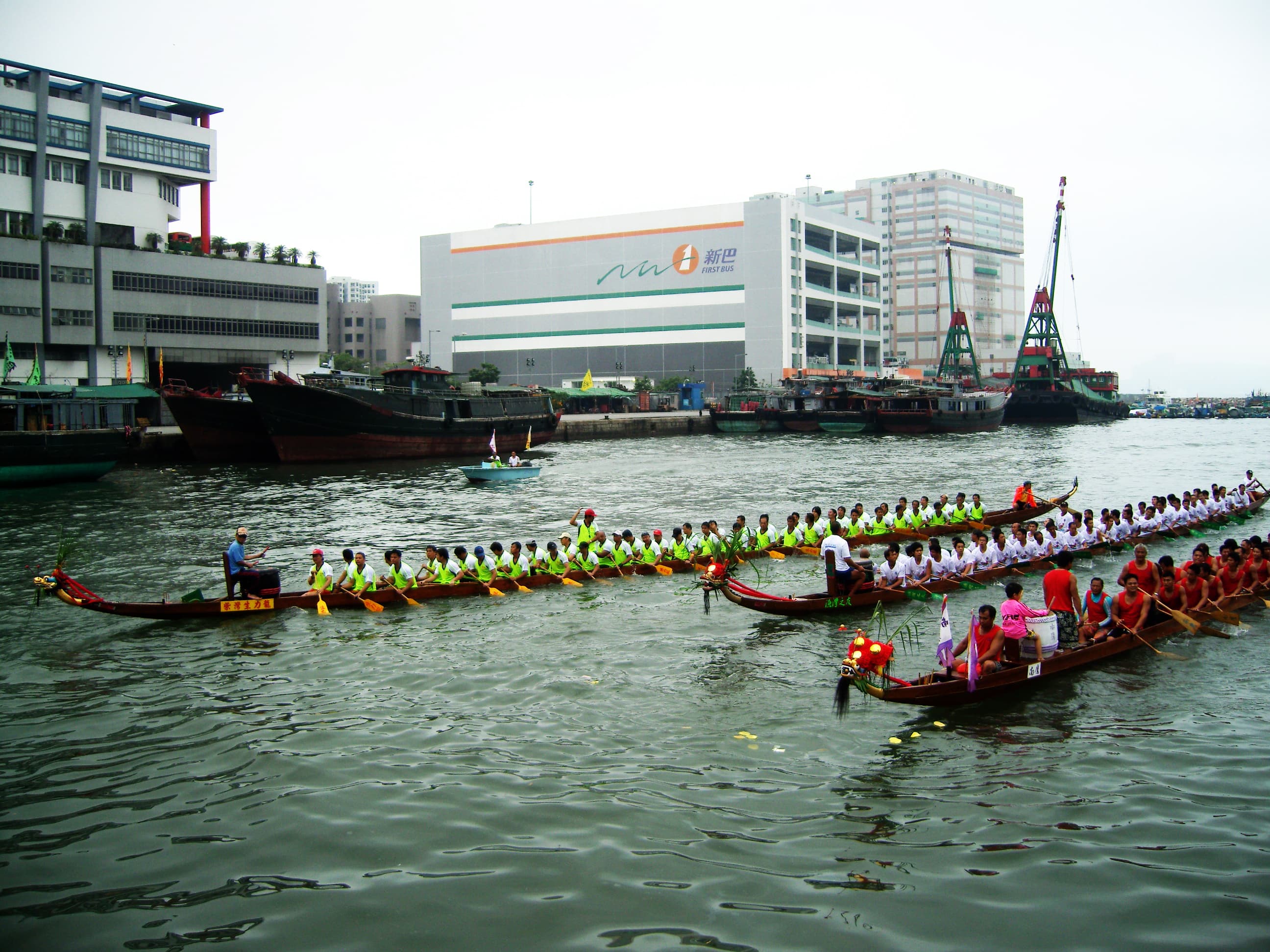
are the beating heart of the festival. The boats, long and narrow, are adorned with carved and painted dragon heads and tails. Each crew typically consists of twenty rowers, a at the bow who sets the rhythm, and a at the stern who steers.
Races are held on rivers, lakes, and even at sea. The most famous take place in Miluo (birthplace of the tradition), in Hong Kong (where the festival has been an international sporting event since 1976), in Hangzhou, in Wuhan, and across southern China. Competition is fierce: teams train for months, and victory brings prestige and good fortune to the village or neighbourhood they represent.
The ritual dimension of the races is just as important as the sporting one. Before the race, a ceremony of involves painting the dragon's eyes last -- this is the gesture that breathes life into it. Offerings are made to the river, and the boats are not mere vessels: they are living creatures that protect the rowers and channel the dragon's energy.
Dragon boat racing has become an international sport. The International Dragon Boat Federation (IDBF) organises world championships in which more than 80 countries compete. The sport featured at the 2010 Asian Games and has campaigned for Olympic inclusion. Germany, Canada, and Australia rank among the most competitive nations outside Asia.
Zongzi: a gift for a dead poet#
are pyramids of stuffed and wrapped in or reed leaves, then steamed or boiled. Their triangular or conical shape varies by region, and their filling sparks one of China's greatest culinary debates: savoury or sweet?
In the south (Guangdong, Fujian, Hainan), zongzi are typically savoury, stuffed with braised pork, salted egg yolk, shiitake mushrooms, chestnuts, or mung beans. In the north (Beijing, Shandong), they tend to be sweet, filled with jujube paste (枣泥, zǎoní) or sweetened red bean. In Shanghai, there is the famous soy-sauce braised pork zongzi, a compromise between the two traditions that satisfies everyone -- or no one.
Preparing zongzi is a family ritual. Grandmothers teach grandchildren the art of folding the leaves into a perfect cone, packing the rice tight, and tying the whole thing with cotton string. Every family has its own recipe, passed down through the generations, and the zongzi debate is a way of talking about regional identity, nostalgia, and belonging.
The fifth month: a dangerous month#
The Dragon Boat Festival is not only a commemoration of Qu Yuan. It is also deeply tied to Chinese beliefs about the fifth lunar month, regarded since antiquity as a dangerous month, a time when malevolent forces are at their peak. The heat of early summer breeds epidemics, venomous insects swarm, and the balance between yin and yang is under threat.
To protect themselves, the Chinese practise several rituals during Duanwu:
- and are hung above doorways to repel evil spirits and insects.
- Children wear filled with medicinal herbs around their necks.
- People drink , a liquor infused with arsenic sulphide said to ward off snakes and spirits -- a practice now largely symbolic, as realgar is toxic.
- Doors are decorated with images of , the demon-slaying god, painted in red with a sword and a terrifying expression.
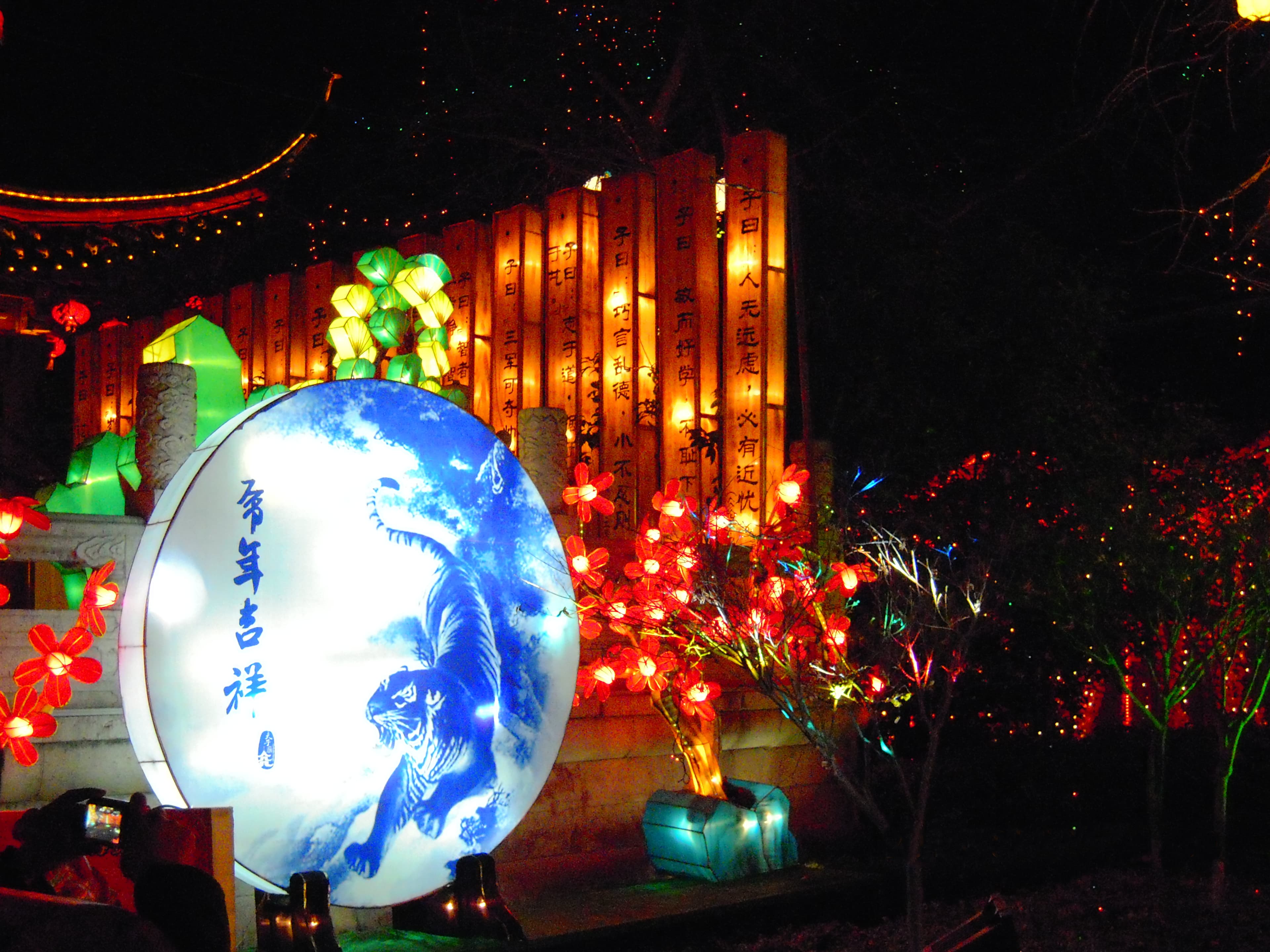
The Lantern Festival closes the Chinese New Year celebrations in a blaze of light. Together with Duanwu and the Mid-Autumn Festival, it forms the trio of great traditional Chinese festivals.
Duanwu in the south: a living festival#
While Duanwu is celebrated across China, it is in the southern provinces that the festival is most spectacular. The connection with water is natural: the Yangtze, the Pearl River, and the countless waterways of Jiangnan and Lingnan provide ideal racecourses.
In Hong Kong, the festival is an official public holiday and a major tourist event. The races at Stanley and Aberdeen draw teams from around the world. In Taiwan, the Lukang races are broadcast nationally. In Macao, Portuguese and Chinese traditions blend in a festival that combines dragon boats and Catholic processions.
In the villages of Hunan and Hubei, near the Miluo River where Qu Yuan drowned, the celebrations carry a special intensity. The villagers consider the poet their own, and the races there have an almost sacred dimension found nowhere else.
The Dragon Boat in the twenty-first century#
Today, Duanwu has been a national public holiday in China since 2008. The festival has become the occasion for a three-day break that the Chinese use to travel, visit family, or simply rest -- which, in a society where overwork is the norm, is no small thing.
Zongzi are now sold in supermarkets and online shops, in inventive flavours: chocolate zongzi, matcha, durian, cheese. Purists wince, but these innovations testify to the vitality of a tradition that knows how to reinvent itself without betraying its roots.
Learning Chinese also means discovering these festivals that punctuate the year and give texture to the calendar. The words zòngzi, lóngzhōu, Duānwǔ are not mere dictionary entries: they are gateways into a civilisation where a poet who died twenty-three centuries ago still sets the drums beating on the rivers.
FAQ#
When is the Dragon Boat Festival? On the fifth day of the fifth lunar month, generally between late May and late June in the Gregorian calendar. In 2026, it falls on May 31.
What are zongzi? Pyramids of sticky rice stuffed (with pork, salted egg yolk, red bean, jujube...) and wrapped in bamboo leaves, then steamed or boiled. Fillings vary by region: savoury in the south, sweet in the north.
Who was Qu Yuan? A poet and statesman of the kingdom of Chu (3rd century BCE), regarded as the first great poet of Chinese literature. He threw himself into the Miluo River to protest the fall of his kingdom, and the Dragon Boat Festival commemorates his memory.
Do dragon boat races exist outside China? Yes. The sport has gone international with more than 80 member countries in the International Dragon Boat Federation. Races are held in Europe, North America, and Oceania.
Photo credits: the images used in this article come from Wikimedia Commons under a Creative Commons licence.
The Lantern Festival: when China lights up the night
History and traditions of the Lantern Festival (元宵节) in China: lanterns, riddles, tangyuan, dragon and lion dances, the fifteenth night of the New Year.
Cover image: Wikimedia Commons · CC BY-SA 4.0