Vocaloid and Hatsune Miku: Japan's Synthetic Pop Revolution
The history of Vocaloid software, Hatsune Miku's rise as a virtual pop star, the creative community behind the phenomenon, and the cultural revolution of Japanese synthetic music.
La rédaction Kotoba
Studio éditorial
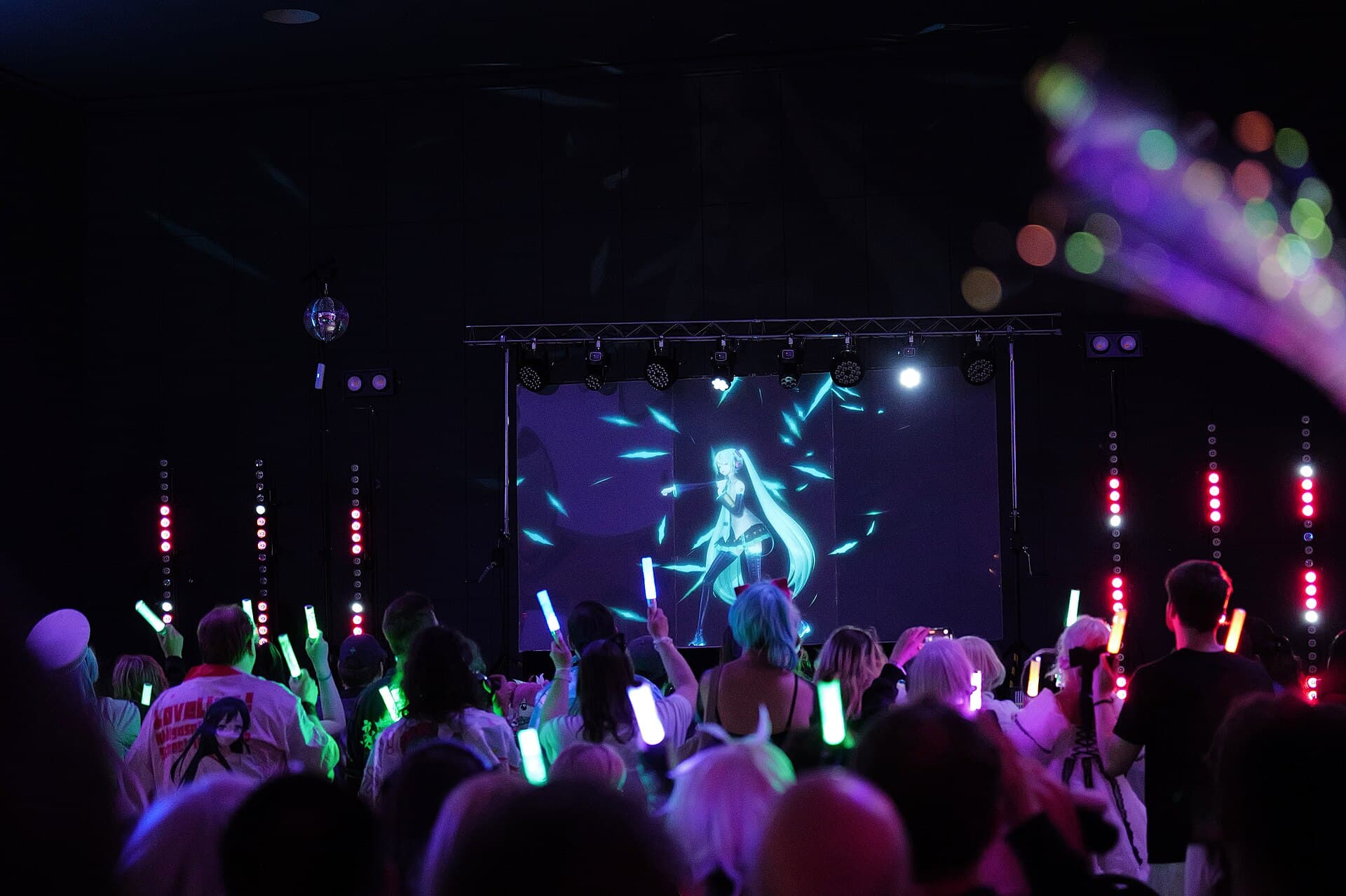
A figure with impossibly long turquoise pigtails takes the stage. Behind her, a live band plays. Before her, fifteen thousand fans wave glowing lightsticks in coordinated colors, singing along to every word. The energy is indistinguishable from any sold-out arena concert, with one staggering difference: the performer does not exist. No flesh, no bones, no breath. She is a beam of light projected onto a transparent screen, her voice generated by software, and she is one of the most recognizable pop icons to emerge from Japan in the twenty-first century. Her name is Hatsune Miku, and she is the face of Vocaloid.
How did a piece of voice synthesis software give birth to a virtual pop star capable of filling stadiums, accumulating hundreds of thousands of original songs, and inspiring a global creative movement? This is the story of a quiet revolution, born at the intersection of technology, participatory creation, and Japanese otaku culture.
What is Vocaloid?#
Vocaloid is a singing voice synthesis software developed by Yamaha Corporation. Its core principle is deceptively simple: a user inputs a melody and lyrics into an editor, and the software produces a synthetic singing voice using samples recorded from real human vocalists. The result is an artificial voice, endlessly adjustable, capable of performing any composition without a human singer ever setting foot in a recording booth.
The word Vocaloid is a portmanteau of vocal (voice) and android (a human-like machine). It refers both to the synthesis engine developed by Yamaha and, by extension, to the virtual characters associated with each voice bank. The term evokes the concept of an artificial singer: a voice without a body, a performer without a life.
The first version of the software was released in 2004. Yamaha chose not to sell voice banks directly; instead, the engine was licensed to third-party companies who created and marketed individual voices, each paired with an illustrated character. This open model would prove to be the key to everything that followed.
The earliest voices, LEON and LOLA (published by Zero-G, English-language) followed by MEIKO and KAITO (published by Crypton Future Media, Japanese-language), found a modest audience among amateur musicians. The technology was promising but stiff, the vocal quality limited. No one suspected what the second generation would bring.
Hatsune Miku: Birth of a Phenomenon#
On August 31, 2007, Crypton Future Media, a studio based in Sapporo, released the first voice in its new "Character Vocal" series for Vocaloid 2: . Everything changed.
The name 初音ミク (Hatsune Miku) breaks down into 初 (hatsu, first), 音 (ne, sound), and ミク (miku, future, written in katakana). Her name means "the first sound of the future." This poetic christening reads as a statement of intent: Miku embodies the sound of a new era, the first voice of a world where music no longer requires a human body to exist.
The character was designed by illustrator KEI: a sixteen-year-old girl with extremely long blue-green twintails, wearing a gray-and-black futuristic outfit with design elements reminiscent of a synthesizer (digital arm warmers, a pleated skirt patterned with keyboard motifs). The appearance was deliberately simple, almost generic, so that anyone could make her their own.
But what drove Miku's explosive success was not merely improved vocal quality. It was the licensing model: Crypton explicitly permitted non-commercial use of Miku by fans. Anyone could create a song, an illustration, a video, a story using the character. This decision transformed Miku from a mere product into a creative commons, a shared cultural property.
Within weeks, sales exceeded all expectations. Within months, thousands of original songs flooded the internet. Hatsune Miku ceased to be software. She became a movement.
The Creative Ecosystem: Niconico, Producers, and Fan Culture#
The soil in which the Miku explosion took root was , Japan's homegrown video platform launched in 2006. Unlike YouTube, Niconico displays viewer comments scrolling directly across the video in real time, creating a collective and reactive viewing experience. It was there that the first Vocaloid composers uploaded their works.
These creators call themselves . Their pseudonyms often carry the "-P" suffix: ryo (supercell), wowaka, DECO*27, kz (livetune), Hachi (now known as Kenshi Yonezu), PinocchioP, Mitchie M. Some were accomplished musicians; others were teenagers with no formal training who discovered composition through Miku.
Around each song, an entire ecosystem unfolds:
- Illustrators create visuals and PVs (promotional videos)
- Animators produce music videos in 2D or 3D (often using the free software MikuMikuDance)
- Cover singers perform the songs with their own voices (the utaite community)
- Dancers choreograph the songs and post their performances (the odottemita community)
- Writers create novels and stories around the characters
This is not a lone artist facing an audience: it is a creative network where every work generates others. A popular song can spawn dozens of covers, illustrations, remixes, and novelizations within days.
The software MikuMikuDance (MMD), created in 2008 by an amateur developer using the pseudonym "Yu Higuchi," allows anyone to create 3D animations featuring Vocaloid character models. Distributed for free, it became one of the most widely used amateur animation tools in the world, generating millions of videos and a thriving 3D modeling community that extends far beyond Vocaloid itself.
The rhythm game Project DIVA, launched by SEGA in 2009 on the PSP, anchored Miku in gaming culture. The series became a commercial pillar, introducing Vocaloid songs to players who had never encountered the online scene.
Live Concerts: When the Virtual Fills Stadiums#
In 2009, Hatsune Miku gave her first live concert in Saitama, projected onto a transparent screen using rear projection technology (commonly called a "hologram" though it is technically a variant of Pepper's Ghost). Behind the screen, a real band performed live. Before it, the audience reacted as they would to any flesh-and-blood performer: screaming, applauding, waving synchronized lightsticks.
The event was a cultural shock. A singer who does not exist, on stage, before a real audience experiencing real emotions. The question it raised was dizzying: what is a performer, if you can weep before a projection?
Since then, the concerts have multiplied and grown. The annual festival, held since 2013, draws tens of thousands of attendees to each edition, combining holographic concerts with exhibitions. Miku has also performed internationally: Los Angeles, New York, Paris, London, Jakarta, Taipei. In 2014, she opened for Lady Gaga on a North American tour.
At Miku concerts, the color of the audience's lightsticks is not random. Each Vocaloid character has an assigned color: blue-green for Miku, yellow and orange for the Kagamine twins, pink for Luka, blue for KAITO, red for MEIKO. The audience switches colors depending on which character is "singing," creating a coordinated visual wave across the entire venue.
Cultural Impact: The Democratization of Music#
Hatsune Miku and Vocaloid represent far more than a technological novelty. They embody a major cultural shift: the radical democratization of music creation.
Before Miku, composing a song with sung lyrics required either singing yourself or finding a vocalist willing to collaborate. Vocaloid removed that barrier entirely. A shy composer, a guitarist without a singing voice, a high school student with no budget could now produce and publish a complete song. This liberation revealed talents that would never have emerged through the traditional gatekeeping of the music industry.
The ethos is profoundly DIY: no record labels, no auditions, no filters. Quality alone decides. The most popular Vocaloid songs have accumulated tens of millions of views without a single yen spent on promotion by any label. Success comes from the community: listeners share, remix, create derivative works, and digital word-of-mouth does the rest.
Several Vocaloid producers have become major artists in Japan's mainstream music scene: Kenshi Yonezu (formerly Hachi) is now one of the most-streamed musicians in the country; ryo (supercell) composes for major artists and anime; kz (livetune) produces for real-world idol groups. For an entire generation, Vocaloid served as both a school and a launching pad.
Miku is not an artist. Miku is an instrument, and that instrument allowed thousands of people to discover that they were artists.
Beyond Miku: Other Voices of the Vocaloid Universe#
While Miku is the flagship, she is far from alone. The Vocaloid universe encompasses dozens of characters, each with a distinct voice, design, and personality shaped by their creative community.
, released in December 2007, are presented as fourteen-year-old "mirror twins." Rin possesses a bright, energetic voice; Len has a soft, versatile boy's voice. Together, they enable duets and narrative dialogues that a single voice cannot achieve.
, released in 2009, was Crypton's first bilingual Japanese-English voice. Her deeper, more mature timbre broadened the palette considerably.
KAITO and MEIKO, Crypton's two pre-Miku voices, were redesigned and relaunched on the wave of their successors' popularity. KAITO, with his gentle male voice, became a fan favorite.
Outside of Crypton, other publishers produced landmark voices: GUMI (Megpoid, by Internet Co.), with a warm, natural tone; IA, whose voice is based on singer Lia; Flower, with an androgynous, rock-leaning voice; VY1 and VY2, voices without associated characters, designed for purists who wanted a neutral canvas.
The total number of original songs published using Vocaloid voices exceeds one million. Niconico alone hosts over 500,000 videos tagged "Vocaloid." This corpus makes the Vocaloid community one of the largest collaborative music creation movements in recorded history, dwarfing the output of most traditional music labels.
The Future: AI Voice Synthesis and What Comes Next#
Vocaloid opened the door, but technology did not stand still. Since the late 2010s, new voice synthesis engines have emerged, built on deep learning and artificial intelligence:
Synthesizer V (SynthV), developed by Dreamtonics, produces voices of startling realism, sometimes indistinguishable from a human singer. The software allows for nuances of expression, breath, and emotion that far surpass the capabilities of the original Vocaloid engine.
CeVIO AI and VoiSona use neural networks to reproduce the subtleties of human singing, including vibrato, falsetto transitions, and emotional coloring. NEUTRINO, free and open-source, makes AI vocal synthesis accessible to anyone with a computer.
Crypton Future Media itself launched Piapro NT, the successor to its historic Vocaloid lineup, with a proprietary engine. The Hatsune Miku brand now transcends the Vocaloid software in the strict sense: Miku has become a cultural icon independent of the technology that gave her birth.
The question looming over this world is one of identity in the age of generative AI. When voice synthesis becomes indistinguishable from reality, when an AI can compose and sing simultaneously, will the Vocaloid model, built on human creators using machines as tools, remain relevant? For now, the community answers yes: what gives Miku her value is not her voice alone, but the human network that creates through her.
FAQ#
What is Vocaloid? Vocaloid is a singing voice synthesis software developed by Yamaha Corporation. It allows users to create songs with an artificial singing voice by inputting melody and lyrics. Each voice bank is associated with an illustrated character.
Who is Hatsune Miku? Hatsune Miku (初音ミク) is a virtual character and voice bank for Vocaloid, created by Crypton Future Media in 2007. Her name means "the first sound of the future." She has become a virtual pop star, performing holographic concerts and inspiring hundreds of thousands of original songs.
Are Miku's concerts real holograms? Technically, no. The concerts use rear projection onto a transparent screen, a variant of Pepper's Ghost. The visual effect is spectacular but does not constitute a hologram in the scientific sense. The band accompanying Miku on stage, however, is entirely real.
Can anyone use Miku to create music? Crypton permits non-commercial use of Miku and her image by fans (under a Creative Commons-style license for the character, with a separate software license for the voice). Commercial use requires specific authorization.
What is the difference between Vocaloid and Synthesizer V? Vocaloid uses a concatenative synthesis engine (stitching together pre-recorded samples), while Synthesizer V relies on deep learning to produce more realistic and expressive voices. Both allow users to create songs with synthetic vocals, but SynthV represents the newer generation of the technology.
Read alsoCity Pop: The Global Revival of a Forgotten SoundThe Vocaloid phenomenon shares a common thread with the city pop revival: Japanese music that, through the power of the internet and online communities, transcended its national borders to reach a worldwide audience hungry for something different.
Credits: information compiled from public sources. Yamaha Corporation, Crypton Future Media. Images under free license or placeholder.
In this article
The cultural terms covered here, each with a short definition.
- Otaku
- Devoted fan of manga, anime or games, and the subculture built around that passion.
Cosplay: From American Sci-Fi to Japanese Pop Culture Phenomenon
From 1930s American science fiction conventions to a multi-billion dollar global phenomenon, the complete history of cosplay, its Japanese transformation, major events, and worldwide cultural impact.
Cover image: Wikimedia Commons contributor · Wikimedia Commons · CC BY 4.0