Chinese tea: a journey through the six families
Guide to Chinese tea and its six great families: green, white, yellow, oolong, red and dark. Gongfu cha, terroirs, preparation and the culture of tea in China.
La rédaction Kotoba
Studio éditorial
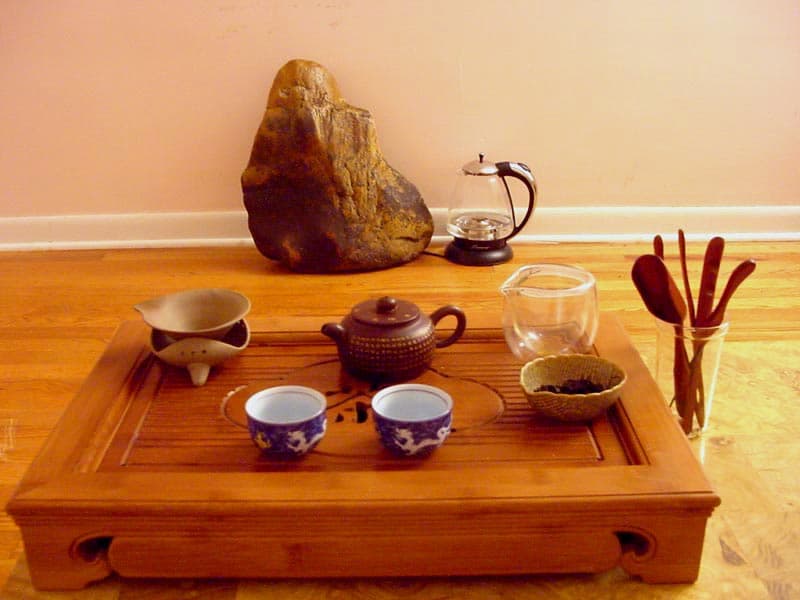
The water shimmers, not yet boiling. The hand pours a first stream over the curled leaves, which awaken in the purple clay teapot like flowers in slow motion. This first infusion is discarded: it is a greeting to the leaf, an awakening, not a drink. The second cup releases a fragrance of orchid and damp forest that lingers in the air long after the last sip. You do not drink Chinese tea: you meet it.
was born in China, and it is in China that it has reached its greatest complexity. Where the Western world knows mainly bagged black tea, Chinese tradition classifies its teas into six great families according to the degree of oxidation of the leaves, a taxonomy that opens a universe of flavours as vast as that of wine. To understand Chinese tea is to accept that a few dried leaves can contain an entire landscape.
The six colours of tea#
The Chinese classification of tea rests on a simple principle: the degree of oxidation of the leaf after picking. From the freshly plucked leaf quickly stabilised by heat to the leaf slowly fermented by micro-organisms, six families emerge.
is the oldest and the most drunk in China. The leaves are heated very quickly after picking to halt all oxidation, preserving their green colour and vegetal freshness. , from Hangzhou, with its flat shape and taste of roasted chestnut, is the most celebrated of Chinese green teas.
, barely processed, is the most delicate. Its young buds, covered in fine silver down, are simply withered then dried. and from Fujian are the jewels: teas of floral sweetness and an almost ghostly paleness in the cup.
Chinese tea is not classified by taste, but by transformation: it is the work of human hands upon the leaf that creates the family, and each family opens a world.
From yellow to red: the spectrum of oxidations#
is the rarest of the six. It undergoes a unique process called menhuang (闷黄, "sealed yellowing"), where heated leaves are wrapped in damp cloth, causing a gentle enzymatic oxidation that softens the bitterness of green tea. , from Junshan Island on Lake Dongting, is a treasure that has become almost impossible to find.
occupies the vast territory between green and red, with partial oxidation ranging from 15 to 85 per cent. It is the tea of virtuosi: depending on cultivar, terroir and degree of oxidation, an oolong can evoke osmanthus blossom, fresh butter, roasted peach or sandalwood. The great oolongs of Fujian (Tieguanyin, Da Hong Pao) and Taiwan (Dong Ding, Ali Shan) rank among the world's most admired teas.
— what the West calls "black tea" — is fully oxidised. Its leaves roll between the fingers and turn dark copper, yielding an amber, round, malty liquor. from Anhui and from Yunnan are among the finest. It was Chinese red tea, exported to Europe in the seventeenth and eighteenth centuries, that gave birth to Western tea traditions.
breaks down graphically into three elements: 艹 (grass) on top, 人 (person) in the middle, 木 (tree) at the bottom. The person between the grass and the tree: tea as a link between nature and humankind. This character, adopted the world over in its variants (chai, tea, cha), is one of the most widely travelled Chinese words.
Pu'er: the tea that ages like wine#
— note, "dark" in the Chinese sense, distinct from Western "black tea" — is a post-fermented tea whose most famous representative is from Yunnan. Here, the leaf undergoes the action of micro-organisms that transform it over months and years, exactly as a cheese ripens.
Pu'er comes in two forms: , pressed into cakes and aged naturally for decades, and , whose fermentation is accelerated by a process invented in the 1970s. A thirty-year-old sheng pu'er develops notes of forest floor, leather, dates and humus, with a sweetness and depth that justify collector prices. Pu'er is the only tea that improves with age, and old cakes are traded like grand crus.
Read alsoThe Silk Road: the history of a network that linked two worldsTea travelled far beyond China's borders along the same routes as silk. The Tea and Horse Road, linking Yunnan to Tibet, was one of Asia's oldest trade routes.
Gongfu cha: the art of patient infusion#
The Chinese way of preparing tea looks nothing like a bag tossed into a mug. is a concentrated brewing method, practised above all in Fujian and Guangdong, that uses a small clay teapot, tiny cups and multiple very short infusions.
The principle is simple: many leaves, little water, infusions lasting a few seconds. Each pour reveals a different facet of the tea, and a good leaf can withstand ten, fifteen, twenty infusions. The first unveils the surface aroma; the third or fourth often reaches the tea's heart; the last offers a rearguard sweetness, like a long farewell. Gongfu cha is not a formal ceremony, but a daily art of attention.
The Yixing teapot deserves a word of its own: shaped from a porous purple clay (zǐshā, 紫砂), it absorbs tannins over the years and "seasons" like a cast-iron pan. An old, well-tended teapot yields a better tea than the same teapot new. You never wash it with soap. You feed it with tea, and it repays you.
Tea in Chinese life#
Tea is far more than a drink in China: it is a social language. Offering tea to a guest is an elementary act of hospitality. During a Cantonese dim sum meal, diners discreetly tap two fingers on the table when someone pours them tea — a silent thank-you whose origin traces back, legend says, to the Emperor Qianlong disguised as a traveller. In the teahouses of Sichuan, people spend afternoons sipping jasmine tea while playing cards or mahjong.
Tea also permeates traditional medicine, poetry and philosophy. , author of the Classic of Tea (Chájīng, 茶经) in the eighth century, the world's earliest known treatise on the subject, elevated tea preparation to an art of living. Centuries later, tea remains this gateway to Chinese culture, a liquid that holds a landscape, a craft and a philosophy. To learn Chinese is also to savour these words, chá, gōngfu, yìxīng, which say that in China the art of living begins with a leaf in water.
FAQ#
How many families of tea are there in China? Chinese classification distinguishes six great families: green (绿茶), white (白茶), yellow (黄茶), oolong (乌龙茶), red (红茶, the Western "black tea") and dark (黑茶, post-fermented tea like pu'er). They differ by the degree of leaf oxidation.
Why is Chinese "dark tea" not Western "black tea"? In China, red tea (红茶, hóngchá) corresponds to Western "black tea," fully oxidised. Chinese "dark tea" (黑茶, hēichá) refers to post-fermented teas like pu'er, a category almost unknown in the West. The confusion stems from a historical translation error.
What is gongfu cha? A concentrated brewing method using a small teapot, many leaves and multiple very short infusions. Each pour reveals a different facet of the tea. The word gongfu (功夫) means "mastery acquired through effort."
Does pu'er really age like wine? Yes. Sheng (raw) pu'er pressed into cakes improves over time through slow microbial fermentation. Cakes several decades old develop complex flavours and are traded at high prices, like fine wines.
Photo credits: the images used in this article come from Pexels and Unsplash and are royalty-free.
Chinese Tea and Gongfu Cha: The Ancient Art of Brewing
The history of Chinese tea and gongfu cha: the legend of Shennong, Lu Yu's Classic of Tea, the six great families, the Yixing teapot and the art of infusion.