Gachapon: Japan's Capsule Toy Culture
The history and culture of gachapon, Japan's capsule-toy machines. Onomatopoeic origins, Bandai, Kaiyōdō, Fuchiko, and an industry worth hundreds of billions of yen.
La rédaction Kotoba
Studio éditorial
A hundred-yen coin drops into the slot with a metallic click. You grip the plastic crank, cold under your fingers, and turn it: gacha, gacha. Somewhere in the belly of the machine, dozens of clear capsules jostle, then one tips over, rolls down the chute and falls, pon, into the tray. You don't yet know which of the eight figures in the series you've just won. That half-second of not knowing, that tiny suspense, is exactly the product you paid for.
The , also written , is not a toy: it is a ritual, an economy, and an aesthetic. Behind the childlike act of cranking a handle lies a Japanese industry worth hundreds of billions of yen, a tradition of miniaturization elevated to an art, and a mechanics of chance so finely tuned that it has rewired the brains of generations of collectors. This is the story of an American import that became, in half a century, one of the most instantly recognizable languages of Japanese popular culture.
Gacha, pon: a name born from the sound of the machine#
The word "gachapon" is pure onomatopoeia, forged from the two sounds the machine makes. mimics the mechanical grinding of the crank as you turn it; reproduces the dull thud of the capsule dropping into the tray. Japanese, a language rich in thousands of and , words that imitate sounds and states, simply named the object after the sonic experience it delivers.
Both variants coexist, and their usage marks a commercial boundary. registered "Gashapon" (ガシャポン) as a trademark in 1988, so the term legally belongs to the company. The wider public tends to say "gachapon," the generic, unprotected form. The neutral, official name for the category remains , literally the "capsule toy." In the everyday speech of the 2010s and 2020s, the shortened drifted into meaning any random-draw mechanic at all, video games included, as we'll see.
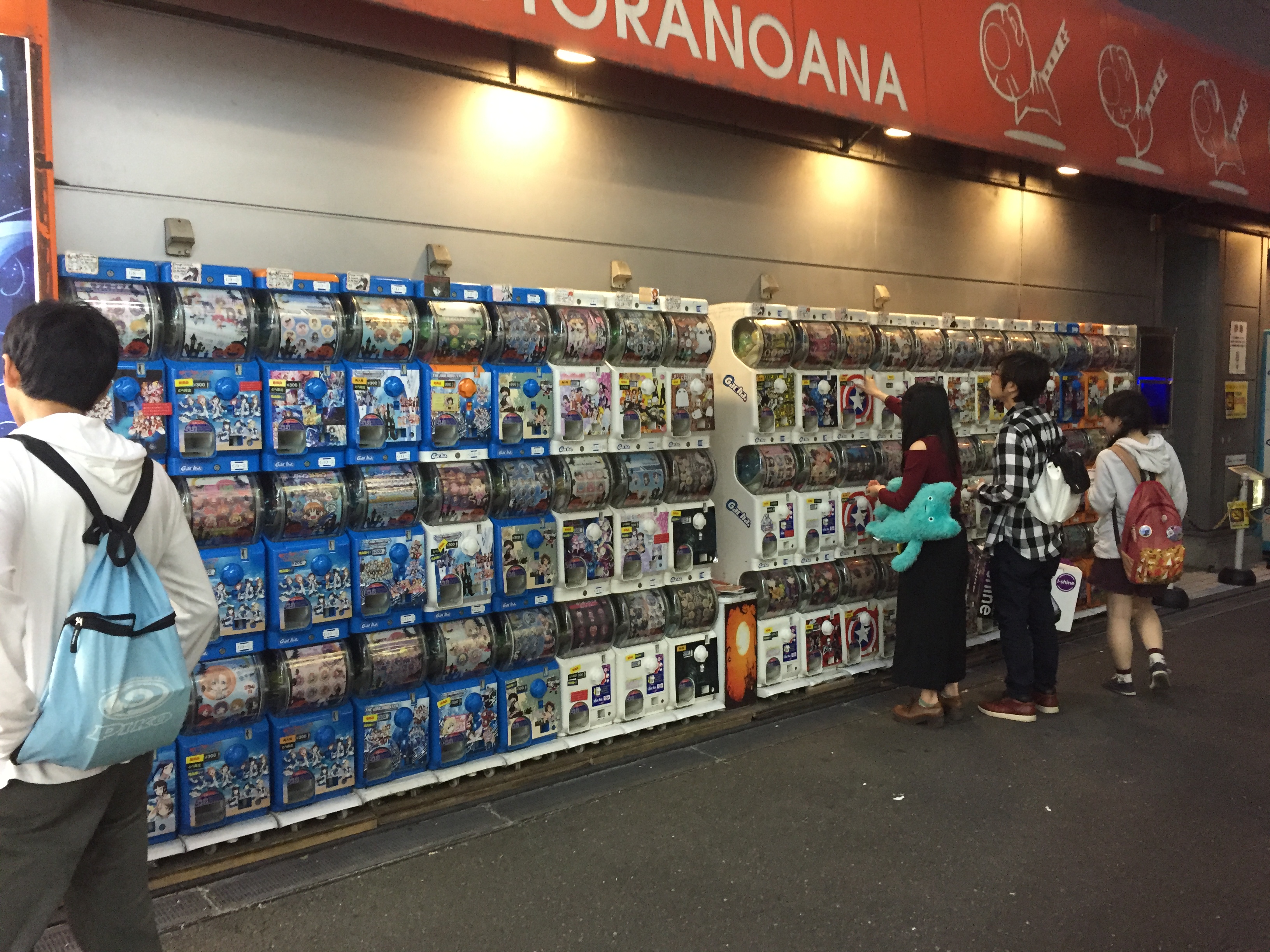
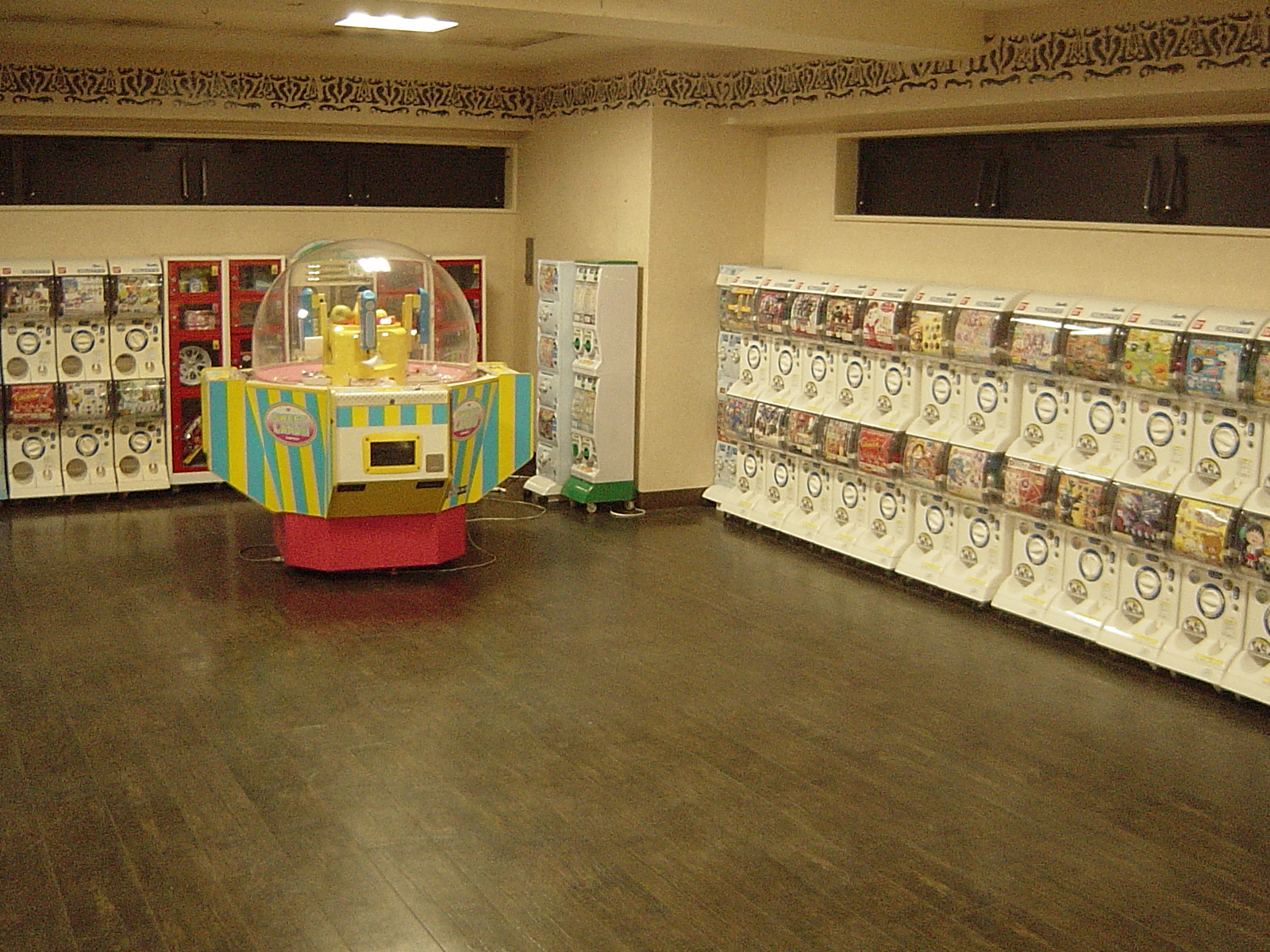
The object itself is disarmingly simple: a column of clear plastic, a coin slot, a crank, a flap. Inside, spherical capsules, usually 45 to 75 millimeters across, each hold a figure, an accessory, or a small gadget, most often with a folded leaflet and a list of the full series. The whole art lies in turning this banal container into a promise.
From an American gumball to an Ōsaka sidewalk#
The gachapon descends in a straight line from American vending machines for candy and trinkets. In the United States, gumball machines, those glass globes dispensing chewing-gum balls for a penny, had been widespread since the late 19th century, and by the 1930s and 1940s variants offered small toys or rings sealed inside capsules. It was this model, the capsule vendor, that Japan imported.
The introduction to Japan is traditionally credited to and his company Penny Co., which, around 1965, brought over American capsule machines and set them up outside sweet shops and , the cheap candy stalls where children spent their pocket money. The first capsules held rudimentary toys sold for ten yen. The format, one coin, one crank, one surprise, fit perfectly into the social life of Japanese childhood.
The industrial turning point came in 1977, when Bandai entered the market and gave structure to what had been a sideline trade. The company standardized the machines, professionalized distribution, and in 1988 launched the Gashapon brand. Where Penny Co. had planted the seed, Bandai built a pipeline: licenses, themed series, quality control, a nationwide machine network. Within a few years the capsule toy stopped being a sidewalk novelty and became an editorialized product, conceived in collections.
Americans invented the machine. The Japanese invented what went inside it, and the reason to come back.
The mechanics of chance: turn, not know, repeat#
The principle of a gachapon comes down to a loop: insert the coin, turn the crank, receive a capsule of unknown contents drawn from a series. That series is the heart of the device. A given theme (say a cat's poses, an anime character's expressions, the species in an aquarium) is split into five, eight, sometimes twelve variants sold under a single machine, all at the same price. The player doesn't choose: they accept the randomness.
The psychology is plain and ruthless. Because you don't know what you'll get, every turn sustains the hope of the missing piece. Manufacturers cultivate this tension through programmed rarity: certain figures, the rares or , don't even appear on the posted list and turn up only at very low frequency. A collector chasing the full set might crank the handle ten times and gather three duplicates before flushing out the coveted piece.
This fertile frustration has a virtuous communal flip side: trading. Duplicates change hands among friends, at secondhand markets, at conventions, rebuilding a small social economy around the object. The capsule itself, once emptied, is reused, collected, or repurposed as a miniature coin purse. Nothing in the ritual is ever quite wasted, except, perhaps, your resolve to stop after one turn.
Kaiyōdō and the quality leap: when the miniature became art#
The great aesthetic shift of the gachapon was the work of a model-making studio turned legend: . Founded in 1964 in Moriguchi, near Ōsaka, this house specialized in precision figures and, at the turn of the 1990s and 2000s, transferred its sculptors' craft into the capsule format, lifting the machines' contents from rough gadget to near-museum-grade miniature.
Kaiyōdō's sculptors, chief among them , a revered figure in the field, brought exact anatomy, nuanced paintwork, dynamic poses. The emblematic series of this revolution is the , launched in 1999 with confectioner Furuta: chocolate eggs holding an astonishingly realistic animal figure. The success blurred the line between toy and adult collectible, and placed Japan at the global forefront of the miniature figure.
This shift belongs to a wider category, the , a contraction of shokuhin gangu (食品玩具), the "food toy": a toy sold alongside a token sweet to work around certain rules on selling toys. Gachapon and shokugan share the same obsession: to pack, into a few centimeters, a density of detail that compels respect.
A bestiary of collaborations: from Pokémon to the rim of a cup#
Today, almost the entire Japanese and global pop imagination passes through the capsule. Gachapon cover a dizzying range of licenses and themes, because the object has become a promotional and emotional vehicle as powerful as it is cheap.
The big licenses#
Major franchises reign here: , whose capsule figures have accompanied the brand since its earliest days; the characters of , from Hello Kitty to Gudetama; the anime and heroes published by Bandai, from Ultraman to miniature Gundam. Studios, publishers, and brands see the gachapon as an ideal channel: low unit cost, strong collecting pull, a physical presence on the street and in train stations.
Fuchiko and the Putitto, the genius of the twist#
The most inventive find of the 2010s was , full name , launched in 2012 by Kitan Club. The idea: a figure of an office worker in uniform designed to perch on the edge of a cup, glass, or screen, in absurd poses: dangling, lying down, balancing. The success was phenomenal, millions of units sold, and it spawned a whole category of "rim" figures, of which the series remains the other big name.
Museums and the animal kingdom#
The gachapon has also been put to the service of knowledge. Japanese institutions offer series reproducing works of art, natural-history specimens, or anatomically rigorous animals: sleeping cats, capybaras, octopuses, endangered species. The machine then becomes a miniature teaching object, extending the Kaiyōdō tradition of zoological realism.
Kawaii, chance, and the miniature: why it works#
The cultural force of the gachapon lies in the meeting of three deeply Japanese drivers: a taste for , a fascination with miniaturization, and the pleasure of controlled chance. None of these three pillars is incidental; together they explain why a salaried adult stops, briefcase in hand, before a row of machines on the way to catch a train.
The miniature holds a singular place in Japanese aesthetics, from the carved of the Edo period to bonsai and on to contemporary scale models: to shrink the world is to master it, contemplate it, possess it in the palm. The gachapon inherits this long lineage. As for kawaii, codified as the dominant aesthetic since the 1970s, it makes the capsule desirable quite apart from any usefulness.
The gachapon sells an emotion in three beats: the wait before the turn, the surprise of the capsule, and the quiet pride of a collection that grows.
Above all, the audience has changed. While children remain customers, it is now adults who drive the economy: nostalgic thirty- and forty-somethings, methodical collectors, tourists hunting a quintessential souvenir. The gachapon is one of the few pleasures where spending a hundred to five hundred yen delivers an immediate, tangible, commitment-free reward.
The retail ecosystem: from stations to capsule department stores#
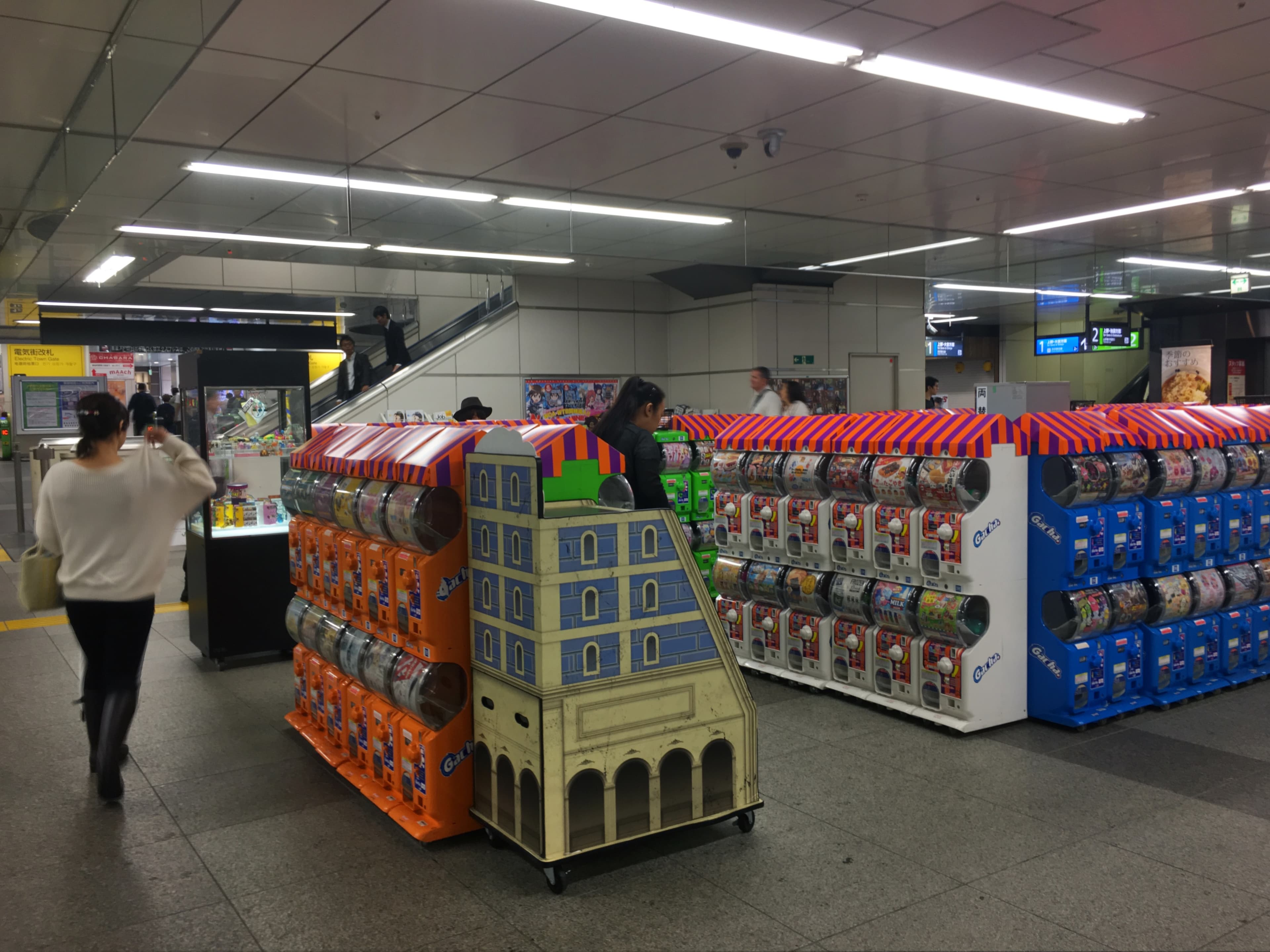
The gachapon is no longer a sidewalk trade but a structured retail network, deployed wherever crowds pass. The machines colonize supermarket entrances, shopping malls, airports, where they conveniently help travelers offload their last yen coins before boarding, and, above all, spaces given over entirely to them.
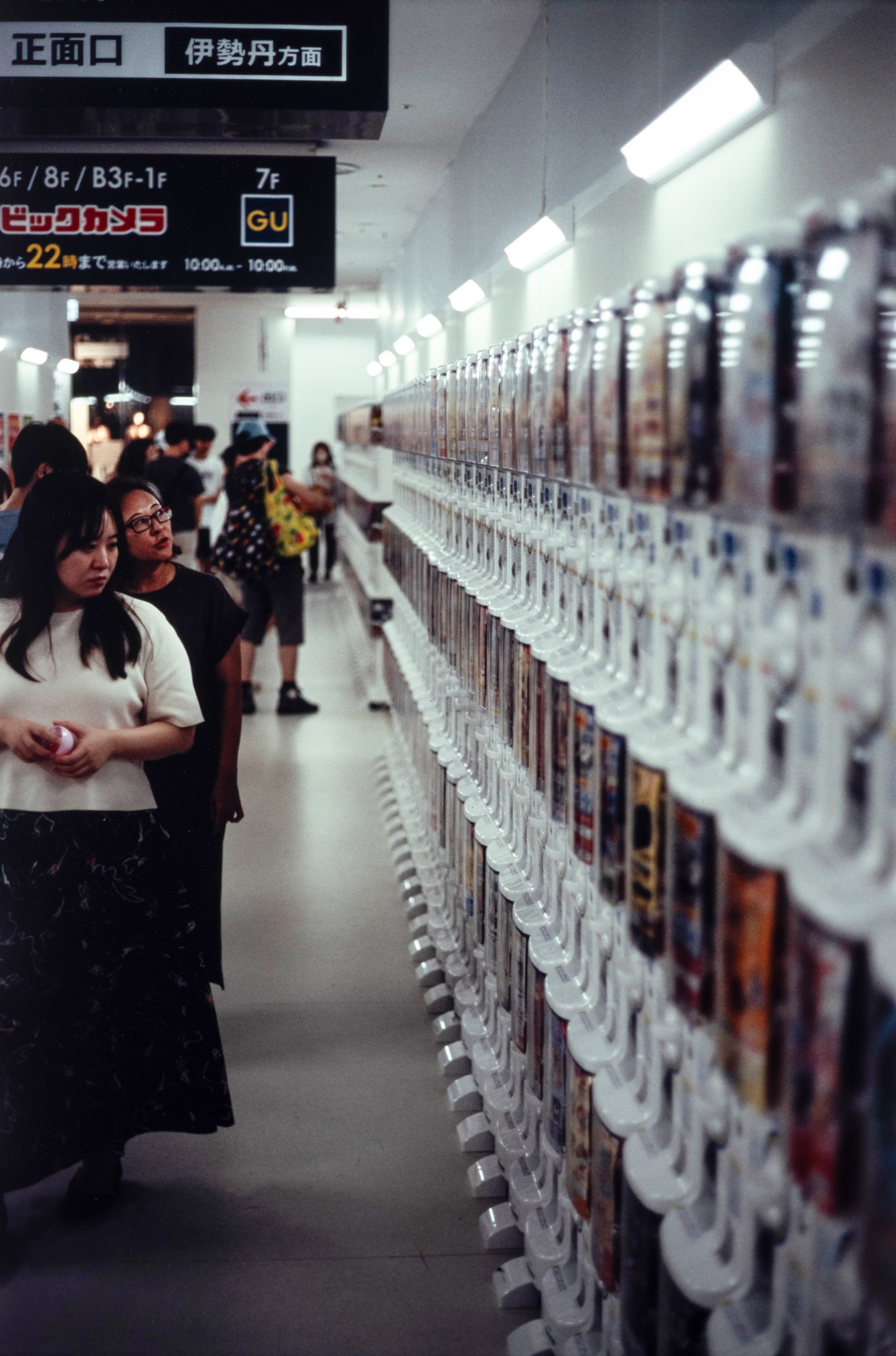
Bandai runs the , official stores gathering hundreds of machines under one roof. The most spectacular, the Gashapon Department Store in Ikebukuro (Sunshine City, Tōkyō), which opened in 2020, lined up more than 3,000 machines on a single floor at launch, instantly becoming a place of pilgrimage for enthusiasts and a backdrop for social media. The visual density of these capsule walls, thousands of colored globes as far as the eye can see, is an experience in itself.
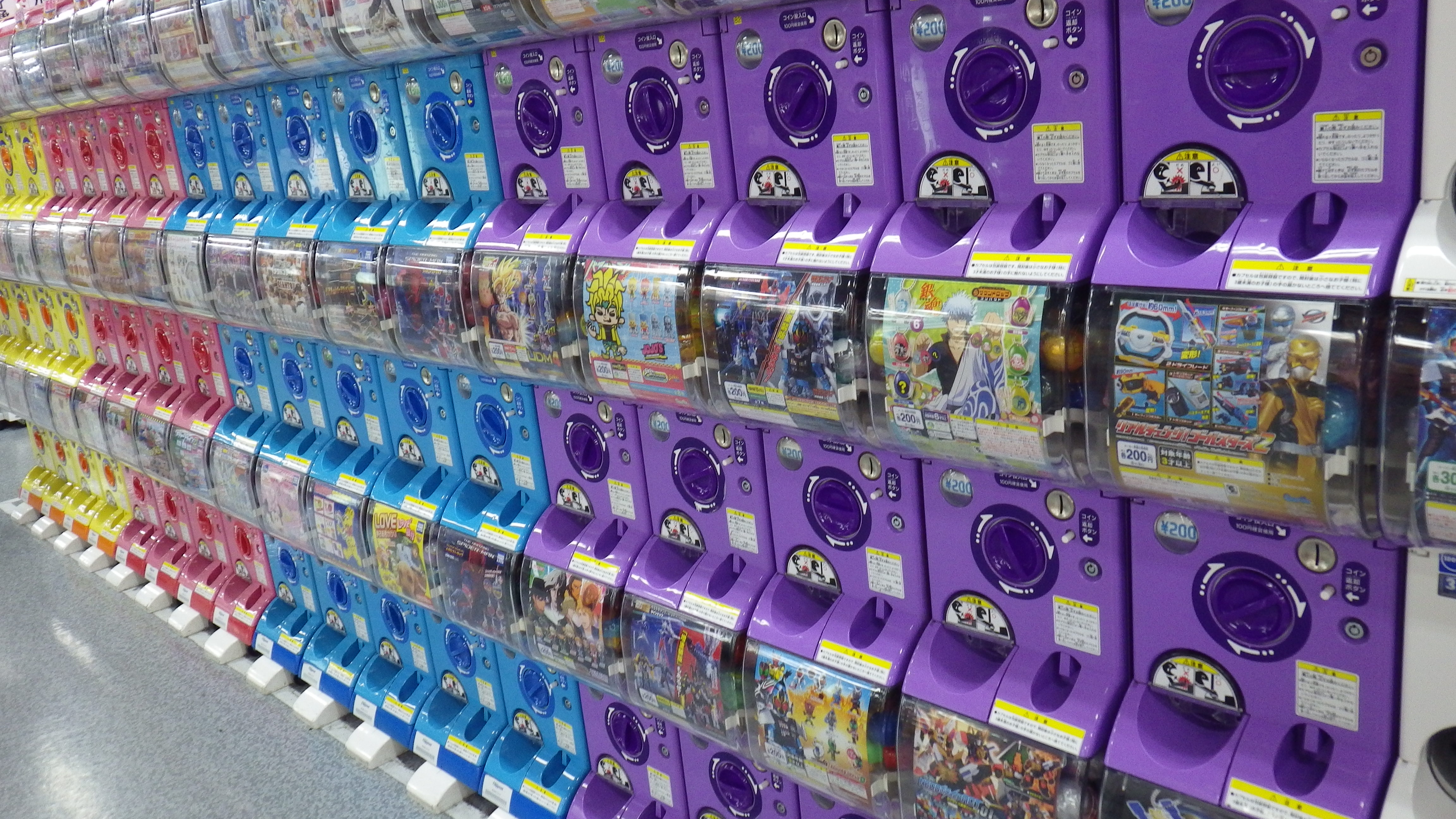
Tourism has seized on the phenomenon. Guidebooks recommend these temples of the capsule alongside shrines, and travelers find in them a souvenir at once cheap, quintessentially Japanese, and Instagrammable. This tourist dimension helped make the capsule-toy market one of the most dynamic segments of the Japanese toy sector in the 2020s, driven by endlessly renewed series and prices climbing toward three to five hundred yen for the most elaborate figures.
Gachapon versus gacha: the capsule and the screen#
There is a deceptive kinship between the physical gachapon and the gacha of video games, and the two must not be confused. The term "gacha" used in mobile games, where you spend real or virtual money to draw a character or item at random, comes directly from the gachapon's onomatopoeia, imitating its mechanic of paid random draw.
The lineage is real, but the stakes differ radically. The gachapon hands you a physical, finished object whose maximum value is known, namely the complete set. The video-game gacha, by contrast, can sustain spending with no ceiling, monetize opaque probabilities, and aim at far more addictive engagement loops, to the point where several countries have legislated on the transparency of draw rates. Where the capsule stops at the machine's flap, the screen never closes. To understand the gachapon is also to grasp where this now-ubiquitous gaming vocabulary came from.
The flip side of the capsule: the plastic question#
The ecological downside of the gachapon has become impossible to ignore. Every turn produces a plastic shell meant, at best, to be kept, but most often thrown away: hundreds of millions of capsules circulate, and the environmental critique targets both the packaging and the figures themselves, made of plastics that are hard to recycle.
The sector has begun to respond. Manufacturers are experimenting with capsules in recycled or biodegradable materials, collection bins are appearing beside machines to reuse empty shells, and some shops encourage their return. These efforts remain modest against the volume produced, and the tension between the disposable pleasure of the capsule and the demand for sustainability is one of the industry's open challenges. An object designed for fleeting surprise must now learn to last.
The capsule as a mirror of a civilization#
In half a century, the gachapon has gone from imported gumball to museum sculptor, from an Ōsaka sidewalk to the three thousand machines of Ikebukuro. It has domesticated chance, miniaturized the world, and turned a hundred-yen coin into a flash of joy reproducible without end.
What the capsule contains matters less than what it reveals: a country that knows how to pack, into a plastic sphere no bigger than an egg, its obsession with detail, its cult of the cute, its tenderness for small things, and its genius for turning a trivial gesture into ceremony. The next time you hear the gacha, gacha of a crank followed by the pon of a falling capsule, consider that this tiny sound sums up an entire way of life.
Is the gachapon just for children? No, and these days it's almost the opposite. Adults, whether collectors, the nostalgic, or tourists, are the market's main engine, drawn by sophisticated series, prestige collaborations, and figures with the quality of sculpture.
What's the difference between gachapon and gashapon? None in substance: they are two onomatopoeias for the same object. "Gashapon" is a trademark Bandai registered in 1988; "gachapon" is the generic form used by the public. The official category name is kapuseru toi (capsule toy).
Where can you find gachapon in Japan? Everywhere: outside supermarkets, in malls, train stations, and airports. For sheer abundance, head to Bandai's official shops and the Gashapon Department Store in Ikebukuro, which lines up several thousand machines.
Is the gachapon related to video-game gacha? Yes in name and in the random-draw mechanic, but no in its stakes. The gachapon delivers a physical object with a capped value, whereas the video-game gacha can drive limitless spending on digital probabilities.
In this article
The cultural terms covered here, each with a short definition.
- Cup no Fuchiko
- Tiny office-lady figurine designed to perch on the rim of a cup, a gachapon hit.
- Gachapon
- Vending machine dispensing toys in capsules, and the toys themselves; named for its turning sound.
- Gashapon
- Bandai's trademark spelling of gachapon capsule-toy machines.
- Kaiyodo
- Japanese company famed for highly detailed collectible figures.
- Kawaii
- Japanese aesthetic of "cuteness," pervasive in pop culture and design.
Sanrio and Hello Kitty: The Global Empire of Japanese Kawaii
From silk to Hello Kitty through Kuromi, Cinnamoroll and My Melody, the history of Sanrio, the Japanese company that invented the economy of kawaii.