Blue and white porcelain: China's fragile treasure
History of Chinese blue and white porcelain: Jingdezhen, cobalt, Yuan and Ming dynasties, kraak ware, export to Europe and a living legacy.
La rédaction Kotoba
Studio éditorial
The piece fits in the palm, light as an eggshell. Hold it up to the light and the translucent wall reveals the shadow of a dragon painted on the reverse: the cobalt blue has passed through the glaze and frozen in the material, forever. This cup is seven centuries old. It is intact. That is the miracle of Chinese blue and white porcelain: an art so accomplished that time no longer dares touch it.
is arguably the most recognisable Chinese art object in the world. From the Middle East to Europe, from Africa to Japan, these white pieces adorned with blue motifs circulated by the million, becoming the first globalised luxury product in history. To understand blue and white porcelain is to follow the thread of a trade that wove the world together.
Jingdezhen: the porcelain capital#
It all begins at , a city in Jiangxi that the Chinese still call "the porcelain capital" (瓷都, cídū). The site offered perfect conditions: deposits of , abundant wood for the kilns, and the Chang River for transporting cargo. By the Tang (618-907), Jingdezhen was producing ceramics, but it was under the Song (960-1279) that its kilns reached a quality that attracted imperial commissions.
Porcelain, fired above 1,280 °C, stands apart from all other ceramics by its whiteness, hardness and translucency. Europe would not crack the secret until the eighteenth century, at Meissen. For centuries, the English word "china" meant porcelain itself, so inseparable were the object and the country.
Blue and white porcelain does not display wealth: it displays mastery. The glow of blue on white is a lesson in restraint as much as in boldness.
Cobalt and the birth of blue#
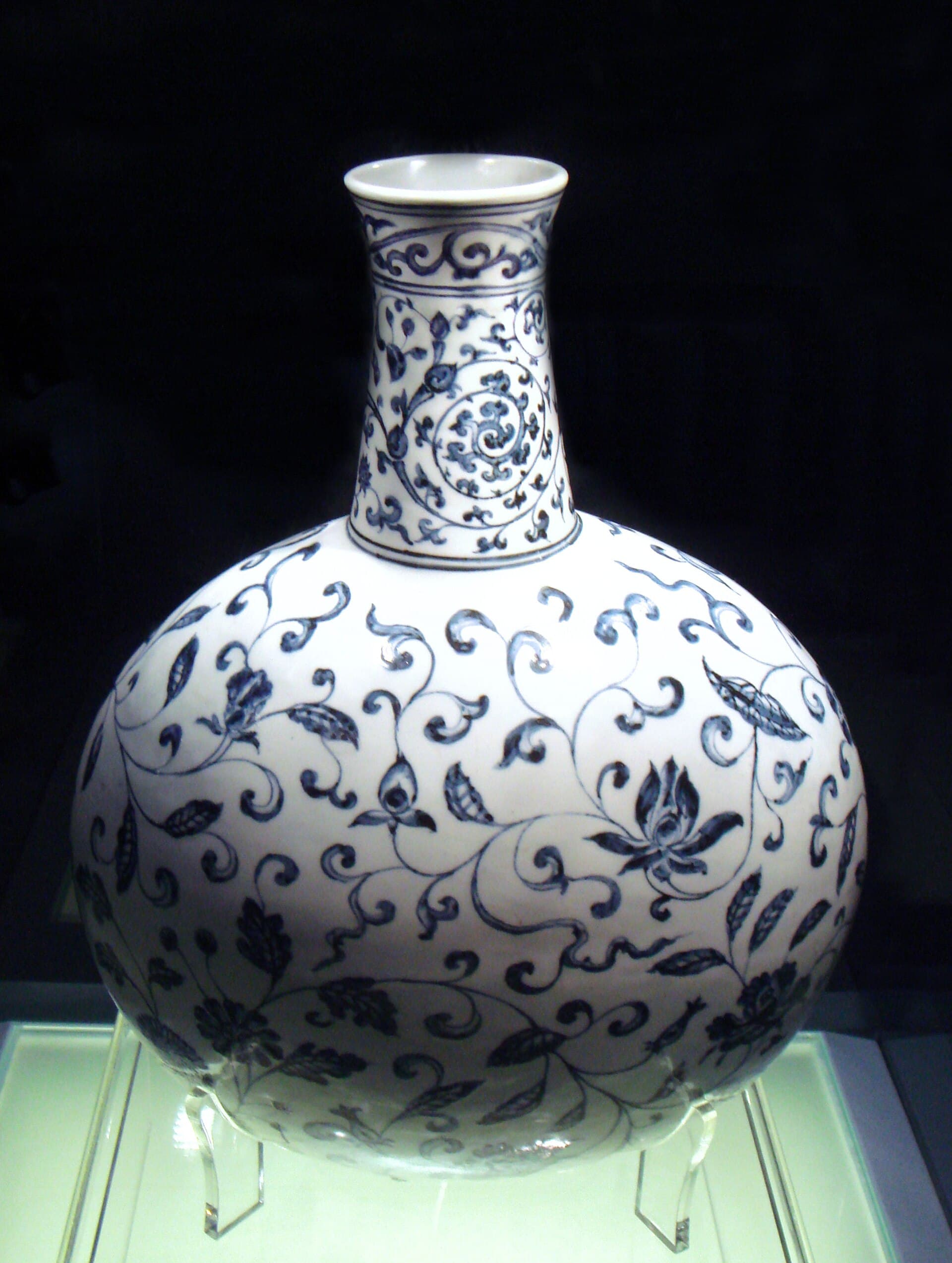
The blue of porcelain comes from cobalt, an ore that potters grind into pigment before painting it directly on the raw biscuit. The piece is then coated with a transparent glaze and fired at high temperature: the blue fuses with the enamel, becoming part of the material itself. Unlike surface paint, it can never be erased.
The first attempts at cobalt decoration appear under the Tang, but the technique remained tentative. Everything changed under the Yuan dynasty (1271-1368). The Mongols, who controlled an empire linking China to the Middle East, facilitated the import of an exceptionally fine Persian cobalt, , whose deep, slightly mottled blue would become the signature of the great Yuan pieces. Vast dishes and monumental jars appeared, destined for the Middle Eastern market as much as for the court.
pairs qīng (青), a colour that in Chinese covers blue, green and grey alike, with huā (花), "flower, motif." The name does not say "blue" but "bluish-greenish motif," a reminder that the Chinese colour spectrum is not divided as the Western one is.
The Ming golden age#
The Ming dynasty (1368-1644) brought blue and white porcelain to its peak. The imperial kilns of Jingdezhen produced pieces of unmatched finesse, supervised by court administrators. The reigns of Yongle (1403-1424) and Xuande (1426-1435) are considered the classical age: deep blue, refined designs of dragons, peonies, waves and landscapes, perfectly balanced forms.
Under Chenghua (1465-1487), the style shifted toward a more intimate elegance: small cups, delicate motifs of chickens and flowers, paler blue and finer line. Chenghua pieces are now among the most sought-after in the world; in 2014, a Chenghua "chicken cup" sold for over 36 million dollars at Sotheby's.
Each Ming reign has its recognisable style, and collectors learn to read in the blue, the line and the form the exact period of a piece, as a wine expert reads a vintage in a glass.
The porcelain road#
Blue and white porcelain did not stay in China. From the Yuan onward, it was exported massively to the Middle East, where it was prized by the Persian and Ottoman courts. The Topkapi Palace in Istanbul still houses one of the world's largest collections of Chinese porcelain, accumulated by Ottoman sultans over centuries.
From the sixteenth century, the Portuguese and then the Dutch of the VOC (Dutch East India Company) organised maritime trade on a grand scale. Kraak porcelain, named after a corruption of the Portuguese word for ships, reached Europe by the cargo-load. The craze was instant: princes, merchants and collectors fought over these blue and white pieces that had no Western equivalent. Chinese porcelain influenced Delft faience, Italian maiolica and even the first European manufactories.
Read alsoThe Silk Road: the history of a network that linked two worldsPorcelain travelled the same land and sea routes as silk. The Maritime Silk Road, linking Canton to Arabia and East Africa, was also a porcelain road.
Imitating, copying, reinventing#
The influence of blue and white porcelain went both ways. Chinese potters produced pieces to order for the Islamic market, adopting Arab forms and calligraphy. Japan, through the kilns of Arita and Imari, developed its own blue and white tradition in the seventeenth century, seizing a share of the European market during the turmoil of the late Ming.
In Europe, the obsession with Chinese porcelain led to decades of research to crack the secret. The German pharmacist Johann Friedrich Böttger succeeded at Meissen in 1708, opening the era of European porcelain. But the debt to Jingdezhen remains immense: blue and white motifs, dragons and mountain landscapes have permeated decorative art worldwide.
A tradition still alive#
Jingdezhen has never stopped producing. Today, the city remains a major centre of Chinese ceramics, blending traditional workshops and contemporary artists. Young creators reinvent blue and white, while historic kilns continue to fire pieces using ancestral techniques. The antiques market, meanwhile, breaks records: great Yuan and Ming pieces change hands for millions at auction.
From the translucent cup to the monumental jar, from Jingdezhen to Delft, blue and white porcelain has circled the globe without ever losing its Chinese centre of gravity. To learn Chinese is also to touch these words, qīnghuā, cídū, gāolǐng, which say that a country invented an art so perfect that the whole planet wanted to possess it.
FAQ#
Why is blue and white porcelain so famous? Because it combines a unique technique (cobalt painted under the glaze, fired at high temperature) with timeless beauty. Produced at Jingdezhen for centuries, it was the first luxury object exported on a massive scale worldwide.
Where does the blue in Chinese porcelain come from? From cobalt, an ore ground into pigment and painted on the raw biscuit before firing. Under the Yuan dynasty, an exceptionally fine Persian cobalt gave the pieces their characteristic deep blue.
What is Jingdezhen? A city in Jiangxi nicknamed "the porcelain capital" (瓷都). It combined kaolin, wood and river transport, and produced the bulk of Chinese porcelain for over a thousand years.
Is blue and white porcelain still produced today? Yes. Jingdezhen remains an active centre, blending traditional production and contemporary creation. Ancestral techniques coexist with artistic experimentation.
Photo credits: the images used in this article come from Pexels and Unsplash and are royalty-free.
Chinese porcelain: Jingdezhen and the white gold of China
The history of Chinese porcelain: Jingdezhen the thousand-year capital, kaolin, blue-and-white, from the Tang to the Ming, the sea route and the secret cracked by Europe.