Macau: where Portugal married China
Discover Macau, a former Portuguese trading post turned Special Administrative Region of China. Colonial architecture, Macanese cuisine, casinos and a unique cultural heritage.
La rédaction Kotoba
Studio éditorial
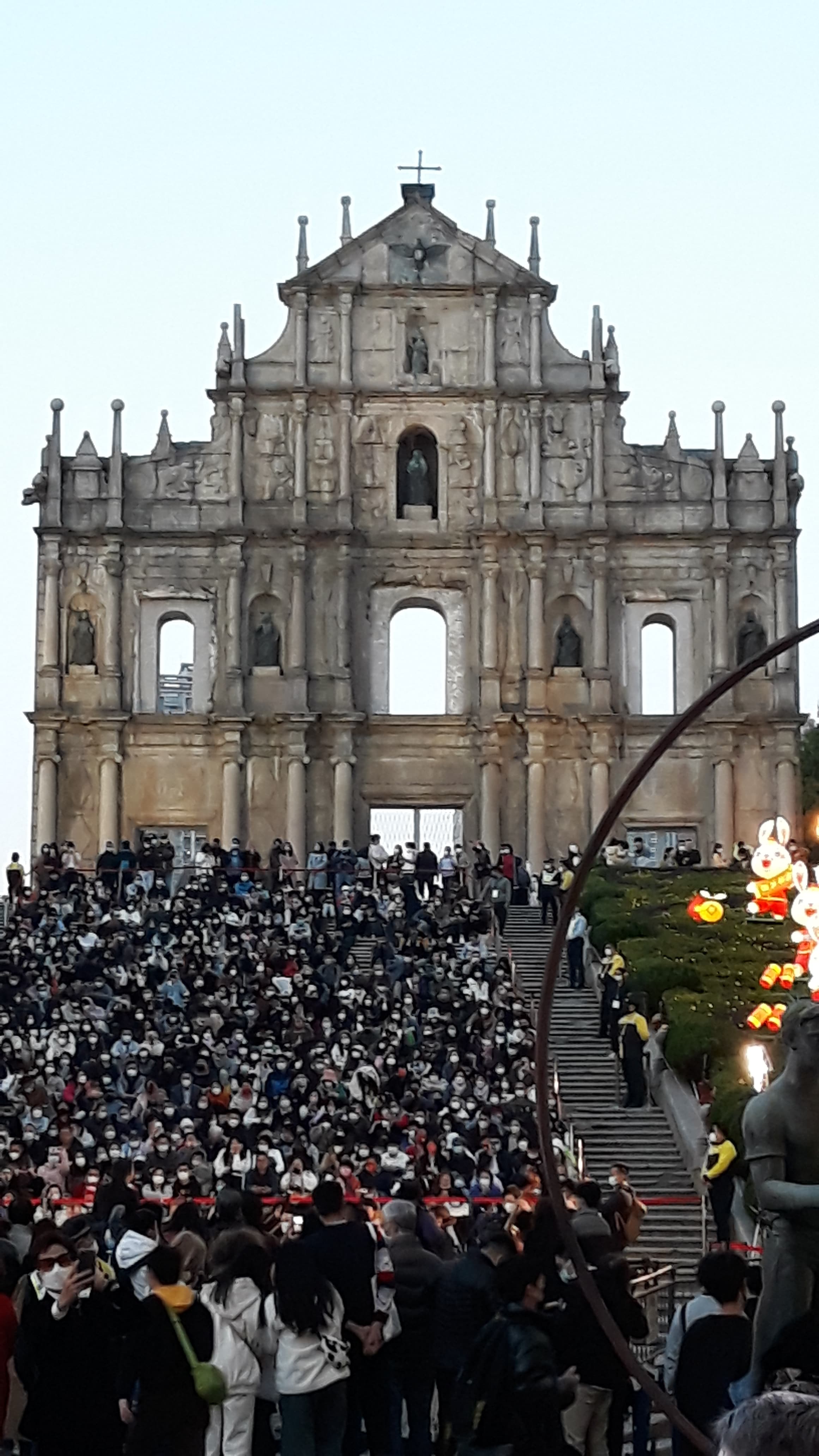
In the heart of a Chinese city bristling with casinos, a grey stone facade stands alone against the sky, with no walls, no roof, no church behind it — just a facade, magnificent and absurd, like an unfinished promise. These are the , the symbol of , and they tell the story of the improbable encounter between Portugal and China better than any history book — an encounter that lasted four hundred and forty-two years and whose traces pervade every street, every dish, every word of this extraordinary city.
Macau is the only city in the world where you can eat a pastel de nata in front of a Taoist temple, cross a square paved with calçada portuguesa to reach a Cantonese market, and hear a grandmother speak Patua — a Luso-Asian creole on the brink of extinction — before she disappears into a casino that would make Las Vegas blush. It is a place where history is not a memory: it is the present, stacked in contradictory and fascinating layers.
combines and . Macau is the "gate of the bay." The Portuguese name Macau is thought to derive from the , dedicated to the sea goddess Mazu, located near the harbour where the Portuguese first landed. According to legend, the sailors asked local fishermen the name of the place, and they answered "Ma Ge," thinking the question was about the temple. The misunderstanding became the name of a city.
The Portuguese arrive (1557)#
The trading post at the edge of the world#
The Portuguese reached the coast of China at the beginning of the 16th century, as an extension of their maritime expansion into Asia. After establishing trading posts in Goa (1510) and Malacca (1511), they sought to open trade with China, then under the Ming dynasty (1368-1644). In 1557, the Ming court granted them the right to settle on the Macau peninsula, a tongue of land south of Canton (Guangzhou), in return for their help combating piracy in the southern seas.
Macau quickly became the central node of trade between Asia and Europe. The Portuguese bought Chinese silk and porcelain there, resold them in Japan for silver, and shipped the silver on to India and Portugal. This triangular trade made Macau one of the wealthiest cities in Asia during the 16th and 17th centuries.
The city of the Jesuits#
Macau was also a stronghold of the Society of Jesus. The Jesuits established churches, colleges and a seminary that trained missionaries bound for China, Japan and Vietnam. The Cathedral of St. Paul, completed in 1640 and destroyed by fire in 1835, was considered the largest church in Asia. Its facade, the only part still standing, blends Christian motifs with Chinese and Japanese design elements — dragons rub shoulders with angels, peonies frame saints — an architectural hybrid unique in the world.
Macau is not a place where East meets West. It is a place where East and West married, had children, and never divorced.
The most famous local quip is that Macau has more casinos than churches, but more churches than police stations. The former missionary trading post has become the gambling capital of the world, surpassing Las Vegas in revenue since 2006. In 2019, Macau's casinos generated 36.5 billion dollars in revenue — six times more than the Las Vegas Strip.
The historic centre: a World Heritage Site#
In 2005, UNESCO inscribed the Historic Centre of Macau as a World Heritage Site, recognising the exceptional coexistence of European and Chinese architecture within such a small territory. The protected area comprises more than twenty buildings and squares:
is the heart of Macau: an esplanade paved with calçada portuguesa (undulating black-and-white Portuguese cobblestones) surrounded by pastel colonial buildings — pink, seafoam green, yellow — housing shops and restaurants. The effect is striking: you could be in Lisbon, except that the signs are in Chinese and the air smells of char siu.
The , dedicated to the sea goddess , dates from 1488 — it existed before the Portuguese arrived. It is one of the oldest temples in Macau and a place of pilgrimage for Cantonese fishermen. Its setting, at the foot of Barra Hill facing the sea, is beautiful enough to justify the trip on its own.
The Monte Fort, built by the Jesuits in 1626, offers a panoramic view of the city and houses the Macau Museum. It was from this fortress that the Portuguese repelled a Dutch attack in 1622, an episode that consolidated their presence for centuries to come.
Macanese cuisine: the world's first fusion food#
Macanese cuisine (澳门菜, Aomen cai) is one of the oldest fusion cuisines in the world, born of the marriage between Portuguese techniques and Asian ingredients. Over the centuries it absorbed Indian (Goa), Malay (Malacca), Japanese and African influences, reflecting the ports of call of the Portuguese empire.
The signature dish is : minced pork and beef sauteed with diced potatoes, soy sauce and bay leaf, served over rice with a fried egg. It is a dish that exists neither in Portugal nor in China — it is purely Macanese, born of the meeting of two worlds in a kitchen.
The of Macau became world-famous thanks to Lord Stow's Bakery on Coloane Island, which has been serving them since 1989. The Macanese version differs from the Portuguese original from Belem: the pastry is flakier, the custard more caramelised, and the result has become so popular that it was adopted across mainland China.
Bacalhau (salt cod) is prepared in the Portuguese style but served with Cantonese rice. Galinha africana (African chicken), despite its name, is a Macanese invention: roast chicken in a spicy sauce made with chilli, coconut, peanut and turmeric. Serradura (sawdust pudding), a dessert made of crushed biscuits and cream, is served in Macanese restaurants around the world.
Read alsoChinese tea: a journey through the six familiesTea is also at the heart of Macanese culture. The Cantonese yum cha tradition (dim sum with tea) has been practised in Macau for centuries, and Portuguese tea rooms coexisted with Chinese teahouses.
The handover and after (1999)#
On 20 December 1999, Portugal handed Macau back to China, two years after the United Kingdom returned Hong Kong. Macau became a under the "one country, two systems" principle (一国两制, yi guo liang zhi), with its own legal system, its own currency (the pataca), and an autonomy that is meant to last until 2049.
Unlike Hong Kong, the transition in Macau was smooth. Relations between the Portuguese community and the Chinese population had always been relatively harmonious, and Portugal, a declining colonial power, had neither the means nor the desire to hold on. The handover was experienced without drama, almost with relief.
Since 1999, Macau has undergone a radical transformation. The liberalisation of casino licences in 2002 attracted American gambling giants (Las Vegas Sands, Wynn, MGM), and the territory became the gambling capital of the world, surpassing Las Vegas in revenue from 2006 onward. The Cotai Strip, built on reclaimed land between the islands of Taipa and Coloane, is a line-up of mega casino-hotels whose scale defies the imagination.
Patua: a language fading away#
, or Macanese Creole, is a Luso-Asian creole born in Macau in the 16th century, blending Portuguese with elements of Cantonese, Malay, Sinhalese and Japanese. It is one of the rarest languages in the world: only about fifty native speakers remain, all elderly.
Patua is a linguistic treasure on the verge of extinction. Local theatre groups, such as Doci Papiacam di Macau, perform plays in Patua to keep the language alive. UNESCO classifies it as "critically endangered." Every word of Patua that disappears takes with it a fragment of Macau's unique history.
Macau today#
Macau is a city of paradoxes. It is the most densely populated territory in the world (21,000 inhabitants per square kilometre) and boasts one of the highest GDPs per capita on the planet. It is a place where Baroque churches stand alongside Buddhist temples, where cobblestone lanes open onto motorways, and where a grandmother can order a cafe galao in a diner that also serves congee.
For the traveller and the Chinese language learner alike, Macau is a reminder that China is not monolithic. It is a country of many histories, and the Luso-Chinese history of Macau — its words, its dishes, its magnificent ruins — is one of the most beautiful and least well known.
FAQ#
When was Macau handed back to China? On 20 December 1999. Macau became a Special Administrative Region of China, with an autonomy that is meant to last until 2049 under the "one country, two systems" principle.
What language is spoken in Macau? Cantonese is the dominant language (spoken by about 85% of the population). Portuguese remains an official language but is spoken by only about 2% of the inhabitants. Mandarin is on the rise. Patua (the Luso-Asian creole) is on the verge of extinction.
Is Macau bigger than Las Vegas for gambling? Yes. Since 2006, Macau's casino revenues have exceeded those of Las Vegas. In 2019, Macau generated 36.5 billion dollars in gambling revenue — six times more than the Las Vegas Strip.
What are the Ruins of St. Paul's? The facade of the Cathedral of St. Paul, completed in 1640 and destroyed by fire in 1835. It is the most iconic monument in Macau, blending Christian, Chinese and Japanese motifs. The historic centre of which it is part is inscribed as a UNESCO World Heritage Site.
Photo credits: the images used in this article are from Wikimedia Commons under the CC BY-SA 4.0 licence.
The Great Wall of China: History, Myths and Truths
The history of the Great Wall of China: not a single wall but 2,000 years of fortifications, from Qin Shi Huang to the Ming, its true length and the myth of visibility from space.
Cover image: Wikimedia Commons · CC BY-SA 4.0