Hanami: The Japanese Art of Cherry Blossom Viewing
A complete guide to hanami in Japan: its thousand-year history, the cultural meaning of sakura, the best viewing spots, picnic etiquette, and blossom forecasts.
La rédaction Kotoba
Studio éditorial
A Saturday in late March, at Ueno Park in Tokyo. On the grass and the gravel paths, hundreds of blue tarps form a tight mosaic. Families unpack bento boxes, coworkers crack open cans of beer, couples take photos beneath a ceiling of white and pink petals. A gust of wind passes, and suddenly the air fills with living confetti — thousands of petals swirling, landing on shoulders, in glasses, on rice. Someone claps. Someone else closes their eyes. This is , and for a few days each year, all of Japan stops to watch flowers fall.
Hanami is not an organized festival or a scheduled performance: it is a collective reflex, a habit rooted for over a thousand years, that consists of gathering under cherry trees in bloom to eat, drink, contemplate and, above all, to feel something difficult to name. That something has a word in Japanese: , the poignant beauty of what does not last.
Etymology: "Watching the Flowers"#
breaks down into two characters: , "flower," and , from the verb miru, "to see, to look." Literally, "flower viewing." Today the word almost exclusively refers to viewing cherry blossoms, the , though it can technically apply to other blooms.
It is telling that Japanese has a specific word for the act of looking at flowers. Where other languages might say "a walk in the park" or "a spring picnic," Japanese elevates floral observation to a named, codified activity, passed down from generation to generation.
From Plum to Cherry: A Thousand-Year History#
Hanami was not always about cherry blossoms. Originally, the flowers people gathered to admire were those of the plum tree, the , which arrived from China during the Nara period (710–794). The deeply sinophile court nobility admired plum blossoms at poetic banquets where each guest was expected to compose a poem about the flowers. The Man'yoshu (万葉集), Japan's oldest anthology of poetry (eighth century), contains one hundred and eighteen poems about plum blossoms, compared to only forty-four about cherry blossoms.
The shift came during the Heian period (794–1185). As Japan asserted its own cultural identity in the face of Chinese influence, the cherry tree established itself as the national flower. The Kokinshū (古今集, 905), the second great anthology, reversed the balance: sakura dominated overwhelmingly. The imperial court now held its spring festivities under the palace cherry trees, and the word hana itself, unqualified, came to mean cherry blossom by default.
In 1598, the warlord organized the most extravagant hanami in Japanese history at the temple in Kyoto. He had seven hundred cherry trees planted for the occasion and invited around one thousand three hundred guests. The celebration lasted several days, featuring sumptuous costumes, sake in abundance, and noh performances. Hideyoshi died five months later. The event is remembered as a final blaze of magnificence.
During the Edo period (1603–1868), hanami became a pursuit for everyone, driven by the Tokugawa shogunate. The eighth shogun, , had cherry trees planted along the Sumida River and in the hills of Asukayama, opening the contemplation to the common people. Hanami ceased to be an aristocratic privilege and became the popular celebration it remains today.
Sakura as Symbol: The Beauty of Impermanence#
The Japanese cherry tree blooms for only a few days — sometimes barely a week. This brevity lies at the heart of its symbolic power. The Japanese see in it the embodiment of , that fundamental aesthetic concept describing the emotion felt before the transience of things: a gentle melancholy, free of bitterness, in the face of beauty that passes.
pairs , "thing, phenomenon," with , an exclamation of moved compassion. The term, theorized by the scholar Motoori Norinaga in the eighteenth century, describes sensitivity to the impermanence of the world. Sakura is its perfect emblem: its beauty is inseparable from its vanishing.
The link between cherry blossoms and death also fed the warrior ethic. In the tradition of , the ideal samurai falls at the height of his glory, just as a cherry petal detaches from the branch in full bloom. The proverb says: "Among flowers, the cherry blossom; among men, the warrior" (花は桜木、人は武士, hana wa sakuragi, hito wa bushi). This association, both magnificent and tragic, was exploited during the Second World War to glorify sacrifice, but it remains deeply embedded in the Japanese imagination.
The Sakura Zensen: Meteorology of the Cherry Blossoms#
Every year, between late January and early May, Japan tracks the progress of the , the "cherry blossom front," with the intensity of a military dispatch. The Japan Meteorological Agency and private companies publish bloom forecasts, updated daily, indicating for each city the date of and .
The front starts in Okinawa as early as mid-January, moves slowly toward southern Kyushu in March, reaches Tokyo and Kyoto in late March or early April, then continues northward, touching Tohoku in April and Hokkaido in early May. This progression, which follows the isotherms of spring, transforms the entire country into a traveling spectacle lasting several months.
The reference tree for Tokyo is a Somei Yoshino cherry in the grounds of Yasukuni Shrine. Every year, meteorologists watch this particular tree: when five or six blossoms open on its branches, the bloom in Tokyo is officially declared. In 2021, this tree bloomed on March 14, the earliest date ever recorded — a sign of climate change.
Types of Cherry Trees#
Japan is home to more than two hundred varieties of cherry trees, but a handful dominate the hanami landscape.
Somei Yoshino (染井吉野)#
The Somei Yoshino accounts for roughly eighty percent of the cherry trees planted in Japan. Created through cross-breeding during the Edo period in the Somei district of Tokyo, it produces five-petaled flowers of a slightly pinkish white that appear before the leaves, giving the trees the appearance of clouds resting on branches. All Somei Yoshino are clones, which explains both why they bloom almost simultaneously in a given area and why they share the same vulnerability to disease.
Shidare-zakura (枝垂桜)#
The weeping cherry, with its long, supple branches cascading downward, is one of the most photographed varieties. Its blossoms range from white to deep pink. The most famous specimen is the in Fukushima Prefecture, over a thousand years old.
Yaezakura (八重桜)#
Double-blossom cherry trees bear dense clusters of twenty to fifty petals per flower in shades of intense pink. They bloom later than the Somei Yoshino, extending the hanami season by one to two weeks.
Hanami Etiquette: The Art of Picnicking Under Cherry Trees#
Modern hanami is above all a picnic, but a picnic governed by unwritten rules.
The Blue Tarp and the Battle for Space#
In the morning — sometimes at dawn — scouts lay out large blue plastic tarps (the famous blue sheet, ブルーシート) in parks to reserve space for their group. In the most popular spots, like Ueno or along the Meguro River, it is common for a junior colleague to be assigned to guard the spot for hours. The group's senior member or team leader arrives later, once everything is set up. The size of the tarp is proportional to the number of guests and, sometimes, to the group's social ambitions.
Food and Drink#
People bring prepared at home or bought at a convenience store, onigiri, fried chicken , edamame, and above all beer and sake. The , skewers of three sticky rice dumplings — pink, white, and green — are the culinary symbol of hanami. The , a rice cake wrapped in a salted cherry leaf, is the other essential treat.
The Unwritten Rules#
Never stake your tarp on a tree's roots, never break off branches, and never leave your trash behind. After the meal, every group departs with its garbage bags. Music is tolerated, but excessive speakers draw disapproving looks. Hanami is a moment of collective joy, but within the bounds of shared space.
Yozakura: Cherry Blossoms by Night#
combines , "night," and , a phonetically altered form of sakura, "cherry tree." Nighttime viewing of cherry blossoms, lit by paper lanterns or spotlights, transforms parks into dreamlike landscapes.
Many sites hang , paper lanterns, along avenues lined with cherry trees. The warm light filtering through the petals creates an atmosphere radically different from daytime hanami: more intimate, more contemplative, almost unreal. The reflections of illuminated cherry trees in the canals of Kyoto or the Meguro River in Tokyo rank among the most iconic images of the Japanese spring.
The Best Hanami Spots#
Tokyo#
- : over eight hundred cherry trees and a festive, carnival-like atmosphere. The historical home of popular hanami since the Edo period.
- : roughly eight hundred cherry trees line the riverbanks for four kilometers. The branches form a tunnel of petals above the water.
- : the imperial garden houses around sixty-five varieties of cherry trees and over a thousand trees in total, offering an extended season from late March through late April. Alcohol is not permitted.
Kyoto#
- : the illuminated weeping cherry at the center of the park is the most famous image of Kyoto's hanami. The yozakura here are spectacular.
- : two kilometers of canal lined with cherry trees, ideal for a quiet stroll.
Beyond the Major Cities#
- : thirty thousand cherry trees tiered across the mountain slopes, divided into four zones of successive bloom. A sacred hanami site since the seventh century.
- : two thousand six hundred cherry trees surround the castle moat. Petals blanketing the water's surface form a "flower raft" (hanaikada, 花筏) of striking beauty.
Hanami fits within the system of Japanese micro-seasons. The blooming of cherry trees corresponds to one of the seventy-two kō, those five-day periods that mark the rhythm of the year.
The Food of Hanami#
Hanami is inseparable from the table. Beyond the occasion's bento, certain preparations are specifically tied to cherry blossom season.
are skewers of three mochi dumplings: pink (cherry blossom and spring), white (melting snow), and green (fresh grass). Their combination is said to trace back to Hideyoshi's grand hanami at Daigo-ji. Sakura mochi comes in two regional variants: the Chomei-ji style from Tokyo, a thin crepe, and the Domyoji style from the Kansai region, coarsely ground sticky rice. Both are wrapped in a salted cherry leaf, which can be eaten or set aside according to taste.
Supermarkets and convenience stores compete in creativity during this period: sakura Kit Kat, sakura latte, sakura beer, sakura chips. The seasonal commerce around cherry blossoms has become an industry in its own right.
Read alsoChanoyu: The Sacred Art of Japanese TeaGreen matcha tea is one of the traditional accompaniments to seasonal wagashi, including sakura mochi — enjoyed under the cherry trees just as in the tea ceremony room.
Modern Hanami: Between Tradition and Instagram#
Twenty-first-century hanami has absorbed the tools of its time without losing its essence. Apps like Sakura Navi and Tenki.jp allow users to follow the bloom front in real time, with five-day forecasts for every park. Social media, Instagram chief among them, has turned some spots into global photography destinations: the Meguro River, Mount Yoshino, and the nighttime cherry blossoms of Nakameguro canal now draw visitors from around the world.
Brands have made sakura a universal seasonal motif: Starbucks launches pink drinks every year, fashion retailers roll out floral prints, and everyday product packaging turns pink. This commercialization, criticized by some as a commodification of tradition, is also, in a way, a continuation of the bond between cherry trees and daily life: sakura is everywhere because it matters to everyone.
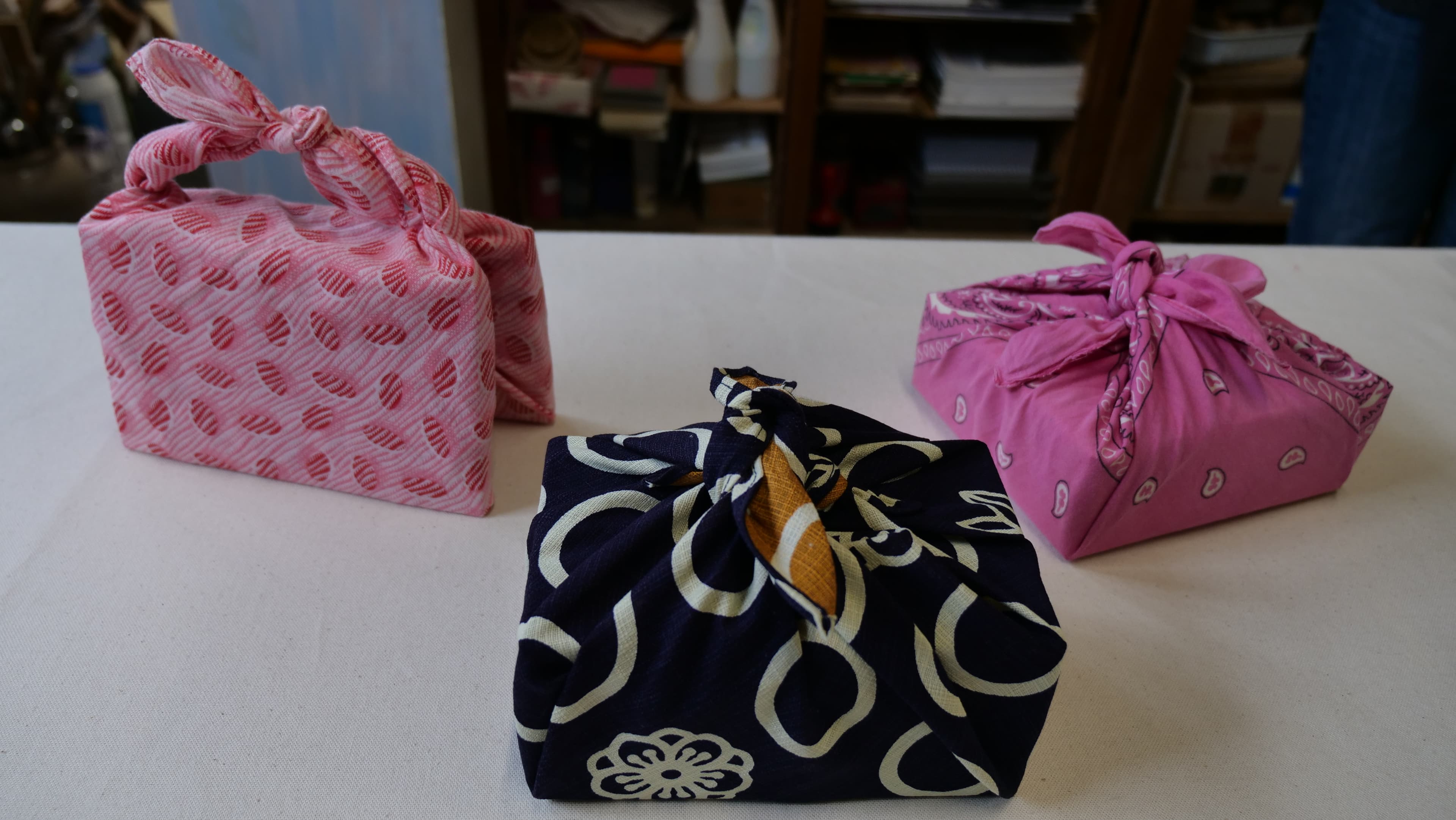
Read alsoFuroshiki: the Japanese art of wrapping with clothIn April, furoshiki cloths with cherry blossom patterns are among the most popular for wrapping seasonal gifts, extending the sakura aesthetic into the art of folding and tying.
Hanami Vocabulary#
- : cherry tree or cherry blossom
- : flower viewing (cherry blossom viewing)
- : full bloom
- : first bloom
- : cherry blossom front
- : nighttime cherry blossom viewing
- : "flower raft," carpet of petals on water
- : "cherry blossom blizzard," cloud of petals carried by the wind
- : aesthetic sensitivity to impermanence
- : tri-colored skewered sticky rice dumplings
- : rice cake wrapped in a salted cherry leaf
When does hanami season take place? The season varies by latitude. In Okinawa, cherry trees bloom as early as mid-January. In Tokyo and Kyoto, the bloom typically occurs in late March or early April. In Tohoku, expect mid-April, and in Hokkaido, early May. Full bloom lasts roughly one week.
Do you need to reserve a spot for hanami? There is no formal reservation system. The custom is to arrive early in the morning to spread your blue tarp in the park of your choice. In the most popular locations, some groups send a member at dawn to secure the space.
Is hanami free? Most parks are free of charge. A few gardens, such as Shinjuku Gyoen (500 yen) or certain temple grounds, charge a modest admission fee. Cherry trees lining rivers and streets are entirely open to the public.
Can you do hanami alone? Absolutely. While group hanami — loud and festive — is the most visible form, many Japanese practice a solitary, contemplative hanami: a walk under the cherry trees, a coffee on a terrace facing the blossoms, a moment of quiet pause.
Why are cherry trees blooming earlier and earlier? Climate change is progressively advancing bloom dates. Researchers at Osaka University have shown that Kyoto's cherry trees now bloom an average of ten days earlier than a century ago. In 2021, Kyoto's bloom was the earliest in 1,200 years of historical records.
Photo credits: cover image from Wikimedia Commons (Kenrokuen Hanami), under a free license.
Furoshiki: the Japanese art of wrapping with cloth
History and technique of furoshiki, the Japanese wrapping cloth. Origins in public baths, musubi knots, motifs, decline and zero-waste revival.