Furoshiki: the Japanese art of wrapping with cloth
History and technique of furoshiki, the Japanese wrapping cloth. Origins in public baths, musubi knots, motifs, decline and zero-waste revival.
La rédaction Kotoba
Studio éditorial
The square of cotton opens flat on the counter, like a page. Two hands take it by opposite corners, cross them, pull, and a knot is born, firm, clean, not a fold too many. In a few seconds, a bottle of sake is sheathed in indigo cloth, ready to give away, its improvised handle resting in the palm. No ribbon, no tape, no box. Just a piece of fabric and a craft more than a thousand years old.
The is no mere wrapper: it is a grammar of fold and knot, an object that has no shape but the one you give it. Where the West invented the bag, the box and disposable paper, Japan perfected the idea that a single square of cloth could embrace an infinity of objects, then fold back, empty, into a pocket. Its history runs through the public baths of the Edo period, the counters of merchants, the postwar oblivion of plastic, and, for the past twenty years, a revival driven by ecology.
Origins: a nameless cloth in the treasures of Nara#
The furoshiki descends from cloth-wrapping practices attested as early as the Nara period (710-794), long before the word itself existed. At the , the imperial treasure house of the Tōdai-ji temple in Nara that preserves objects from the eighth century, fabrics have been found that were used to wrap and protect precious goods and ritual dance costumes. These squares then bore the generic name , from the verb tsutsumu, to wrap.
The wrapping cloth already held value in itself. During the Heian period (794-1185), the court used to store and carry clothes, and , a simple square folded over its contents without elaborate knotting. The gesture was noble: to wrap was to protect, but also to mark the respect owed to the object and to its recipient. That idea, that the wrapping is part of the gift, has never left Japanese culture.
At this stage, nothing is yet called furoshiki. The term would be born in a very particular place, and much later: the public bath.
Why "bath spread"? The sentō and the birth of the word#
The word furoshiki crystallized during the Muromachi (1336-1573) and Edo (1603-1868) periods, and it comes literally from the bath. Its composition admits it plainly: and . A cloth spread out in the bath: that is its first meaning, and its origin is the subject of a story widely repeated by historians of Japanese dress.
Tradition links the name to , who is said to have built a steam bath in his residence for distinguished guests. To avoid confusion among the clothes of lords gathered in one place, each laid his garments on a cloth marked with his family crest (kamon, 家紋). The square served both as a marker and as a bundle for carrying one's belongings home. A caveat is in order: this appealing story is as much legend as verified record, and several specialists see in it a folk etymology reconstructed after the fact.
What is better documented is how the word spread with the rise of the public baths, the , during the Edo period. In these establishments open to all, bathers spread a square of cloth on the floor to set down their clothes, undressed while standing on the cloth so as not to dirty their bare feet, then, the bath over, knotted the whole thing into a bundle to carry home. The cloth "spread out in the bath" had become, by metonymy, the furoshiki.
Before it is an object, the furoshiki is a gesture: to spread, to set down, to wrap, to knot. The name speaks of the movement, not the thing.
The merchants' century: Edo and the golden age of the bundle#
During the Edo period, the furoshiki left the bath to become the universal tool of commerce and travel. With the peace imposed by the Tokugawa shogunate, the growth of cities and the circulation of goods, the square of cloth proved the merchant's perfect ally: it carries, protects, stores, and stores itself once empty.
Tradesmen, whether drapers, sake sellers or medicine vendors, printed their shop sign on it, the , or their commercial crest. A furoshiki thus became at once a wrapper, a delivery bag and a walking advertisement: the customer left with a square stamped with the name of the shop, which then circulated throughout the whole city. Artisans carried their tools, peddlers their wares, ordinary people their gifts and ceremonial clothes, all knotted in the same kind of square.
Size and material varied with use. Small cotton squares served daily needs; large formats, sometimes over a meter on a side, carried bedding or bulky clothing. This radical versatility, a single object, flat, foldable, with no moving part, able to adapt to any load, explains its dominance for nearly three centuries. The bundle knotted over the shoulder or held at arm's length is one of the most recognizable silhouettes in the prints of the period.
The technique: it is all in the knotting#
The art of the furoshiki rests almost entirely on one thing: the , the knotting. No sewing, no staple, no fastening, only folds and two or three fundamental knots, whose combinations generate dozens of different wraps. To master the furoshiki is first to master a handful of gestures that you repeat and assemble.
The basic knots#
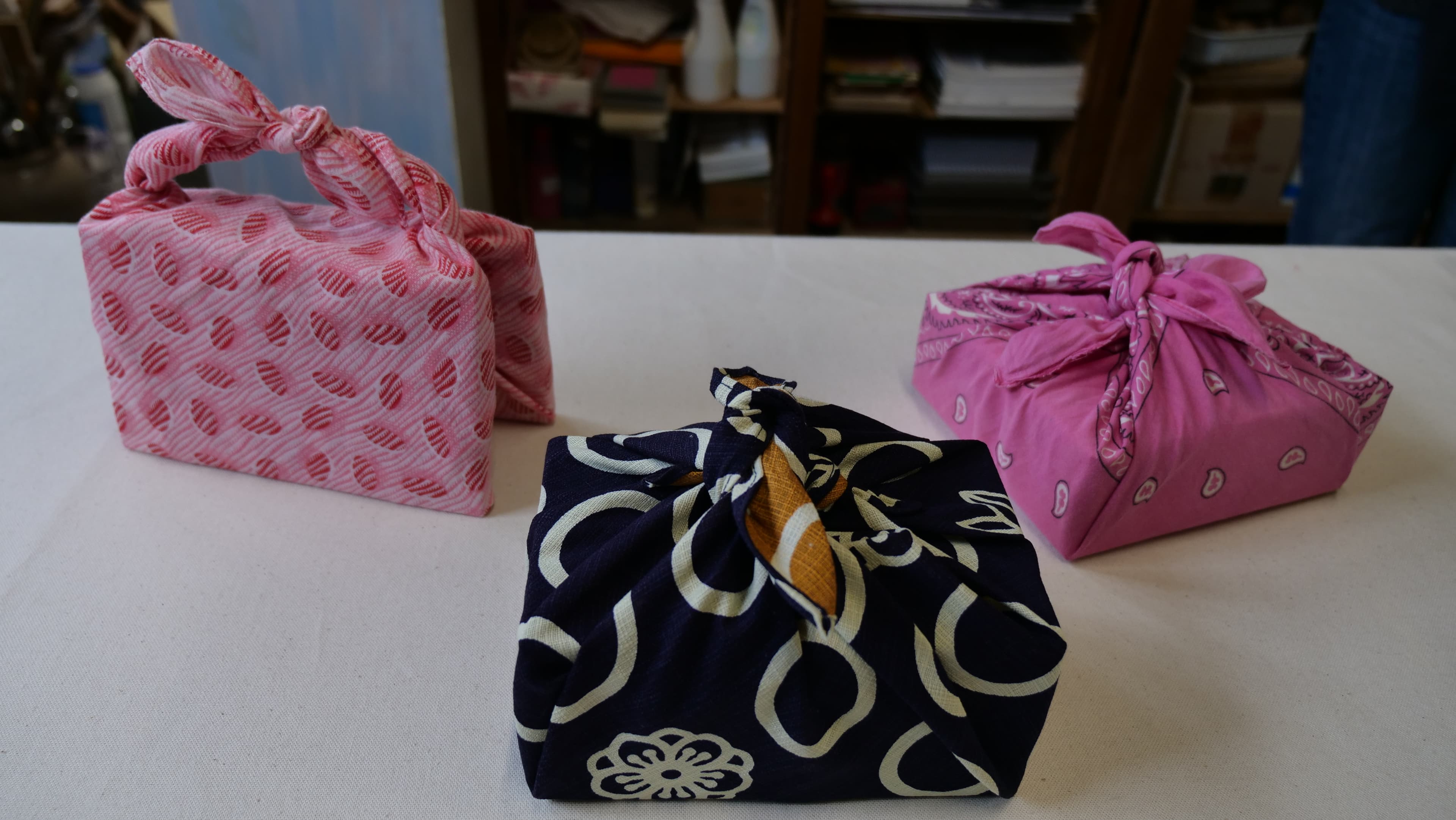
The king of knots is the , our square knot: two corners crossed a first time, then tied again in the opposite direction, which yields a knot that is solid, symmetrical and, a decisive virtue, easy to undo with a tug when you wish. It is this knot that closes most wraps and holds the handles.
The , a single knot formed on one corner or by folding one angle onto itself, serves to lock a flap, create a stop or adjust the tension. From these two gestures, and careful folding, the entire repertoire arises.
A few classic wraps#
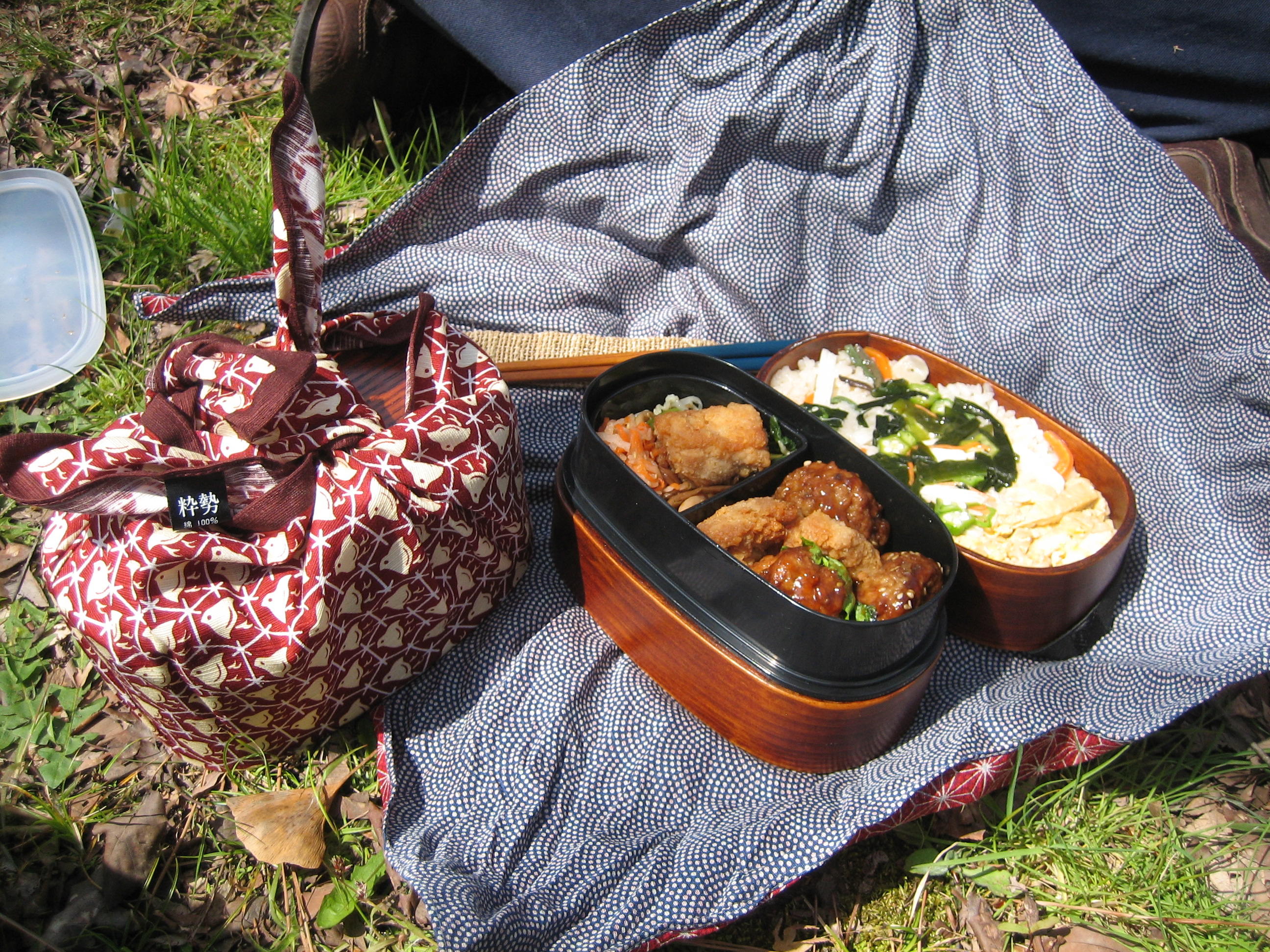
The most elementary is the , for square or rectangular objects: you set the object diagonally at the center, fold over one corner, then the opposite corner, and tie the last two corners over the top with a ma-musubi. It is the everyday wrap, for a box, a book or a bentō.
The dresses a bottle, whether sake, wine or oil, by drawing the cloth up along the flask and crossing the corners around the neck to form a carrying handle. A variant lets you carry two bottles side by side from a single square, separated and held upright by a central knot: an elegant and stable gift.
For round, heavy objects, the spherical carry, that of the watermelon or a melon, distributes the weight by crossing two perpendicular ties that form a cradle and a handle. Finally, several constructions turn the square into a bag: you knot two pairs of corners to create two handles, and the furoshiki becomes a soft, closable tote that folds flat the moment it is empty.
One square, dozens of shapes. The furoshiki imposes nothing on the object: it bends to it. That is its philosophy as much as its technique.
Materials and motifs: from cotton to silk, from seigaiha to karakusa#
The choice of cloth is not neutral: it speaks of use, season and degree of formality. Cotton (momen, 木綿) dominates everyday use: sturdy, washable, inexpensive. Silk and , that silk crêpe with a finely pebbled grain, are reserved for formal occasions, ceremonial gifts and precious pieces; today, polyester and rayon offer more accessible, easy-care versions.
The motifs, for their part, form a language. You find the great classics of Japanese ornament, often bearers of wishes: the , those concentric scales evoking the swell and standing for calm and continuity; the , a geometric pattern of six-pointed stars associated with growth and the protection of children, for hemp grows fast and straight; the , those arabesques of undulating vines, the green-and-white version having become, in the popular imagination, the furoshiki par excellence, the one on the bundle. To these classics are added crests, seasonal flowers and, since the modern era, the creations of contemporary designers.
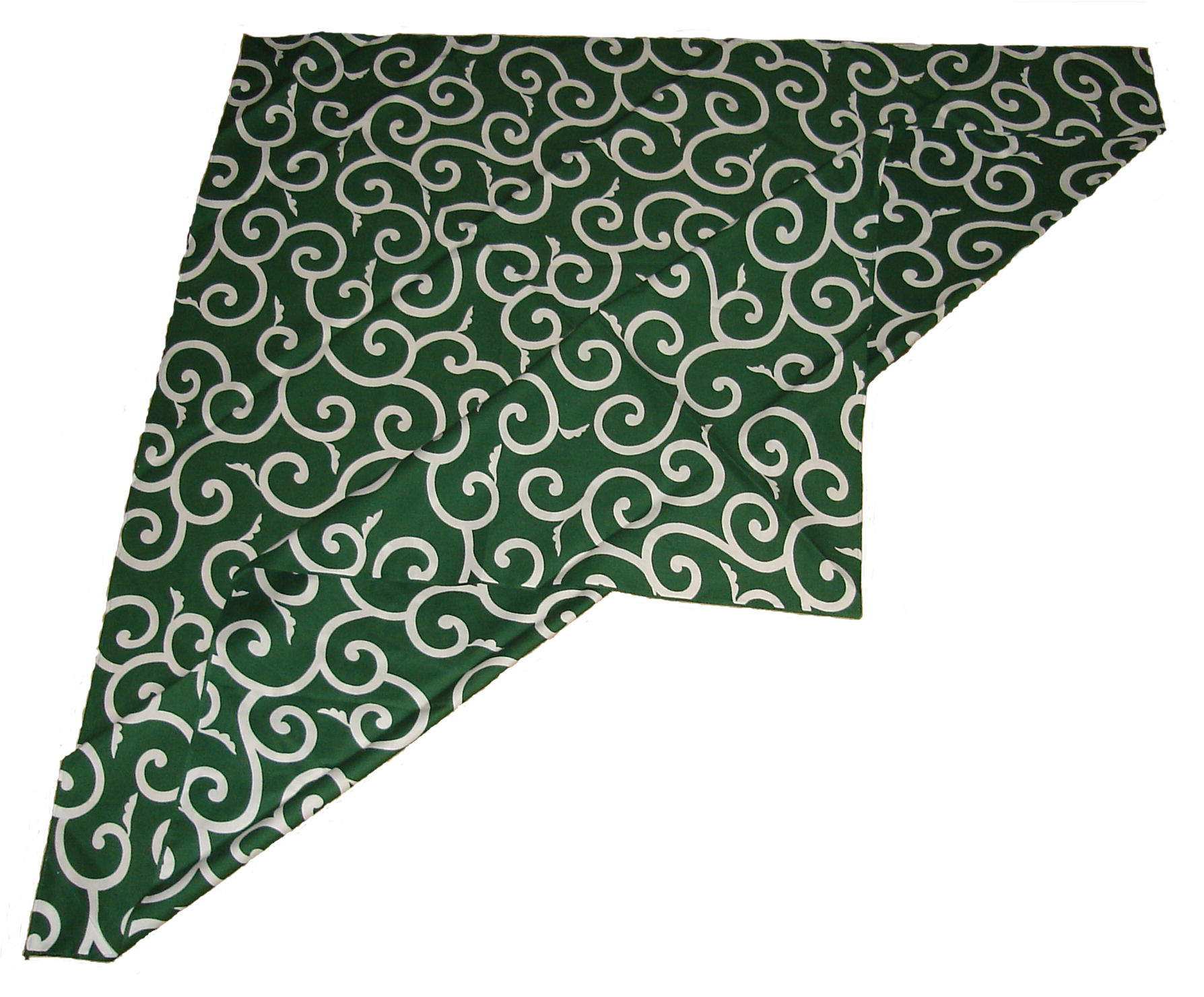
To offer a gift wrapped in a beautiful furoshiki engages a subtle etiquette: depending on the region and the family, the square is returned after use or given with its contents, the motif matching the occasion, sober for mourning, festive for a birth or a wedding. The wrapping speaks before anything has been opened.
The decline: when plastic almost erased everything#
The furoshiki nearly disappeared during the second half of the twentieth century, swept aside by the plastic bag. In postwar Japan, accelerated modernization, the spread of department stores and then supermarkets, and the arrival of disposable bags, free, light, waterproof, made the cloth square seem obsolete to a population eager to embrace Western-style consumption.
Carrying a knotted bundle began to smell of the past, even of poverty; the shop's paper bag and the plastic bag became the markers of an aspired modernity. The furoshiki took refuge in its most traditional uses: carrying the bentō, ceremonies, formal gifts between families, the world of tea. A whole generation grew up seeing it only in the hands of their grandparents. The skill of knotting, until then passed from mother to daughter, began to be lost.
The revival: mottainai, zero waste and the furoshiki of 2006#
The furoshiki came back through ecology, and one date is the hinge: 2006. That year, Japan's Minister of the Environment launched the , a square made from recycled fibers and presented as a concrete gesture against packaging waste and plastic bags. The initiative was part of the international promotion of the word , that untranslatable exclamation of regret at waste, "what a shame to throw away what could still serve," made globally famous by the Kenyan Wangari Maathai, 2004 Nobel Peace Prize laureate, who had made it a banner of her ecological campaign.
The timing was perfect. Environmental awareness, the fight against single-use bags and the rising culture of zero waste gave the furoshiki a fresh case: reusable hundreds of times, washable, compact once empty, with no plastic or adhesive. What was regarded as a relic became an avant-garde object once more, on precisely the ground where it was least expected: sustainability.
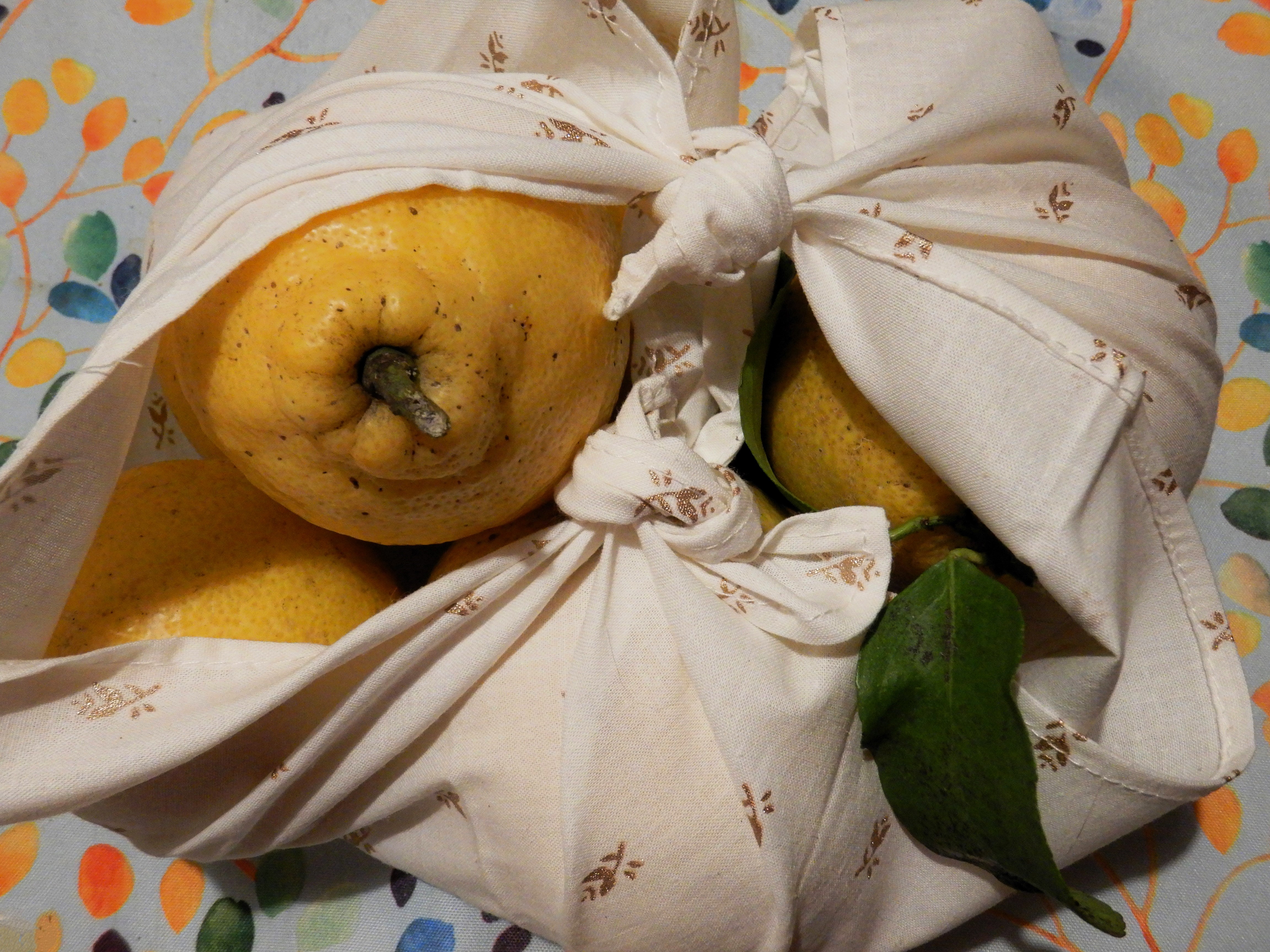
Today the furoshiki leads a double life. A foldable shopping bag and zero-waste gift wrap for some; a design object and graphic playground for others, with collaborations from brands, museums and creators. Abroad, eco-design has seized on the idea: sustainable wrapping workshops, alternatives to disposable gift paper, and a growing appetite for this frugal elegance that sums up a certain Japanese wisdom of less.
Its lesson lies in the gesture itself. A single square, no imposed shape, and the ability to embrace the world as it comes: a bottle, a book, a watermelon, a gift. The furoshiki adds nothing you will have to throw away; it merely wraps, then folds back, ready to begin again. At a time when every package ends up as waste, this old cloth from the baths of Edo may have something surprisingly modern to teach us: the beauty of what still serves.
Is the furoshiki hard to learn? No. Two knots are enough, the ma-musubi (square knot) and the hitotsu-musubi (single knot), to make the vast majority of wraps, from a box to a bottle. A few minutes of practice already let you tie a presentable bag or gift.
What size of furoshiki should I choose? A 45 to 50 cm square suits bentō and small gifts; 70 to 90 cm for bottles, books and shopping bags; over a meter for bulky objects or bedding. As a rule, the cloth should be about three times the width of the object to be wrapped.
What is the difference between furoshiki and hira-tsutsumi? Hira-tsutsumi (平包み) refers to the flat wrap, ancestor of the furoshiki, in which the cloth is simply folded over without elaborate knotting. The furoshiki, whose name comes from the baths of Edo, covers the whole modern practice founded on the fold and the musubi (the knotting).
Why is the furoshiki coming back into fashion? For ecological reasons. Reusable, washable and compact, it offers an alternative to disposable bags and paper, in tune with the values of zero waste and mottainai (the refusal of waste), revived in particular by the "Mottainai Furoshiki" launched in 2006 by Minister Koike Yuriko.
Photo credits: images from Wikimedia Commons, under a free license.
In this article
The cultural terms covered here, each with a short definition.
Chanoyu: The Sacred Art of Japanese Tea
Explore the art of Japanese Sadō, where every gesture, bowl, and season carries a centuries-old philosophy blending hospitality, aesthetics, and spirituality.
Cover image: Culture Japon · Culture Japon · CC BY-SA 4.0