Bibimbap: the Korean bowl where everything mixes
History and codes of Korean bibimbap: rice tossed with namul and gochujang, the sizzling dolsot, the five obangsaek colours, its ritual origins and Jeonju bibimbap.
La rédaction Kotoba
Studio éditorial
The bowl arrives before you like a painting: a circle of white rice, and laid upon it in neat wedges, brown fern, dark-green spinach, orange carrot, pale courgette, an intact egg yolk at its centre, a red comma of chilli paste. It is beautiful, it is orderly — and the first thing expected of you is to destroy it all. Spoon in hand, you crush, you turn, you blend: the masterpiece becomes mush, and that is exactly where bibimbap is born.
is probably the best-known Korean dish in the world: a bowl of rice mixed with seasoned vegetables, meat, an egg and chilli paste. Its name says it all: bibim (비빔), "to mix," and bap (밥), "cooked rice." To understand bibimbap is to grasp a Korean philosophy of balance, where each ingredient keeps its identity until the instant they all melt into a single mouthful.
Anatomy of a bowl#
At the base there is the rice, warm, spread across the bottom of the bowl. Over it unfold the : cooked or blanched vegetables seasoned one by one — bean sprouts, spinach, gosari fern, doraji bellflower root, courgette, carrot, mushrooms. To this are often added marinated, stir-fried beef, a fried egg or its raw yolk, slivers of grilled seaweed, a drop of sesame oil.
The binder is , the fermented chilli paste, sweet and hot, whose quantity you adjust to taste. Once everything is in place, the ritual begins: you mix vigorously with the spoon until each grain of rice is coated, each flavour diffused through the whole. The dish is not made to be contemplated, but stirred.
Bibimbap is a lesson served in a bowl: distinct ingredients, each prepared for itself, which reveal their harmony only once mixed.
Five colours on the plate#
The beauty of bibimbap is no accident: it obeys an ancient principle, that of the . This palette — white, black, blue-green, red, yellow — structures Korean aesthetics and cooking, linked to the five directions and the five phases of East Asian cosmology.
In the bowl, the principle becomes appetite: the white of the rice, the green of the spinach, the orange-red of the carrots and gochujang, the brown-black of the ferns and mushrooms, the yellow of the egg. It is often read as a search for nutritional as much as visual balance — vegetables, proteins, starches brought together. Tradition links these colours to the idea of health and harmony, even if today's eater seeks first the pleasure of the eyes before that of the spoon.
The word bibimbap is transparent: 비빔 (bibim) comes from the verb bibida, "to mix, to rub together," and 밥 (bap) means cooked rice, but also, by extension, the meal itself in Korean. Literally, then: "mixed rice." The gesture is in the name.
Origins: a bowl born of ritual and necessity#
The exact origin of bibimbap is debated, but several converging trails illuminate its birth. A widespread hypothesis ties it to : after the ceremony, the offerings — rice, varied vegetables, meat — were shared, and it was natural to gather everything in a single bowl to eat them together.
Another, more prosaic explanation sees it as an end-of-day or year's-end dish: leftovers, the banchan (반찬) that had not been finished, were assembled on a bed of rice so that nothing was wasted. Farmers' meals in the fields, or travellers' meals at inns, are also invoked. The old name goldongban (골동반), "rice with mixed ingredients," appears in texts from the late Joseon era. All these roots say the same thing: a popular, practical, democratic dish.
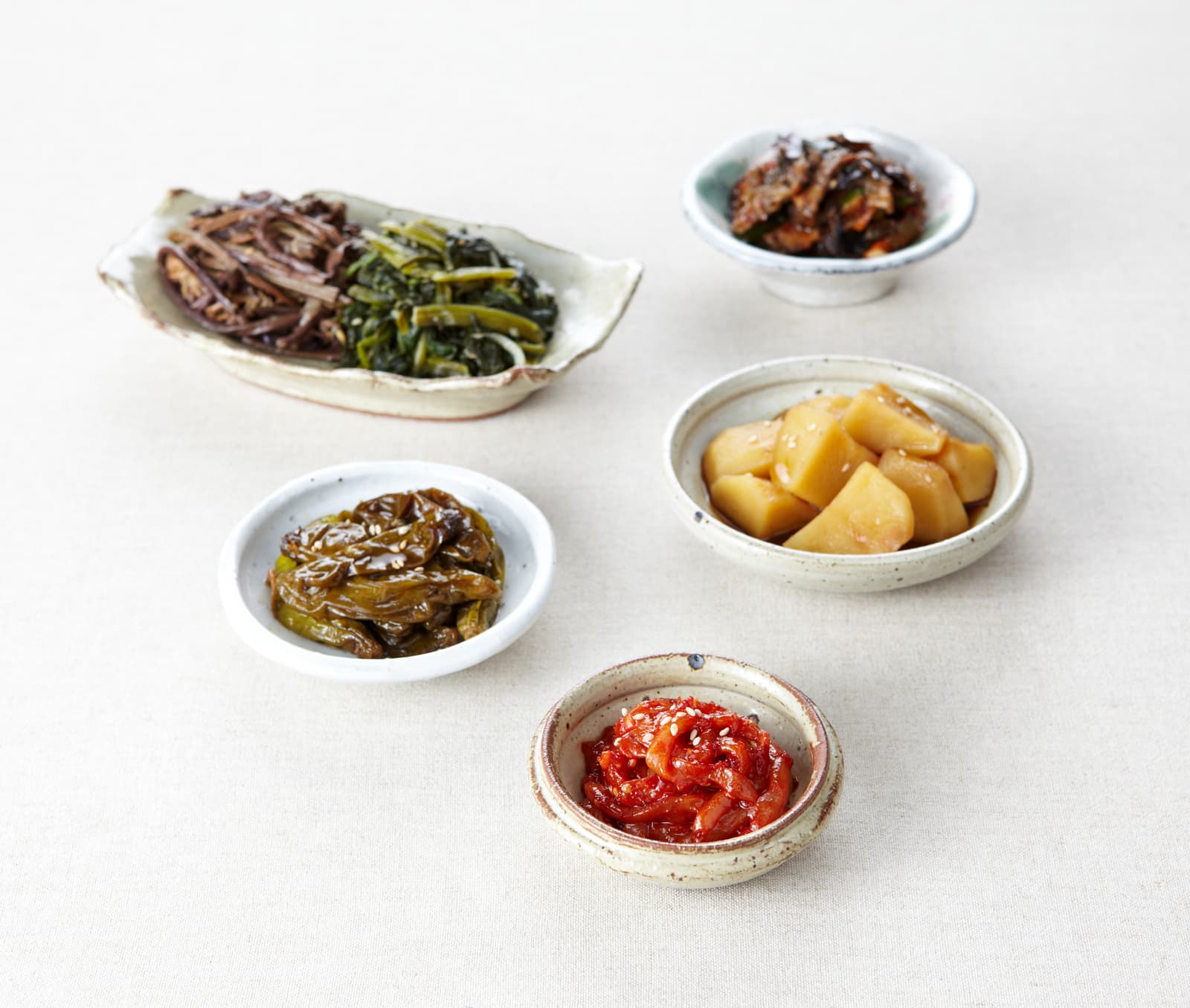
Read alsoBanchan: The Small Dishes That Define Korean DiningMany of bibimbap's toppings are banchan, those small dishes that cover every Korean table. To understand this art of the side dish, explore banchan.
Dolsot and regional variants#
Bibimbap comes in several styles, the most spectacular of which is , served in a scorching stone bowl. The stone, heated white-hot, makes the rice crackle against the sides and forms a golden, crunchy crust, the prized nurungji (누룽지). You hear the dish sizzle before you even mix it.
The regions have their versions. , from the city of Jeonju renowned for its gastronomy, is the most famous: rich in namul, sometimes enriched with yukhoe (raw beef) and cooked in a broth. The bibimbap of Jinju, that of Andong, the yukhoe bibimbap with raw beef, or the sanchae bibimbap with mountain vegetables testify to the dish's infinite flexibility. Each region projects its produce and its know-how into it.
Bibimbap has also conquered the sky: Korean Air has served it on board since the 1990s, and the dish won the Mercury Award of the international airline catering association in 1998. Compact, balanced, adjustable, it proved ideal for the meal tray — a leftovers dish become an ambassador at altitude.
A world dish#
Today, bibimbap is everywhere: in the canteens of Seoul as in Korean restaurants in Paris, New York or São Paulo, carried by the hallyu wave and by its ability to charm vegetarians and meat-eaters alike. It lends itself to every adaptation, welcoming tofu, fish, seasonal vegetables, without ever betraying its principle: distinct flavours brought together by the act of mixing.
From the bowl of offerings to the airline tray, bibimbap has carried a simple, profound idea: diversity does not oppose unity, it nourishes it. To discover bibimbap is to taste a cuisine that thinks in colours and balances — and to learn Korean is to understand why, in this bowl, the most important word is not bap, the rice, but bibim, the mixing.
FAQ#
What is bibimbap? A Korean dish made of a bowl of rice topped with seasoned vegetables (namul), often meat and an egg, bound by chilli paste (gochujang). Its name means "mixed rice": you stir everything together before eating.
How do you eat bibimbap? You mix all the ingredients vigorously with a spoon, working in the gochujang to taste, until the rice is coated. The dish is meant to be blended, not eaten ingredient by ingredient.
What is the difference with dolsot bibimbap? Dolsot bibimbap is served in a scorching stone bowl that crisps the rice at the bottom (the nurungji) and keeps the dish hot. Classic bibimbap is served in an ordinary bowl, at a milder temperature.
Where does bibimbap come from? Its origin is debated: it is linked to the sharing of offerings after ancestral rites, to the using-up of leftovers (banchan), or to farmers' meals. The old name goldongban appears in texts from the late Joseon era.
Photo credits: the images used in this article come from Pexels and Unsplash and are royalty-free.
In this article
The cultural terms covered here, each with a short definition.
- Namul
- Seasoned vegetables or herbs, blanched or sautéed, served as Korean banchan.
Tteokbokki: the rice cake that sets Korea ablaze
History and codes of tteokbokki, Korean street food: rice cake sticks in a sweet-and-spicy gochujang sauce, from royal kitchens to the street stall, its cult variants.