Nami Island: nature escape and K-drama legend in the heart of Korea
Discover Namiseom, Nami Island in Gapyeong: the legendary Winter Sonata filming location, metasequoia lanes, culture and tourism in South Korea.
La rédaction Kotoba
Studio éditorial
An hour from Seoul, a crescent-shaped island emerges from the calm waters of the Bukhan River. , better known as Nami Island, draws millions of visitors each year seeking a slice of serenity among towering metasequoia lanes, peaceful riverbanks and memories of iconic television dramas. Here is the story of a place that turned a sandbar into a cultural micro-republic.
A name, a general, a legend#
The island takes its name from General , a military hero of the Joseon dynasty. At just seventeen, he helped repel the Jurchen during the Northern Campaign under King Sejo. Falsely accused of treason under King Yejong, he was executed at twenty-seven. Legend has it that his remains were buried on this island, though no official tomb has been found. A memorial and tumulus at the centre of the island honour his memory.
From sandbar to cultural republic#
Before the 1960s, Namiseom was a modest sandbar regularly submerged during floods. The construction of the Cheongpyeong Dam in 1944 raised the water level and shaped the island's current contours, covering roughly 430,000 square metres.
In 1966, businessman Minn Byeong-do purchased the island to develop it as a resort. But it was under the leadership of Kang Woo-hyo, CEO from 2002, that Namiseom reinvented itself as a cultural destination. In 2006, the island symbolically declared itself the , complete with its own flag, stamps, phone code and even a passport stamp. This gesture, both artistic and marketing-savvy, cemented the island's identity as a space apart, devoted to nature, art and childhood.
Winter Sonata: the drama that changed everything#
In 2002, the television drama transformed the island overnight. The series, starring Bae Yong-joon and Choi Ji-woo, was largely filmed along Namiseom's snow-covered lanes. The show became a massive hit in Korea, then in Japan, China and across Southeast Asia, triggering what the media dubbed the first wave of the , the Korean cultural wave.
The iconic scenes filmed under the snowy metasequoia lane became a pilgrimage site. To this day, bronze statues of the two protagonists welcome visitors, and the island carefully maintains the drama's legacy with photo panels and scene recreations.
The legendary lanes#
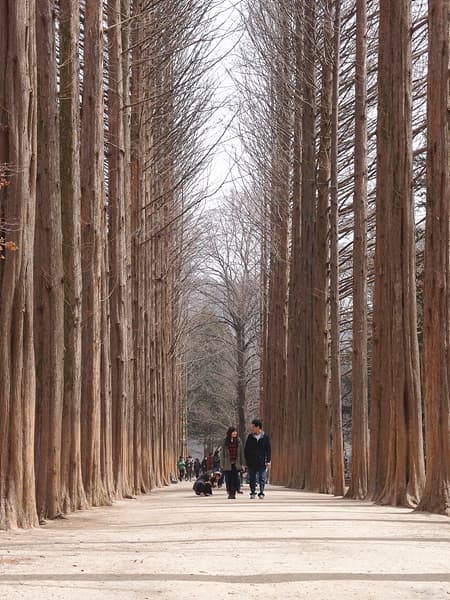
Much of Namiseom's charm lies in its tree-lined lanes, each offering a distinct atmosphere depending on the season:
- : the most famous, the Winter Sonata lane. In autumn, the foliage turns fiery red-orange; in winter, bare branches form a graphic vault against the grey sky.
- : a tunnel of pure gold in October-November, perfect for photography.
- : a shaded walk year-round, bordered by nut pines typical of the Gapyeong area.
- : an explosion of white and pink in spring, usually in early April.
- : wide and majestic, offering generous shade in summer.
A preserved ecosystem#
Namiseom has made ecology a pillar of its identity. The island enforces a zero-waste policy: bins have been replaced by sorting stations, and organic waste is composted on-site. Motorised vehicles are banned; visitors travel on foot, by bicycle or by small electric train.
Wildlife thrives in this tranquillity. Squirrels, rabbits, mandarin ducks and ostriches share the grounds with visitors. The riverbanks shelter grey herons and kingfishers. The island is part of the UNICEF Child Friendly programme for its commitment to environmental education.
Open-air art and culture for all#
The island operates as an open-air museum. Sculptures, installations and works by Korean and international artists line the pathways. The Song Museum displays musical instruments from around the world. Pottery, natural dyeing and traditional kite-making workshops are offered to families.
Namiseom also hosts the annual Nami Island International Children's Book Festival (NAMBOOK), bringing together publishers and illustrators from across the globe. This culture-and-childhood positioning is unique in South Korea and attracts an audience well beyond drama fans alone.
Practical information#
Getting there: from Seoul, take the ITX-Cheongchun line or the Gyeongchun metro to Gapyeong Station (가평역), then a local shuttle or taxi (5 minutes) to the Namiseom wharf. The ferry crossing takes about 5 minutes. You can also arrive by zip line (Zip Wire), a 940-metre descent over the river.
Opening hours: the island is open daily from 7:30 a.m. to 9:00 p.m. (last return ferry at 9:40 p.m.). The first ferry departs at 7:30 a.m.
Admission: the entrance fee (including the return ferry) is approximately 16,000 won for adults (around USD 12). Packages including bicycle hire or activities are available.
Best time to visit: every season offers a different face. Autumn (October-November) and spring (April) are the most spectacular. A snowy winter revives the Winter Sonata atmosphere. Summer is lush but can be hot and humid.
Nami in the Korean imagination#
More than a simple tourist spot, Namiseom embodies a certain image of a romantic, natural Korea, running counter to the technological, urban image of Seoul. The island has proven that a small territory can reinvent itself through culture and ecology, becoming a model studied in tourism schools across Asia.
For Korean language learners, Namiseom offers a rich vocabulary: 섬 (seom, island), 나무 (namu, tree), 길 (gil, path), 겨울 (gyeoul, winter), 자연 (jayeon, nature). A linguistic stroll as much as a poetic one.
Boys Over Flowers: How a Japanese Manga Became a Korean and Global Phenomenon
From Hana Yori Dango to Boys Over Flowers, a look back at the history of a franchise that crossed borders, languages, and screens, from shojo manga to the most widely exported K-drama of the 21st century.
Cover image: Wikimedia Commons